A clockwork platformer that trusts its jumps more than its sword#
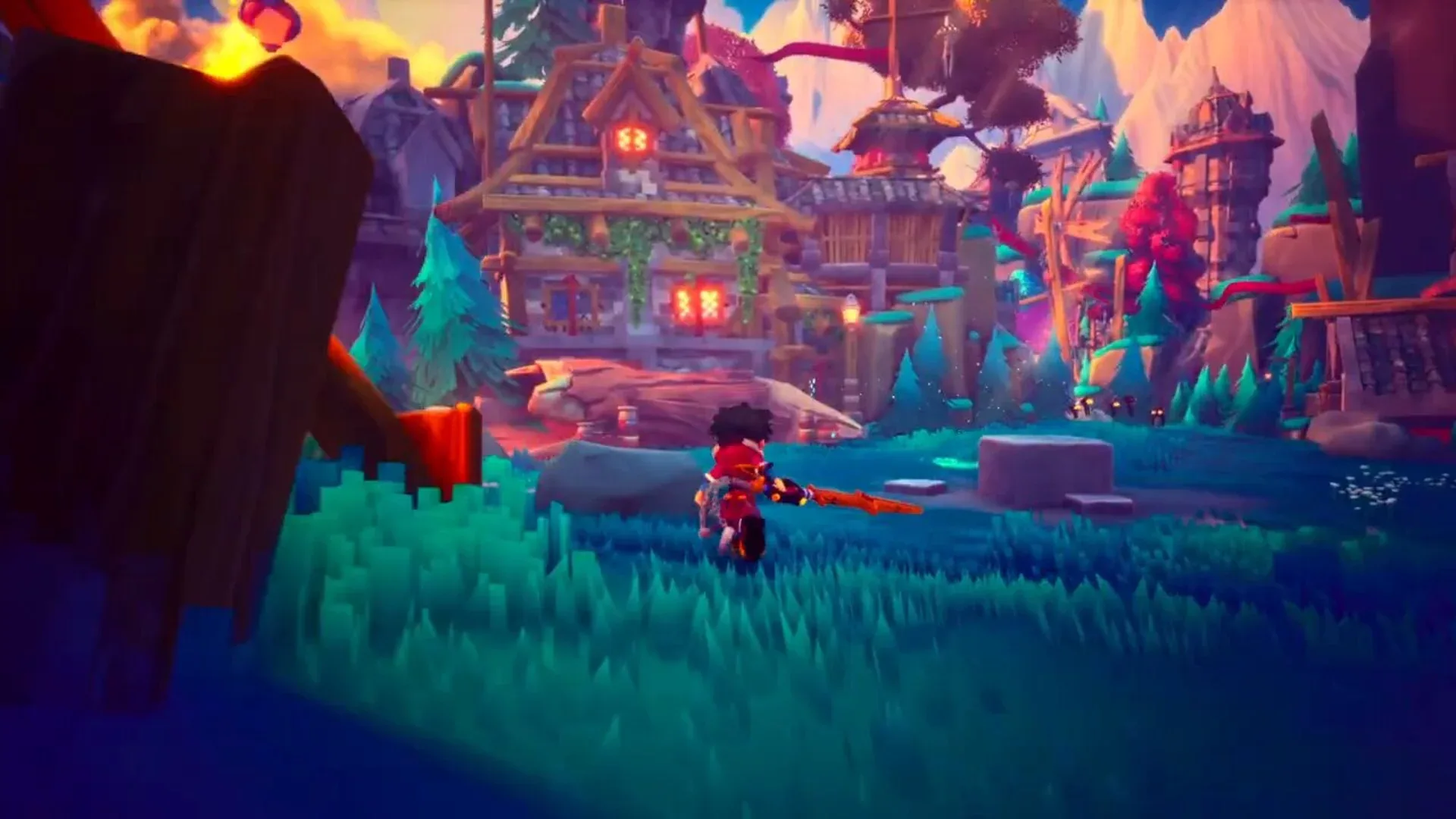
Duskfade is a 3D action platformer built in the shape of the genre's late-1990s and early-2000s golden age, the era of a hero, a small flying sidekick and a hub world stitched to a handful of themed levels. Developed by the Spanish studio Weird Beluga and published by Fireshine Games, it released on 13 August 2026 for PlayStation 5, Xbox Series X|S, Nintendo Switch 2 and PC. What it gets right, it gets very right: a traversal kit that rewards chaining moves together, a hub that never wastes your time getting back to a level, and a clockpunk art style that carries its own weight without leaning on nostalgia alone. What holds it back is just as clear: a combat system that never grows past its first hour, in a genre where combat and platforming are supposed to escalate together.
The premise is a fairy tale told in a sentence. Zirian's sister Allira has been taken into a mysterious clock tower that has plunged the land of Tearfeld into permanent night, and Zirian sets out with his grandfather's sword and a small mechanical bird named Cuckoo to break the chains sealing the tower and get her back. Nothing about that setup is trying to surprise you, and the game does not pretend otherwise. It spends its energy instead on making the road there worth walking.
What makes Duskfade different#
The one idea that separates Duskfade from the platformers it is openly paying tribute to is Temporal Energy, a clock-themed slow-motion ability that ties the game's title, its aesthetic and its combat design into a single system. Fuelled by Star Core Fragments collected across Tearfeld, Temporal Energy lets Zirian slow the world's clock by roughly a third for a few seconds at a time, stretching out a boss's fastest wind-up into a window you can actually see and react to, or giving a mistimed dash or an air-jump correction a second chance mid-flight. A shorter, charged variant called Rewind Pulse yanks Zirian himself back a fraction of a second rather than slowing everything around him, which turns out to be the tool most players lean on to recover from a platforming mistake rather than a combat one.
It is a small system, mechanically, but it is doing a lot of quiet work. Every boss encounter in Tearfeld is built around Temporal Energy's rhythm: a long, dangerous wind-up, a slow-motion window to punish it, a short cooldown, repeat with a variation. That structure is why the boss fights end up being the best-designed part of the whole campaign even though the base combat around them stays simple, and it is also why Duskfade feels distinct from Jak and Daxter or Ratchet & Clank rather than just imitating them; neither of those series built an entire combat rhythm around slowing down its own clock.
Tick Town and the four paths through Tearfeld#
Tick Town is the hub, a small clockwork settlement with shops for gear, cosmetics and a currency exchange, and four gates leading out to Tearfeld's biomes: a sun-bleached desert, a molten lava region, a frozen ice expanse and a submerged sea zone, each broken down further into roughly twenty named smaller regions along the way. Each of the four main paths takes somewhere around two hours to cross on a first attempt, and none of them are a straight corridor to the next boss. Villages, forests, catacombs and stretches of shredded, otherworldly terrain sit along the route to the chain guarding the clock tower, and a fair amount of what makes each biome distinct shows up in these connective spaces rather than in a single signature set piece.
The traversal kit is what makes crossing Tearfeld worth doing on its own terms. Zirian starts with a jump, a dodge roll and a dash, and quickly picks up a grapple hook, a wall jump, an air dash reset off grapple points, a rail grind and a glide, with the full kit expanding gradually rather than arriving all at once. Chaining these together is the game's real showpiece: a long jump timed off a dodge roll, a grapple swing that resets into a second grapple before you land, a wall jump into a glide across a canyon that would otherwise be uncrossable. None of it is technically difficult to pull off once you know the inputs, but it reads well on screen and it rewards paying attention to a level's geometry rather than just holding forward. Tearfeld's four biomes are gorgeous in the way Tick Town's clockwork spine ties them together visually, deep blues, amber lantern light and gilded brass machinery threading through desert dunes as easily as icy cliffs, and it is a look the small team sustains across the entire campaign rather than only in a handful of showcase areas.
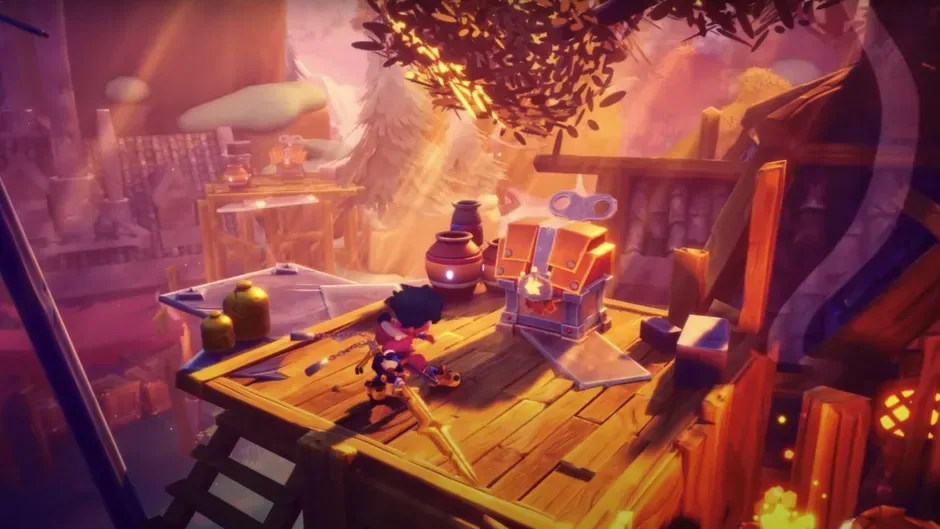
Combat: sword, counters and Cuckoo#
Combat is where Duskfade's ambitions visibly narrow. Zirian's grandfather's sword covers most of the moment-to-moment fighting, with a counter that punishes a well-timed block and a perfect dodge that opens a brief window for bonus damage, both systems clearly built to reward a player who learns enemy patterns. In practice, a simple dodge-then-attack loop handles the overwhelming majority of encounters just as well as the more deliberate counter-and-perfect-dodge play the game is nudging you toward, and once that becomes clear, usually within the first couple of hours, there is little incentive to engage with the deeper options on offer. New enemy types appear across each biome, but few of them ask for a genuinely different approach; most simply take more hits or move faster than the last.
Cuckoo softens the gap. The mechanical bird fights alongside Zirian rather than following passively, mopping up smaller stragglers with automatic fire and later gaining an upgraded three-way shot that makes crowd control noticeably easier during the busier mid-stage encounters. It is a small addition, but it means combat never feels entirely one-note even when Zirian's own toolkit stays static, and it is one of the clearer signs that Weird Beluga understood where the combat needed support rather than trying to paper over the gap with more enemy health.
Bosses: mid-stage duels and the chain guardians#
The boss design is Duskfade's clearest strength and the strongest argument that the combat system, thin as it is, was built with intent. Each biome carries at least one mid-stage duel acting as a breather between traversal stretches, and a larger chain-guardian fight waiting at the gate to the clock tower's next link. Both categories lean on platforming phases as much as on the sword: a guardian might force Zirian onto crumbling clockwork platforms mid-fight, or telegraph an arena-wide attack that needs a grapple swing rather than a dodge roll to escape, folding the traversal kit directly into combat encounters in a way the regular enemy fights rarely bother to. The pacing helps too; because the fights are built around Temporal Energy's slow-and-punish rhythm rather than a long combo string, most of them stay tense without stretching into the kind of attrition battle that overstays its welcome.
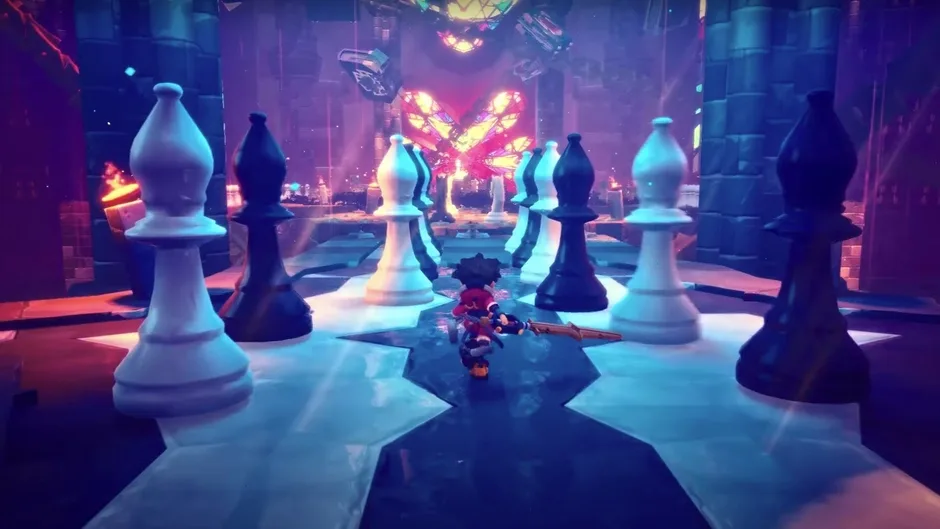
Difficulty and the four settings#
Duskfade ships with four difficulty settings, adjustable at any point rather than locked in at the start, covering everything from a story-focused mode aimed at players who want the platforming and the narrative without much resistance up to a setting that meaningfully sharpens boss telegraphs and enemy damage. The demo that preceded launch shipped the same four options across its opening hour, and the full game keeps that structure intact rather than gating the higher settings behind progress. It is a sensible approach for a game whose difficulty is genuinely uneven, punishing bosses bracketed by an otherwise gentle default difficulty in regular combat.
Collectibles and Tick Town's shops#
Tearfeld scatters several kinds of things to find: ingots that change the sword's appearance, rescuable cats that unlock new outfits for Zirian, Star Shards spent at Tick Town's shops, Upgrade Gears that unlock nodes on Zirian and Cuckoo's separate skill branches, and coins that buy stickers and trading cards toward an in-game album. A rarer set of Broken Stained Glass shards, hidden across all four biomes, unlocks an alternate ending for anyone willing to comb every region rather than beeline for the chain guardians.
The trouble is that most of this sits closer to decoration than to a meaningful reward loop. A new sword skin or cat outfit changes how Zirian looks and nothing else, and the sticker album exists mainly for players who already enjoy completionist checklists for their own sake. The skill trees fare better, since Upgrade Gears translate directly into new moves and Cuckoo abilities that change how a fight plays out, but even there the pool of meaningfully different upgrades runs out well before Tearfeld's fourth biome.
Story: Zirian, Allira and the clock tower#
The story keeps its scope narrow: a brother, a missing sister and a tower that needs breaking into, told through short cutscenes between biomes and a handful of named residents scattered through Tick Town and the villages along the way. It rarely tries to be more ambitious than that, and for the most part it does not need to be; a platformer built around four self-contained biomes does not require a sprawling plot to justify itself. Where it comes up short is delivery rather than structure. The voice acting is competent without ever being memorable, and the script gives Zirian and Allira few moments with real weight behind them, so a reveal near the clock tower's upper floors that should land as the emotional peak of the campaign mostly plays out as the expected next beat rather than a surprise worth the build-up.
The residents scattered through each biome carry more of the writing's actual personality than the main plot does. A clockmaker hiding out at the edge of the ice biome, a pair of siblings running Tick Town's general store, a retired guardian who explains why the chains around the tower exist in the first place: none of it changes the outcome of the story, but it fills in Tearfeld's history in a way the central plot leaves largely unspoken, and it rewards the same instinct to explore that the traversal kit is built to encourage. Skipping past these conversations to rush toward the next chain guardian costs you very little in terms of mechanics, but it does make Tearfeld feel considerably thinner as a place, which is a strange trade-off for a game whose art direction works this hard to make the world feel lived in.
New to 3D platformers? Start here#
Duskfade is a reasonable entry point for anyone who has never played this kind of game, precisely because its lower difficulty settings genuinely soften the boss fights without touching the platforming itself. Start on the second difficulty tier rather than the lowest one; it keeps Cuckoo's damage output and Temporal Energy's window generous enough to learn boss patterns without removing the tension entirely. Spend Upgrade Gears on traversal-adjacent nodes, the grapple reset and the extended glide, before combat nodes; the platforming carries more of the game's second half than the fighting does, and a wider traversal kit makes the later biomes noticeably less frustrating. Do not skip the demo's opening biome if you played it before launch, since the retail build changes little about Tick Town's first hour beyond the performance and soft-lock fixes added in the post-launch patch.
Compared with Ratchet & Clank: Rift Apart and Kingdom Hearts#
Ratchet & Clank: Rift Apart is the fairer comparison for scale and polish, and Duskfade does not pretend to match Insomniac's production values or its dimension-hopping traversal. What Duskfade does share with it is the basic collectathon shape, a hub, gadgets, a small flying companion, and it holds up reasonably well on traversal feel specifically, even if its four biomes are smaller and its combat noticeably shallower than Rift Apart's arsenal of weapons. If raw spectacle and combat variety matter more to you than a clockpunk aesthetic, Rift Apart remains the stronger pick.
Kingdom Hearts is the more pointed comparison, since several reviewers reached for it specifically to describe Duskfade's combat structure: a sword-swinging protagonist, a small companion doing support work, and platforming stitched between fights. Kingdom Hearts' combat has decades of iteration behind it, deep combo strings, magic, summons, and Duskfade's sword loop simply has not had the time or scope to build anything comparable. Where Duskfade pulls ahead is traversal: its grapple-and-glide kit is more consistently satisfying to move through a level with than Kingdom Hearts' more combat-focused movement options, and its boss design leans harder on platforming phases as a result.
Worth the money?#
At $29.99 / €29.99 / £24.99, with a 20 percent discount for the first two weeks after launch, Duskfade sits well below full retail price for a genre where a comparable game often costs twice as much. A story-focused run to the credits takes roughly 9 to 10 hours on the easier difficulty settings, climbing to somewhere around 15 to 17 hours for a normal playthrough that stops to explore each biome, and full completion, all four biomes' collectibles, both endings and the sticker album, runs closer to 20 hours. For that price and length, the ratio is generous even accounting for how quickly the combat's novelty runs out.
| Platform | Frame rate | Launch condition |
|---|---|---|
| PlayStation 5 | 60 fps | Stable performance, the strongest of the four versions |
| Xbox Series X|S | 60 fps (Series X), lower on Series S | Series S sees occasional dips in busier fights, addressed partly by a post-launch patch |
| Nintendo Switch 2 | 60 fps docked, 40 fps handheld | Noticeable frame-rate dips in busy fights and long sightlines even after the performance patch |
| PC | Uncapped | Runs smoothly on modest hardware given the game's stylised, less texture-heavy art |
PlayStation 5 and PC are the safest picks for anyone who wants the platforming to feel as responsive as it is designed to. The Switch 2 version is the one to be cautious about if you are sensitive to dropped frames, even though its portability suits a game built around short, level-based sessions. Text and voice are available in nine languages, including English, French, German, Spanish, Japanese, both forms of Chinese, Italian and Brazilian Portuguese; there is no Swedish localisation. Buying now at the launch discount is a reasonable call on PlayStation 5 or PC, where the technical picture is already solid; anyone set on Switch 2 loses little by waiting for a second performance pass before diving in.
Play this instead if …#
Shorter: Astro Bot delivers a similarly joyful traversal-first platformer with a critical path that clears in roughly half of Duskfade's story length, without asking for the same amount of biome backtracking.
Easier: Kao the Kangaroo trades Duskfade's boss-focused difficulty spikes for a gentler, more forgiving collectathon built around the same basic jump-and-punch loop.
Cheaper or co-op: The Spyro Reignited Trilogy regularly sells for less than a single Duskfade biome's worth of playtime would suggest and offers three full collectathon campaigns built on the same PS2-era spirit Duskfade is chasing.
Frequently asked questions#
How long is Duskfade? Around 9 to 10 hours for a story-focused run on the easier settings, 15 to 17 hours for a normal playthrough across all four biomes, and roughly 20 hours to collect everything and see both endings.
Is Duskfade open world? No. Tick Town works as a central hub connecting four large, self-contained biomes rather than one continuous open map, closer in structure to a classic collectathon platformer than to a modern open-world game.
Does it have co-op or multiplayer? No. Duskfade is a single-player campaign from start to finish, with Cuckoo controlled automatically as a support character rather than by a second player.
Is there a difficulty option? Yes, four adjustable settings ranging from a story-focused mode to one that sharpens boss telegraphs and enemy damage, and the choice can be changed at any point in the campaign.
Do you need to know other platformers to enjoy it? No. The story and mechanics are self-contained, though familiarity with games like Jak and Daxter or Ratchet & Clank makes the tribute easier to spot.
Is the Switch 2 version worth it? It is playable and portable, but it drops frames more often than the PlayStation 5 or PC versions during busy fights, even after the post-launch performance patch targeting Switch 2 and Xbox Series S.
The GameAvant verdict#
Duskfade is not the platformer its own marketing sometimes suggests it is, a full-scale return to the genre's late-1990s peak. It is something smaller and more honest: a game that clearly spent most of its development time on movement and level design and treated combat as the part that only needed to be good enough to connect the platforming together. That decision mostly pays off. Tearfeld's four biomes are a pleasure to move through, Temporal Energy gives the boss fights a genuine identity, and Cuckoo's support keeps the weaker sword combat from ever becoming actively unpleasant. What it is not is a complete package, and a genre built on the promise that combat and platforming grow together is always going to feel the gap when one half stays where it started. Weird Beluga has built a hub, a toolkit and a handful of bosses worth remembering; the sequel this clearly deserves needs a sword that keeps pace with everything else.
7 out of 10 – a gorgeous, generous throwback whose combat never quite earns the platforming and bosses built around it.