

A story that lasts exactly as long as a tape#
Mixtape is a short game about a long feeling: the last day before everything in a friend group changes. Developer Beethoven & Dinosaur, the studio behind The Artful Escape, sends teenager Stacey Rockford through one final day in the fictional town of Blue Moon Lagoon, Northern California, in the 1990s, and lets licensed songs decide the pace, the mood and the shape of every scene. It is stylish, sincere and confident about what it wants to be, and it earns an 8 out of 10 because it does that one thing better than most games that run ten times as long.
The trade is obvious from the first minutes. Mixtape is not a game about doing. It is a game about being somewhere, with someone, while a specific song plays. If that sounds like a reasonable way to spend three or four hours, the rest of this review will mostly confirm it. If it sounds like a poor use of a game, nothing below will change that, and the score reflects a game that is very good at a narrow job rather than a game that tries to please everyone.
What makes Mixtape different#
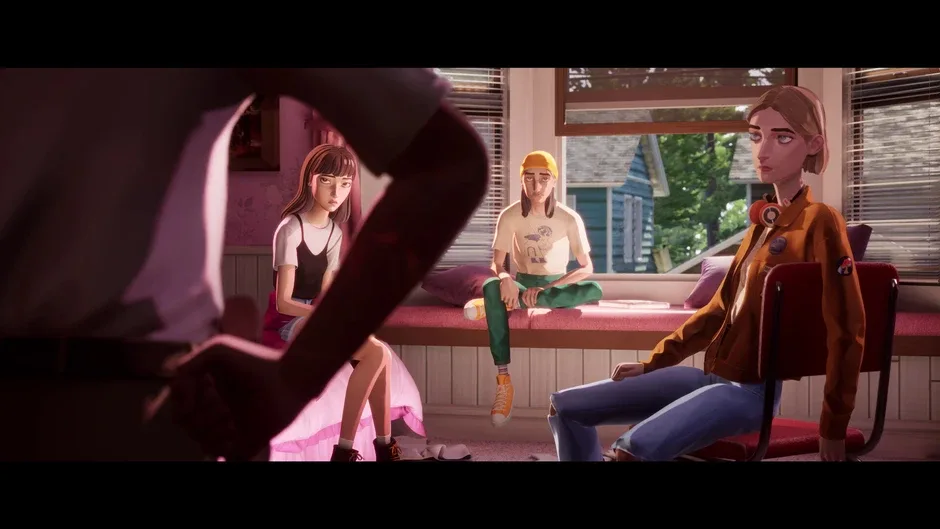
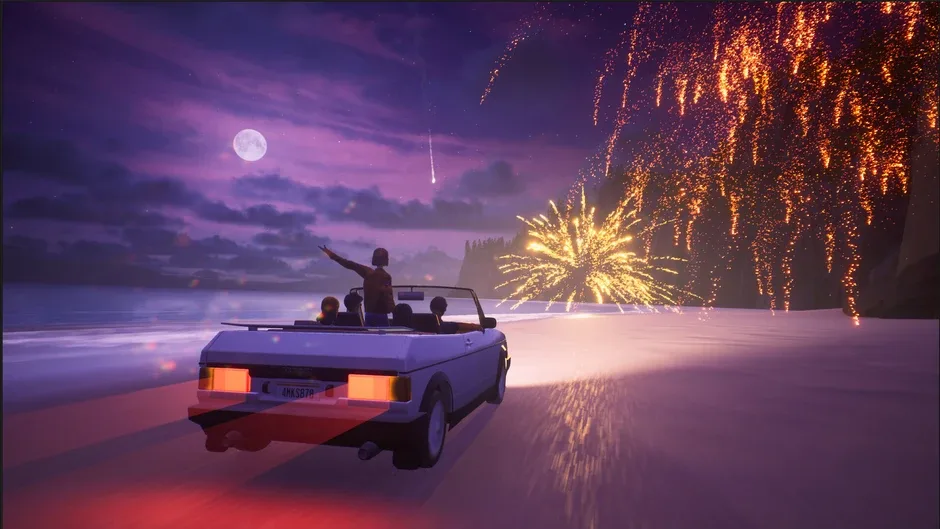
The one idea that carries the whole game is that the soundtrack is not accompaniment but architecture. Stacey is an aspiring music supervisor, the person whose job in film and television is to choose the right song for the right moment, and the game is structured as though she were doing that job on her own life. She introduces songs by speaking to the player directly, and each scene is designed around the track it was built for. The studio has said that the levels are designed around the songs, and that is exactly how it plays: a scene begins when a track begins, follows its energy, and ends when it does.
That inverts how most narrative games treat licensed music. Usually a song is dropped over a cutscene to raise the emotional temperature, and the rest of the game is scored in the background. Here the song comes first and the situation is shaped to fit. A hilly road exists because a track needs downhill momentum. A pond exists because a quieter track needs somewhere to look at. The result is a game that feels less like a script with music laid on top and more like a playlist that happens to have a plot.
The songs themselves come from a wide slice of alternative and post-punk history. Devo, Smashing Pumpkins, Iggy Pop and Joy Division are all part of the soundtrack, and Devo's song That's Good is one of the tracks the game names in its own material. One band did not make it: Pink Floyd was planned and then dropped after a licensing failure, which is a small reminder of how fragile a game built on licensed music really is. It also explains a decision that matters to a certain kind of reader: the game ships without a streamer mode, because the studio treats the licensed music as the soul of the game and does not offer a version with the songs stripped out or replaced.
The cast: three friends and the people around them#
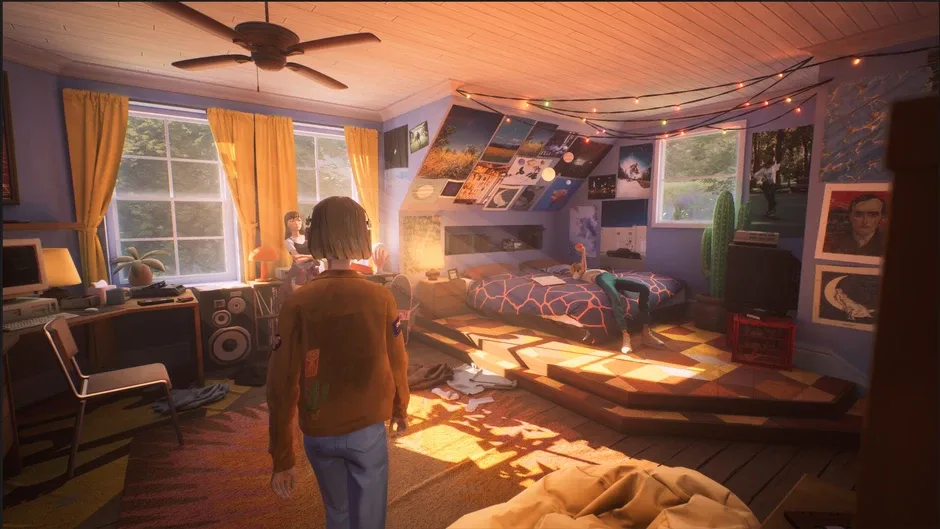
The emotional core is a trio. Stacey Rockford is the aspiring music supervisor who has just secured an opportunity in New York, and who cancels a planned road trip to take it. Van Slater is her childhood friend. Cassandra Morino, called Cass, is the police chief's daughter who joined the group in high school. Around them sit Camille Cole, who organises the farewell party, and Jenny Goodspeed, a student Stacey does not like.
The game gives its three leads distinct musical eras. Slater belongs to the late eighties and early nineties, Stacey to the middle of the decade, and Cass to the end of it, and that difference is more than a costume choice. It means the friends do not share a single musical vocabulary, which gives the conversation between them a real texture: one person's favourite record is another person's embarrassing phase. That is the right kind of friction for a story about people who are about to be separated, because it shows a friendship made of differences rather than a friendship made of slogans.
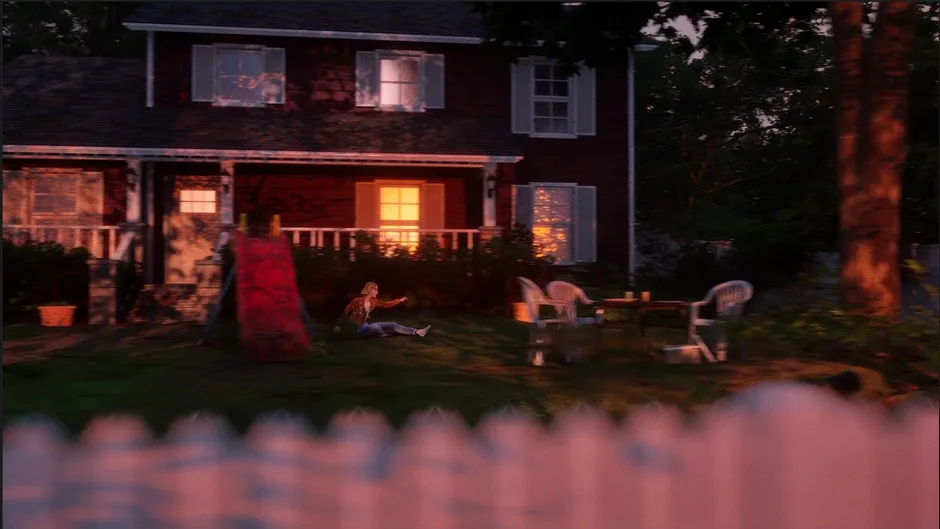
The story unfolds over the last day the three spend together, moving between places such as an abandoned shack the friends call The Ritz, Stacey's bedroom, the homes of Cass and Slater, a convenience store and the location of the final party. Tension builds, reconciliation follows, and an incident at the group's gathering place eventually forces the friends apart. The ending is deliberately not spelled out here, because the game's entire method is to let one evening arrive with its full weight, and a review that flattens that arc into a plot summary does the game a disservice.
Vignettes: what you actually do#
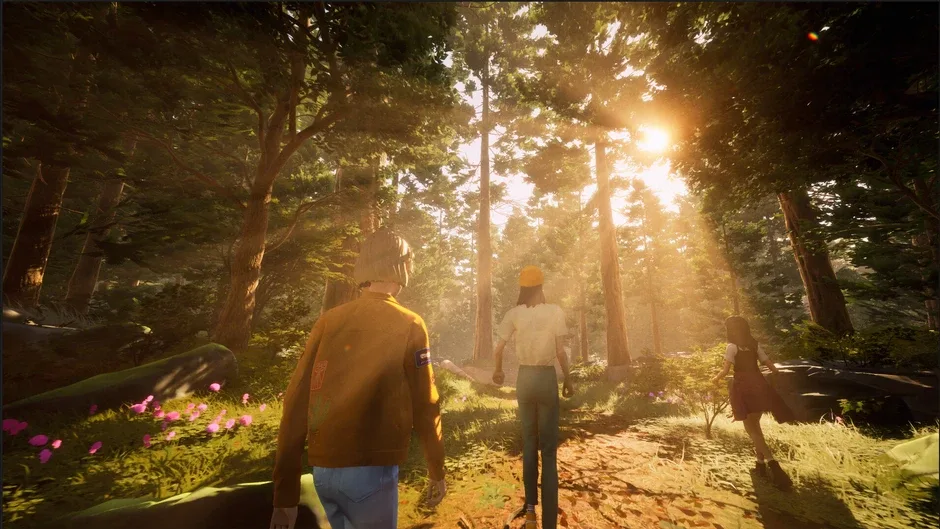
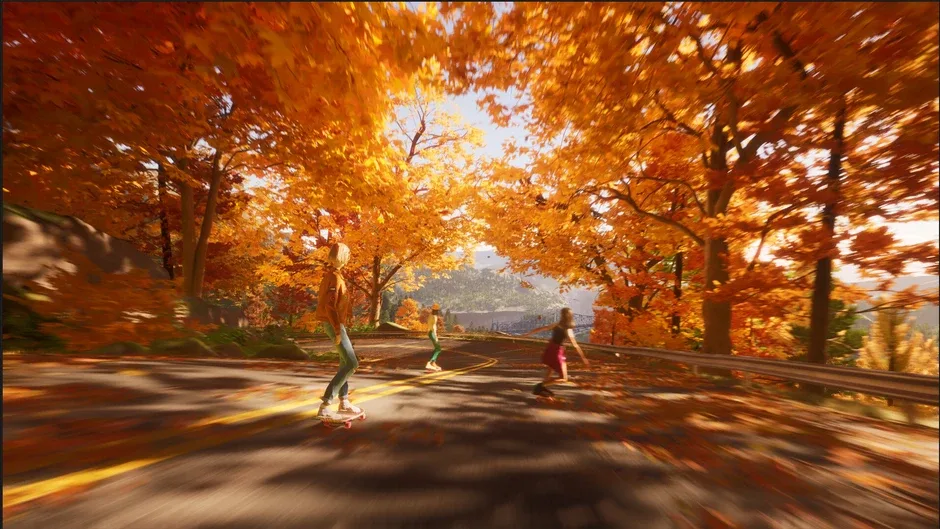
The playable part of Mixtape consists of short vignettes rather than a continuous system. The game describes them as moments like skateboarding down a hilly road, skipping rocks across a pond, or exploring a run-down dinosaur park. None of these is a mechanic that develops. Each is an activity that exists for the length of one song, does what it needs to do, and gives way to the next.
That structure has real strengths. Because no vignette has to justify itself as a system, each one can be designed purely for feel. Skateboarding down a hill is about momentum and the sense of leaning into a corner, not about scoring or unlocking. Skipping stones is about a pause and a gesture. Exploring a place is about looking at a set that was built to be looked at. The pacing stays varied, and no single idea outstays its welcome, which is the classic failure of short games that stretch one mechanic across their entire runtime.
It also has an obvious cost. A vignette is not a challenge, and a game made of vignettes has no curve. Nothing you learn in the first hour helps you in the third, because there is nothing to learn. For players who want something to master, that is a flat line, and it is the reason the score is not higher. The game is honest about this in its structure: it never pretends to be more of a game than it is, but it also never gives the hands much to do beyond steering and pressing.
Look and feel: stop-motion in a game engine#
Visually, Mixtape uses a stop-motion-inspired animation style, running on Unreal Engine 5. That pairing is unusual, because Unreal Engine 5 is most often used to chase photorealism, and here it is used to fake the opposite: the slightly jerky, slightly imperfect movement of models moved by hand one frame at a time. The effect is a world that looks made rather than simulated, with a texture closer to a craft project than to a render.
That choice suits the subject matter. A story about memory should not look like a security camera. Stop-motion aesthetics carry an immediate association with things that were assembled with care and imperfect hands, which is exactly how a teenager remembers a summer. The look has also been compared to the hand-made, comic-book energy of the animated Spider-Man film Into the Spider-Verse, which is a fair shorthand for a style that treats imperfection as a feature.
The game also leans on the visual language of the era. Bedrooms, corner shops and half-abandoned local landmarks are staged like a film set, and the dinosaur park in particular gives the game a piece of American roadside decay that no engine could invent without an idea behind it. The studio has cited films like Wayne's World, High Fidelity and Dazed and Confused as reference points, and the filmmaker John Hughes as an influence on the narrative approach, and those influences show. Everything is staged to be looked at and to be felt.
Story and writing: a day that means it#
The writing has one job, which is to make three people feel like friends who have known each other for years, and it does that job with warmth and a light comic touch. Stacey addresses the player directly to introduce songs, breaking the fourth wall in a way that could easily be irritating but instead gives the game a guiding voice. That voice is the reason the game feels curated rather than scripted: someone with taste is choosing each track for a reason, and telling you why.
The one-day structure is the game's smartest storytelling decision. A story that spans months has to explain the passing of time; a story that spans one evening can spend all of its effort on the moment. Every scene therefore feels like it matters, because there are so few of them and because the clock is visible to the characters. The ending is earned by that pressure, and the emotion that arrives at the end is not manufactured by a plot twist. It comes from the plain recognition that this is the last time.
There are limits. Because the story is compact, secondary characters such as Camille Cole and Jenny Goodspeed remain sketches. Jenny in particular exists mainly as someone Stacey does not like, which is a useful trait but not a person. A longer game would have room to complicate that. This one does not, and the cast outside the central trio never gets the depth the leads receive.
Length: three to four hours, and why that is the right size#
The story runs roughly three to four hours. For a game priced like a full indie release, that is short, and it is the single most divisive fact about Mixtape. Some players will feel that a game this brief is not a game at all. Others will point out that a song-shaped story with no filler is exactly what should be this long, and that padding it to eight hours would destroy the effect.
Both reactions are reasonable, and the honest answer is that the length is right for the design and wrong for the shelf price. Once a game consists of scenes built around individual songs, each scene has a natural length, and adding more only adds more of the same. A mixtape works because it is edited. Stretching it would turn it into a compilation. In that sense, the runtime is not a weakness of the writing but a consequence of the idea.
The issue is not that the game is short, but that shortness has a price tag. At roughly 19 euros on Steam, the cost per hour is well above what most games ask, and players who buy by the hour will feel that. The game does nothing to hide this. It is a short experience that is worth having, priced like a small premium object rather than like a filler purchase.
No streamer mode: a design decision with consequences#
Mixtape ships without a streamer mode, and that is worth stating plainly because it changes how the game can be shared. Many games that use licensed music offer a toggle that swaps the tracks for royalty-free alternatives, so that a broadcast does not trigger copyright claims. Mixtape does not, and the reasoning is consistent with the rest of the design: if the songs are the soul of the game, a version without them is a different game.
For most players this changes nothing. For anyone who makes videos or broadcasts live, it is a real limit, and it should be considered before buying. Anyone who plans to stream the game should expect that the music may cause problems on the platform. The decision is principled and easy to defend, but principled decisions still have costs, and this one falls on a specific group of people.
It also says something about how the team sees the project. A game that removes its own songs to be more shareable would no longer be the game it set out to be. Beethoven & Dinosaur chose the version of the game that fits the vision over the one that would spread more easily, and that kind of commitment is a large part of why the game feels like it has a point of view.
Compared with The Artful Escape, Life is Strange and Gone Home#
The natural comparison is the studio's own earlier game, The Artful Escape, from 2021. Both are music-forward, both are visually distinctive, and both treat the medium as a stage rather than a test. The Artful Escape leaned on spectacle and cosmic guitar-hero imagery; Mixtape is smaller, more grounded, and more interested in ordinary rooms and ordinary conversations. Anyone who liked the earlier game's attitude but wanted more emotional weight will find that here, and anyone who wanted more sheer visual excess may find this one restrained by comparison.
Life is Strange is the reference for anyone whose interest is teenage friendship and music as characterisation. That series gives players choices and consequences across many hours; Mixtape gives players one evening and one shape. If branching decisions are what you value in a coming-of-age story, Mixtape offers little of that, because it is built to be experienced, not to be steered. If what you value is tone and soundtrack, it is the tighter of the two.
Gone Home is a fair reference for a quiet, mostly non-mechanical story about young people and a specific place. Gone Home asks the player to discover a story by exploring; Mixtape hands the story over in a more directed, more musical form. Neither is better. They answer the question of what a story game without systems should be with different instincts, and Mixtape's instinct is that the song, not the environment, should be in charge.
New to story-first games? Start here#
Mixtape is an easy way into a kind of game that can feel unfamiliar, because it asks for so little. There is no difficulty to tune, no build to plan and no failure state to fear. A few habits still make it land better.
- Play it in one or two sittings. The story is built around a single day, and breaking it into many short sessions weakens the sense of a continuous evening.
- Use good speakers or headphones. The game is built around songs, so a poor audio setup costs it far more than it would cost most games.
- Let the scenes play out. The vignettes are short by design, and rushing through them defeats their purpose.
- Do not treat the missing mechanics as a mistake. The game is not hiding a depth you have not found. Flatness is the design.
Worth the money?#
At a launch price of 18,99 euros on Steam, Mixtape costs more per hour than almost any other game in its category. For a first playthrough of three to four hours, that is a premium price, and it is fair to say the game should be judged against that figure. There is little reason to expect the price alone to make it feel like a bargain, and buyers who measure value in hours should wait for a discount.
There is a counter-argument. The game is edited to be the length it is, it has a strong point of view, and it is executed with a level of craft that most padded games never reach. A well-made evening can be worth the same as a good night at a concert or a cinema, and on that measure the price is defensible. The right way to think about it is not as a game of thirty hours in miniature, but as a complete piece of work that is priced like a small premium object.
Best platform: the game is available on Windows, PlayStation 5, Xbox Series X|S and Nintendo Switch 2, and its structure suits a handheld or a couch equally well. Nothing about it demands precision input or a large display, so the choice mainly comes down to audio: the platform that gives you the best speakers or headphones is the right one. Language support should be checked on the store page of the platform you buy on before purchase, since this review does not assume any specific localisation.
Play this instead if…#
Shorter: Mixtape is already short, but for anyone who wants an even more compact, music-adjacent experience, the studio's earlier game The Artful Escape offers a comparable focus on style and sound with a more spectacular, less grounded tone.
Easier: Gone Home asks nothing of your reflexes and tells its story through a single house, which makes it a fine choice for players who want a mechanic-light story without the licensed-music focus of Mixtape.
Cheaper or co-op: Life is Strange offers a much longer teenage friendship story built around choices and soundtrack, and it spreads its cost across many more hours, which gives it a lower price per hour than Mixtape. None of these is a co-op game, and Mixtape is strictly a single-player experience.
Frequently asked questions#
How long is Mixtape? The story takes roughly three to four hours to finish.
Is Mixtape an open world? No. It is a linear story that moves through a set of locations in Blue Moon Lagoon over a single day, with playable vignettes between scenes.
Does Mixtape have co-op? No. It is a single-player game.
Is there a difficulty setting? No, and none is needed. The game does not have a challenge to tune, since its vignettes are about feel rather than skill.
Do I need to know the music? No. Stacey introduces each song, so familiarity with Devo, Smashing Pumpkins, Iggy Pop or Joy Division adds recognition but is not required to follow the story.
Can it be streamed? The game has no streamer mode, and the developer treats the licensed music as central to the game. Anyone who plans to broadcast it should be aware that the songs may cause problems on streaming platforms.
The Game Avant verdict#
Mixtape is not a complete game in the way that most players use the word. It has almost no systems, its scenes ask little of the hands, and its price per hour is steep. Those are real limits, and anyone who buys it expecting depth of mechanics will be disappointed. It is also a game with an unusually clear idea of what it is for, which is to deliver one evening built out of songs, and it delivers that evening with taste, warmth and a sense of proportion that most bigger games lack.
The unpopular position here is that its brevity is a virtue rather than a flaw. A mixtape is only good because someone decided what to leave out, and Mixtape leaves out everything that would have made it longer. Whether that is worth the asking price depends on how you value an evening. For those who value it highly, this is one of the most focused and most affecting stories the medium has produced in a while.
8 out of 10 – a short, stylish, song-shaped story that is right about everything except how much you get for the money.