
A sequel that grows up#
Mortal Shell II is the standalone follow-up to Cold Symmetry's 2020 soulslike, and it arrives with a clear ambition: do everything the original did, only bigger, faster and more varied. The premise stays the same. You possess the bodies of fallen warriors, called Shells, use their flesh as a weapon and a shield, and fight through a ruined, god-haunted world. What changes is the scale of the machinery around that idea, and it is the reason this review lands at an 8 out of 10.
The short version is that most critics see a studio that learned from its first attempt. The praise concentrates on the Shell system, the weight and speed of the combat, the atmosphere and the compact, interconnected world. The complaints concentrate on scarce resources, uneven bosses, a plot that is easier to admire in pieces than as a whole, and technical rough edges at launch. Player reception mirrors that split: Steam sentiment settled at roughly four in five reviews positive across a large number of reviews, which counts as solidly positive without being the kind of near-unanimous praise the genre's biggest hits receive.
This review is built on published critic and player reception, developer and store information and patch notes, not on first-hand play.

What makes Mortal Shell II different#
Many soulslikes borrow the same skeleton, so identity matters. Mortal Shell II gets its identity from the Shell. Instead of building one character from a blank sheet and living with the result, you switch between bodies, each with its own stats, abilities and personality. The original had four; the sequel doubles that to eight. Each Shell is a distinct class, and reviewers highlight that they come with their own memories, the unlockable pieces of backstory and ability you buy with a currency called Glimpse.
The names alone hint at the variety. Tiel plays as a shadowy thief, Proxima wields an axe, Lazlo is the heavily armoured tank and Sester Genessa summons clones. That is a range of fantasies rather than a set of stat variants, and it is the part of the design that most reviews single out first.
The second distinctive piece is the refund rule. Reviewers note that you can take upgrades spent on one Shell and apply them to another. In a genre where respeccing is often expensive or awkward, this lowers the cost of curiosity. You can try a heavy build, decide it is not for you and move on without feeling you wasted hours.
The eight Shells and how they build#
Each Shell has a dozen or so abilities to upgrade, according to reviews, and the combination of Shell, weapon, Seal and Tarstone creates the build. Tarstones provide passive or active boosts, and item familiarity improves as you find duplicates, so repeated finds are rewarded instead of feeling like junk.
Weapons range from greatswords and scythes to pikes and dual weapons. On top of those sit sidearms, including crossbows, a lute that turns enemies against one another and creature-based shooters. Sidearms run on a resource called Resolve, which you refill through melee, so the ranged tools do not replace close combat. They are woven into it. That detail matters, because it keeps the fights rhythmic: you hit, gain Resolve, spend it and return to the melee exchange.
The cost of all this is complexity. Several systems collide, and a minority of critics describe the ambition as overwhelming. Others note that resource distribution can feel confusing and may nudge players away from experimenting, which is a real tension with the build-variety pitch. The system is a strength, but it asks for patience in the first hours.

Combat: weighty, fast and unforgiving#
The first game was admired for its stillness and its deliberate pacing. The sequel is described as faster and more fluid, and the most striking change is that there is no stamina bar. Instead, attacks come with animations that cannot be cancelled, so every swing is a commitment. You win by reading openings, not by managing a meter.
Defence is handled through Seals. The Harden ability, the signature move of the series, is tied to a specific Seal, while other Seals cover blocking or offer tighter parry windows that deal more break damage. That makes defence a build decision, and it lets different Shells approach the same enemy in different ways.
The danger level is high. Enemies can down you in one or two hits and knock you out of your Shell, which exposes your own fragile body. Early on, reviewers describe the player as fragile, and falls from ledges and knockbacks account for a number of deaths. This is the usual soulslike deal: learn the patterns and the game opens up. If you dislike dying to a single mistake, the first hours will test your patience.
Boss fights are the area where opinions split most. Several critics enjoy the spectacle, while others note that some bosses spam unblockable attacks or telegraph so heavily that the fight turns mechanical. Enemy variety is also described as plateauing in the later stages, and open areas lean on swarms of enemies to create pressure. These are manageable complaints, but they keep the combat from landing in the very top tier.
Difficulty options and accessibility#
One of the more interesting design choices is that difficulty can be adjusted in both directions. The Slayer Seal is the easier option, giving boosted stagger and healing. Its trade-off, according to reviewers, is that using it disables achievements. The harder option is the Gloombound Candle, which darkens the world and empowers enemies.
This matters for a genre that has argued about difficulty for more than a decade. Mortal Shell II does not offer a conventional easy mode, but the Seal and the Candle give players a way to tune the experience, and the option for extra challenge is as welcome as the option for extra help. Players who want a genuinely relaxed adventure will still find the game demanding, since the baseline remains a soulslike with no stamina bar and fast, lethal enemies.
Accessibility settings beyond those two items are not covered in the sources used for this review, so check the store page and the in-game options if you rely on specific features.

World, structure and exploration#
Despite the open-world tag that appears in some databases, critics describe the map as compact and tightly interconnected rather than open. Think of the Dark Souls school of design: areas fold back on each other, shortcuts connect distant places and verticality is used to hide things. Reviews mention secrets, false walls and a large number of dungeons, with one review putting the count above 60, though that figure should be checked against other sources.
Dungeons come with their own ideas. Puzzles include reversed controls and spotlight avoidance, and corrupted statues trigger arena-style waves in exchange for rewards. Beacons act as sparse checkpoints, which keeps tension high between rests. Side content pays out in upgrades, new Shells or lore, so wandering off the main route has a point.
The pacing is not flawless. Some swamp areas are called derivative, and later gates are described as formulaic. But as a whole, the dense, connected structure is a common reason for the positive reviews, and it suits a game that wants every corner to matter.
Story and atmosphere#
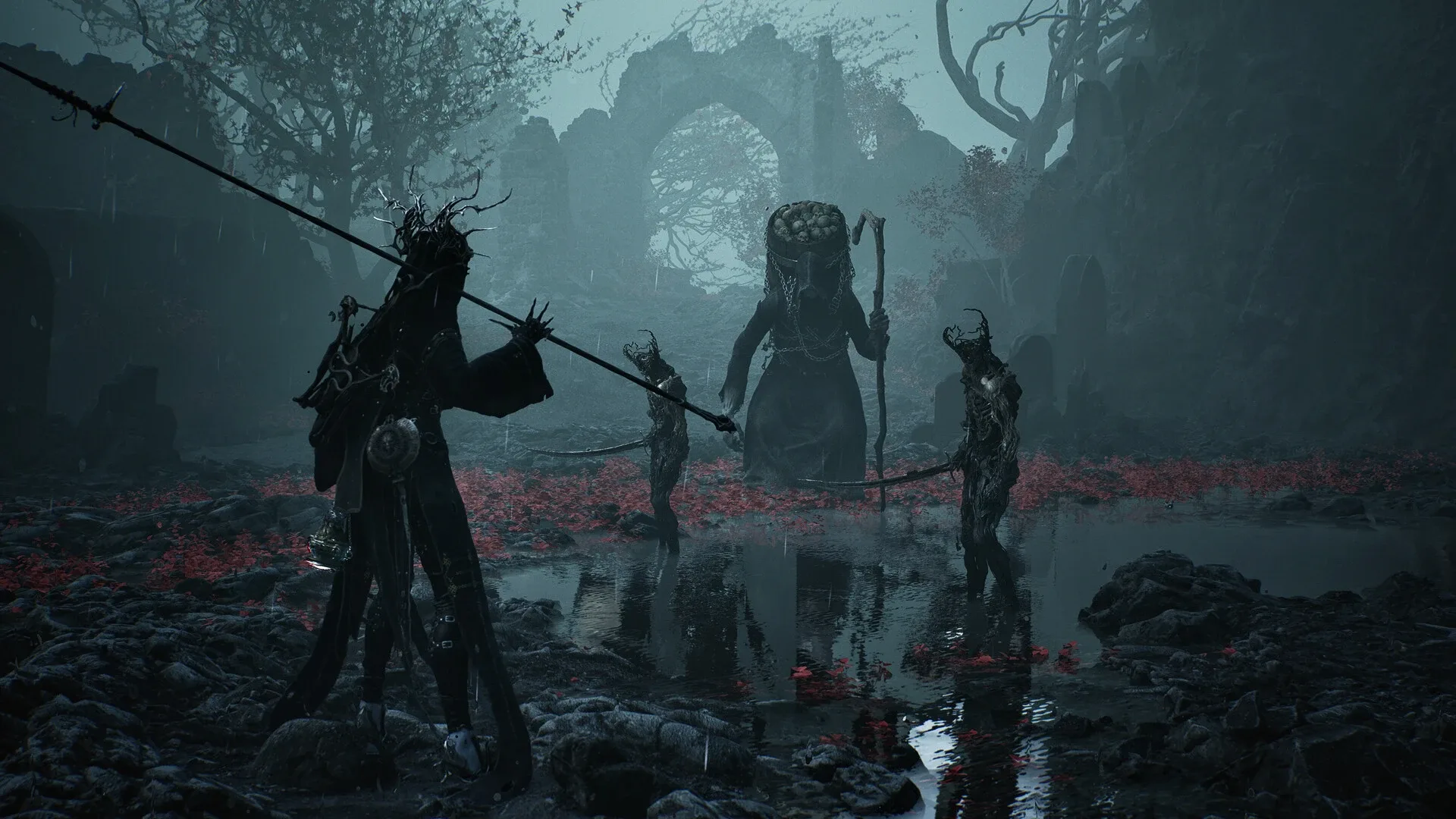
The setting is a bleak dark-fantasy world of false gods, decay and ruined strongholds, and the art direction is one of the game's most consistently praised aspects. The mood is oppressive without turning into noise.
The story draws mixed reactions. One reviewer found the main plot unengaging, while the backstories attached to individual Shells add depth. That fits the studio's approach: lore sits in fragments and memories instead of long cutscenes. If you like piecing a world together, there is plenty to find. If you want a gripping central narrative, expect to lean on the Shells' stories rather than the main thread.

Technical state and patches#
Technical polish is the area where reviewers are most cautious. Performance was generally described as solid on capable hardware, but critics reported occasional animation and camera bugs, navigation problems and clipping through geometry. A day-one patch was expected, and the game continued to need work after release.
The first major update, version 1.000.008, appeared around the start of September. According to coverage of its notes, it fixed an interrupted-save problem that could destroy a save file, removed several softlocks and places where players could get stuck, closed exploits and made many crash fixes. On performance, it moved shader compilation to the menu to remove a hitch, reduced enemy counts in some of the busiest areas and optimised lighting, effects and background work, including on console.
That is a healthy sign, but it also confirms that the launch version had real problems. Anyone sensitive to bugs should read the latest store reviews and patch notes before buying. Another practical point reported around launch: the PC install size is reported as larger than the figure first listed, so check the Steam page for the current requirement.
Compared with Dark Souls, Elden Ring and the first Mortal Shell#
The natural comparison is the original Mortal Shell. The sequel is bigger, faster and more flexible, and it trades some of the first game's cold stillness for a more fluid, build-driven approach. If you liked the original's weight, the new combat keeps it, but you now have more options.
Elden Ring is the genre's open-world benchmark, and it is not what Mortal Shell II is trying to be. The sequel stays compact, which gives it density but not Elden Ring's sense of endless discovery. The Dark Souls games are the better structural comparison, since both rely on interlocking areas, sparse checkpoints and lethal enemies. Mortal Shell II adds a body-swapping identity that those games do not have.
| Mortal Shell II | Elden Ring | |
|---|---|---|
| Structure | Compact, interconnected world | Large open world |
| Build identity | Eight Shells with refundable upgrades | Free character building |
| Combat | Fast, no stamina bar, committed swings | Stamina-based, wide weapon range |
| Length | Roughly 30-40 hours reported | Much longer |
| Co-op | Single player only | Multiplayer options |

New to soulslikes? Start here#
Mortal Shell II is a demanding place to begin, but the difficulty options and refundable upgrades make it less punishing than it looks. A few habits help.
- Pick a Shell that matches your instincts, and try another when you hit a wall, since upgrades can move with you.
- Learn one weapon and one defensive Seal before experimenting with sidearms.
- Spend time on side areas, because they feed upgrades, Shells and lore.
- If a boss blocks you for too long, consider the Slayer Seal and accept the trade-off, or adjust your build instead.
Worth the money?#
The launch price was reported as 49.99 US dollars for the standard edition, with a higher-priced Devout Edition that adds early access and extra content. Prices differ by region and over time, so check the current price on your platform. For a campaign that reviewers put at roughly 30 to 40 hours, with real replay value from the other Shells and Seals, that is a fair price for the genre.
The case for buying now is that the game is already well regarded and has received a significant patch. The case for waiting is that technical polish is still catching up and that a sale would soften the risk. If you are sensitive to bugs, waiting a little is a sensible choice. If you want to be part of the early conversation and the build experimentation, the base game is enough.
The game is single player only. There is no co-op mode and no player-versus-player. Supported languages are not confirmed in the sources used for this review, so check the store page before buying.

Play this instead if…#
Shorter: The original Mortal Shell offers the same Shell idea in a more compact package, and it is the natural pick if you want to see where the concept started.
Easier: Lies of P is a more guided soulslike with clearer signposting and a more linear route, which makes it a gentler way into the genre.
Cheaper or co-op: Dark Souls III or Elden Ring appear in discounts more regularly and include multiplayer options. Mortal Shell II itself is strictly single player.
Frequently asked questions#
How long is Mortal Shell II? Reviews put the main journey at roughly 30 to 40 hours, depending on how much side content you take on.
Is it open world? No. The map is compact and interconnected, with shortcuts and verticality, and not a large open world.
Do I need to play the first Mortal Shell? No. Mortal Shell II is a standalone sequel, though the first game gives context for the Shell idea.
Which platforms is it on? PC, PlayStation 5 and Xbox Series X|S since 20 August 2026.
Does it have co-op or multiplayer? No. It is a single-player game.
Is it very hard? Yes, by default. Enemies can defeat you in one or two hits. The Slayer Seal makes the game easier, with the trade-off that achievements are disabled, and the Gloombound Candle makes it harder.
Is it stable now? A major patch addressed save problems, softlocks, crashes and performance. Check the latest patch notes and recent store reviews for the current state.

The Game Avant verdict#
Mortal Shell II is the rare sequel that sharpens the identity of the original instead of diluting it. The Shell system gives it a hook that other soulslikes lack, the combat is weightier and quicker, and the compact world rewards curiosity. Critics widely praise the atmosphere and the build variety, and players have largely agreed.
The cost is friction. Resources can be scarce, some bosses lean on cheap-feeling tricks, the main story is the weakest part of the package and the launch build needed a serious patch. None of that breaks the experience, but it keeps the game from reaching the very top tier of the genre.
The contrarian view is that the ambition is the problem: too many systems, too many weapons and sidearms, and an overwhelming first few hours. That is a fair reading for players who prefer a leaner design. For anyone who wants a soulslike with room to experiment, this is an easy recommendation.
8 out of 10 – a weighty, inventive soulslike with a real identity, held back by resource grind and launch roughness.