

A card shop where the best part is the counter#
TCG Card Shop Simulator, from the developer OPNeon Games, asks a simple question: what if the fun part of collecting trading cards was the shop itself? You rent a small store, order booster packs and other products, set the prices, serve the customers who wander in, and slowly turn a nearly empty room into a busy local hobby shop. In between, you can open packs for your own collection and chase the rare cards you would otherwise be selling.
The short version of this review is that the game delivers on that fantasy. It is a calm, first-person management sim with a loop that is easy to understand and hard to stop, and the release of version 1.0 in September 2026 rounds it out with a playable card game and a much larger set of platforms. It earns an 8 out of 10 because the core loop is consistently satisfying and the game respects the player's time, but it stops short of the top tier because the presentation is plain and the repetitive chores never fully disappear.

What makes TCG Card Shop Simulator different#
Shop and supermarket simulators have become a crowded genre, so the first question is what this one does differently. The answer is the cards. Instead of selling generic goods, you sell products whose value moves and whose contents are a gamble, and the cards you open can be sold, displayed or kept. That gives the loop a second layer: you are both the shopkeeper and the customer, and the temptation to keep a rare pull instead of selling it is part of the design.
The result sits between a management game and a collecting game. The management side supplies structure, with ordering, pricing, rent, electricity and wages creating a steady stream of small decisions. The collecting side supplies emotion, because opening a pack is a moment of anticipation that the game builds the whole business around. Critics who have written about the 1.0 release tend to describe it as approachable and quietly addictive, and that matches what the design is trying to do.
It also helps that the game does not demand any knowledge of real trading card games. The cards belong to the game's own world, so a newcomer can learn what the rarities mean as they go, while a longtime collector will recognise the shape of the hobby immediately.
The daily loop: ordering, pricing and selling#
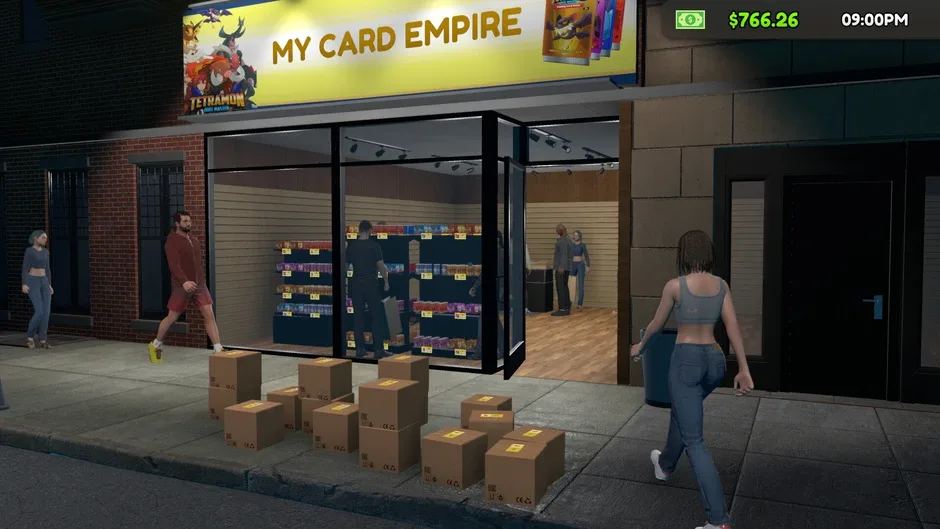
A typical day starts with stock. You order booster packs and other products, which arrive as deliveries, and you place them on shelves and in display cases. Then you open the doors, customers come in, pick what they want and queue at the till. At the end of the day you look at what sold, pay your costs and decide what to buy next.
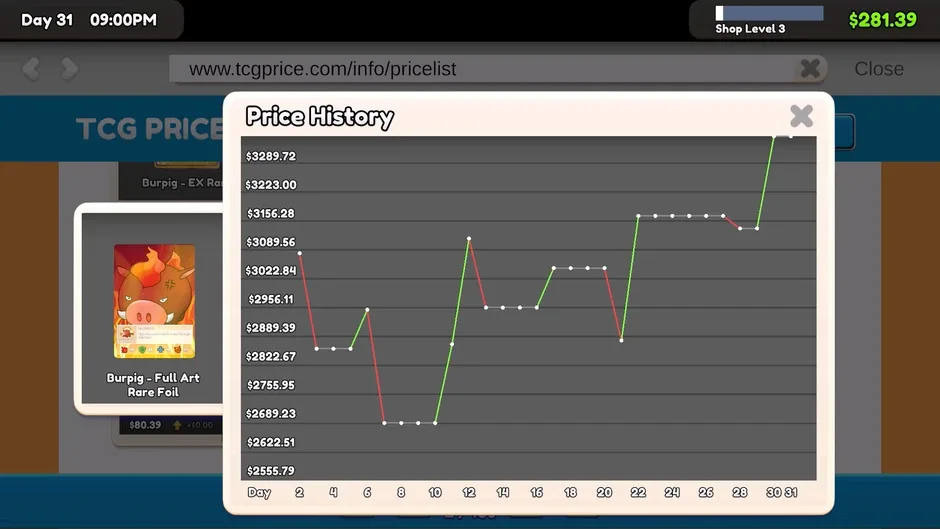
Pricing is where the management side becomes interesting. Market prices fluctuate from day to day, and you can check them on your in-game phone. Setting a price too high means customers walk away, and setting it too low means you leave money on the table. The game never turns this into a punishing economics exercise, but it gives you a reason to pay attention. Costs matter too. Rent, electricity and wages come out of your earnings, so a shop that looks busy can still be running thin.
The honest weak point here is the bookkeeping. Reviewers have noted that tracking daily spending is largely a manual chore, and a built-in cost and profit tracker would be an obvious improvement. It is a small annoyance rather than a deal-breaker, but it is the sort of thing a management game should do for you.
Pack opening and collecting#
If the pricing loop is the engine, pack opening is the fuel. The game has a large card pool with varied artwork and a rarity system that includes foils and full-art cards, so each pack has the chance of containing something special. That sense of possibility is exactly what makes the real hobby compelling, and the game captures it well.
The game also keeps the stakes safe. No real money is involved, and the game has no microtransactions, so the thrill of a good pull comes without the cost. That matters, because it lets the game focus on the feeling instead of the spending. The temptation that remains is internal: it is very easy to hold on to a valuable card you could have sold, or to spend too much of your budget on a rare you want for your collection. That tension is a feature, not a bug, and it is one of the more human moments in the game.
Since Early Access, the card pool has grown considerably. Reports from the 1.0 release put the total at 4,436 cards, up from 2,714 earlier in development, and the Ascension expansion alone is described as adding well over a thousand new cards. For a collector, that is a lot of reasons to keep opening packs.
Staff, customers and automation#
Early in the game, you do nearly everything yourself. You stock the shelves, run the till and clean up. That is deliberate, and it makes the first hours feel hands-on, but it also means that you remain the best cashier in the shop for a long time. Hiring staff takes a while to pay off, and the early game can feel busier than the later stretches.
Employees have different strengths, such as handling the till or restocking shelves, so choosing who to hire becomes a small planning question. As the shop grows, automation takes over more of the grind, and the late game shifts the player's time towards what they actually enjoy, which is opening packs, expanding the store and building a collection.
Customers add personality to the routine. Some are well-behaved, and some are not. Reviewers mention customers who need to be dealt with because they smell, and card traders who may try to lowball you or occasionally overpay. Notably, the game does not include shoplifters, and deliveries left outside are not stolen, which fits the low-pressure tone. A game that wanted to punish you would have added them. This one does not.
Expanding the shop and the shape of the game#
There is no story and no map to explore, so the structure comes entirely from growth. You level up the shop, unlock new products, buy furniture and decorations, and expand the floor space. Reports from the 1.0 release say the number of sellable unlocks rose from 77 in Early Access to 111, furniture from 21 to 43, and that there are more than 270 decoration options. That is enough variety to make the shop feel like your own.
The layout matters in a practical way as well as a cosmetic one. A shop needs enough room for customers to move around and for merchandise to be displayed, so a tidy layout also makes the business more efficient. It is a pleasant overlap between decoration and function.
The pace of progress is gentle. There is no ending to chase, so the game works best as a long, open-ended hobby that you return to for an hour at a time. That is a strength for players who like to relax, and a limit for players who need a goal.
Tetramon: the card game inside the shop game#
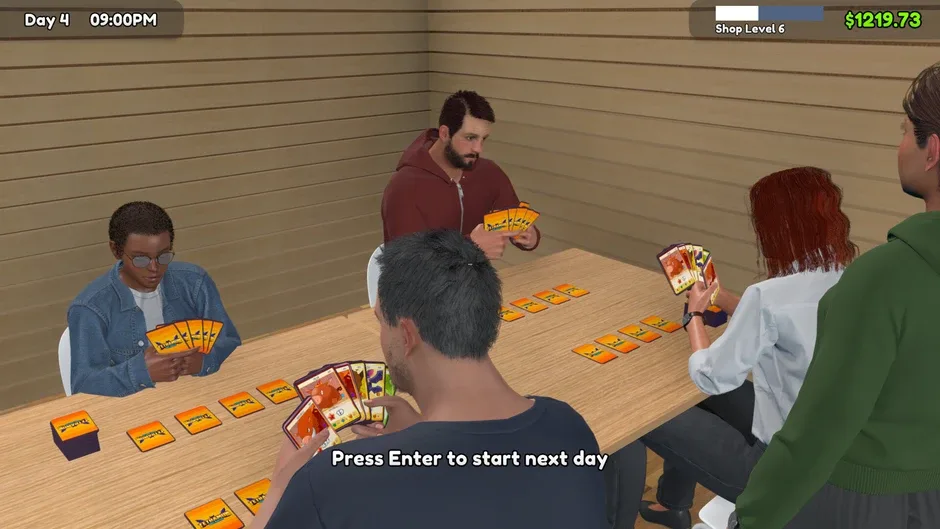
The biggest addition in version 1.0 is Tetramon, a playable trading card game that uses the cards you collect. Until now, the cards were collectables and trade goods. Now they are also a toolbox. Once the workbench unlocks at a mid-level shop rank, you can read the rulebook, build a 50-card deck and play matches, and you can challenge customers at play tables in your store. Matches are described as short, around three to five minutes, which suits the pace of the rest of the game.
The 1.0 version also adds a tournament mode, where your store can host matches with computer-controlled opponents and you can set formats and entry fees. That ties the card game neatly back into the business, because tournaments become another source of income and another reason for customers to visit.
Whether Tetramon succeeds depends on what you want. It gives the collection a purpose beyond selling, and it adds depth for players who enjoy deck building. On the other hand, it is a second system with its own rules, and shopkeeping fans who only wanted the till and the shelves may feel it is a detour. It is optional, which helps, and it does not replace the core loop.

Presentation, performance and accessibility#
The game's weakest area is its look and sound. Critics describe the graphics and music as plain, and some character models have been compared to older Sims games. The shop itself is clear and readable, and the cards are well drawn, but nobody will buy this for visual spectacle. The music is unobtrusive rather than memorable.
Performance is better news. Version 1.0 optimised models and textures, reduced memory usage and fixed bugs, and one reviewer reports smooth play on a Steam Deck at between 30 and 60 frames per second depending on settings. Console performance is less documented at the time of writing, particularly on the older Switch and Xbox One hardware, so it is worth checking recent player feedback for your platform. Cross-save and online features are not confirmed, and old saves from the earlier Prologue are not compatible with the full game.
In terms of accessibility, the game is about as gentle as a management sim gets. There is no combat, no time-critical danger and no punishing failure state. The first-person controls are simple, and the systems are introduced gradually. Supported languages for text have not been verified for this review, so check the store page for English, Swedish and German options before buying.
Compared with Supermarket Simulator and Stardew Valley#
The obvious comparison is Supermarket Simulator, which popularised the first-person shop management format that this game builds on. Both games ask you to stock shelves, set prices and run the till, and both reward patience. The difference is in the goods. Selling groceries is functional, but selling card packs adds the gamble of opening them, and that makes this game's loop more emotional.
The second reference is Stardew Valley, which several reviewers use to describe the feeling of progression. The comparison is about rhythm, not content: a small business that grows in satisfying steps, a gentle daily routine and a steady stream of unlocks. TCG Card Shop Simulator lacks Stardew's world, characters and story, but it shares the sense that tomorrow will be a little better than today.
| TCG Card Shop Simulator | Supermarket Simulator | |
|---|---|---|
| Goods | Booster packs, cards and collectibles | Groceries and household goods |
| Hook | Pack opening and rare pulls | Efficient shelf and till management |
| Extra system | Tetramon card game and tournaments | Store layout and logistics |
| Tone | Relaxed, collecting-focused | Relaxed, management-focused |
| Multiplayer | Single player only | Check the store page |

New to shop sims? Start here#
The game is a good first management sim because it introduces its systems slowly and never punishes a slow start. A few habits make the early hours smoother. Keep an eye on the daily market prices before setting your own, because a small adjustment can make a large difference. Reinvest steadily rather than hoarding cash, because growth is the engine of the whole game. And decide early how much of your pulls you want to keep, because the urge to collect can quietly drain your budget.
- Order a modest range of stock, and place it where customers can reach it easily.
- Check the market prices on your phone each day and adjust your own prices to match.
- Run the till yourself until a hired employee can do it faster, then shift to restocking.
- Put profits into expansion and furniture so that the shop can handle more customers.
Worth the money?#
A final price is not confirmed in the sources this review relies on, and it varies by platform and region, so check the current price on your platform of choice before buying. The game is also available through Game Pass, which makes it an easy try for subscribers. Because the game spent two years in Early Access, many players already know it, and the 1.0 release is aimed at both them and newcomers.
The value argument is straightforward. The game has no story to finish, so the length depends entirely on how long the collecting loop holds you. Players who enjoy open-ended management and collecting can expect many hours, and the 1.0 content, with thousands of cards, a card game and over a hundred unlockable items, gives that loop plenty of room. Players who need a goal or a challenge will probably find the hours thinner. Reports suggest the game has found a very large audience, with player reception described as strongly positive, which is a reasonable sign that the loop works for most people who try it.
The platforms are broad: PC through Steam and the Microsoft Store, PlayStation 5, Xbox Series X|S, Xbox One, Nintendo Switch and Nintendo Switch 2. That makes it easy to pick up wherever you already play.

Play this instead if…#
Shorter: A shorter management game with a clear end, such as a small business sim with a fixed campaign, suits players who want a finished experience instead of an open-ended hobby.
Easier: Stardew Valley is a gentle, welcoming alternative with a world, characters and a story, and it offers the same sense of steady progress with more variety.
Cheaper or co-op: Supermarket Simulator covers the same first-person shop management format with groceries instead of cards, and it is worth checking for sales and for its current multiplayer options. TCG Card Shop Simulator itself is single-player only, so anyone specifically after co-op should look elsewhere.
Frequently asked questions#
How long is TCG Card Shop Simulator? There is no fixed length. The game is open-ended, with no story ending, so playtime depends on how long you enjoy collecting and expanding.
Is it single-player? Yes. The game is a single-player experience, with no co-op or online multiplayer.
Which platforms is it on? PC via Steam and the Microsoft Store, PlayStation 5, Xbox Series X|S, Xbox One, Nintendo Switch and Nintendo Switch 2. It is also on Game Pass.
Is it still in Early Access? No. Version 1.0 launched on 15 September 2026 and ended the Early Access period.
Does it have microtransactions? No microtransactions have been reported, and no real money is spent on the in-game cards.
Do you need to know trading card games? No. The cards belong to the game's own world, and the playable card game, Tetramon, teaches its own rules through the rulebook.
The Game Avant verdict#
TCG Card Shop Simulator is a good example of a simple idea done with care. It understands that the pleasure of the hobby is in the anticipation of a pack and the slow growth of a collection, and it builds a calm, forgiving business loop around that feeling. The addition of Tetramon in version 1.0 gives the cards a purpose beyond selling, and the large card pool, the furniture and the staff give the shop room to grow. Its flaws are the plain look, the manual bookkeeping and the early hours of doing everything yourself.
The contrarian view is that the lack of a story, challenge and variety will make the middle of the game feel repetitive. That is a fair concern for anyone who needs a goal, and it is the main reason the score is not higher. For players who enjoy a relaxed, open-ended business to tinker with, it is easy to recommend, and the strongly positive player response suggests that most people who try it come away happy.
8 out of 10 – a relaxed, addictive card shop sim whose pack-opening loop works, held back by plain presentation.