- Pick Give Me a Balanced Experience for a first run. Give Me a Story removes the challenge almost entirely; Give Me God of War is a deliberately punishing mode for a second playthrough, not a first one.
- The Leviathan Axe throw-and-recall is the whole combat system in miniature: throw it to freeze an enemy, fight bare-handed for a moment, then call it back through anything in its path.
- The Blades of Chaos do not unlock until partway through the story. Do not look up "why can't I use the blades yet" guides that spoil the moment; it comes on its own.
- Shields are optional equipment, not a fixed loadout piece: the Guardian Shield blocks and parries, and other shields can be found or bought and swapped at any time.
- Muspelheim and Niflheim, the two trial realms, only open up once the story reaches Tyr's Vault around the midpoint. Do not go looking for them earlier.
- The nine Valkyries, and their queen Sigrún, are the hardest optional fights in the game and are meant for a maxed-out, endgame Kratos, not a fresh one.
- If you plan to also play God of War Ragnarök, finishing this game first is the intended order: Ragnarök picks up its story directly where this one ends.
What God of War (2018) actually is#
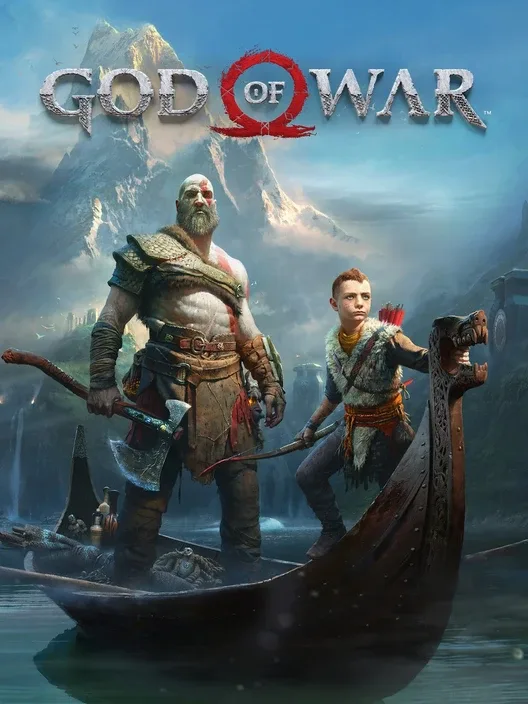
God of War is Santa Monica Studio's 2018 reboot of the series, released on 20 April 2018 for PlayStation 4. It moves the setting from Greek mythology to Norse myth, drops the old hack-and-slash camera for a single unbroken shot that never cuts away, and turns Kratos from a rage machine into a father travelling with his son Atreus. A PC port followed on 14 January 2022, published by Sony and built by Jetpack Interactive, with an unlocked frame rate, ultrawide support, and Nvidia DLSS and Reflex on supported hardware.
The PS4 version also received a free performance patch, released in February 2021, that added a PS5 boost. On PS5 the options screen offers a Performance mode targeting 4K checkerboard resolution at 60 fps, and a Resolution mode closer to the original 30 fps presentation. There is no separate paid PS5 edition: the same disc or download simply runs better on the newer console.
The game is not open-world in the Elden Ring or Skyrim sense. It is built around one long central hub, the Lake of the Nine, that opens up gradually as the story gives you tools to reach new parts of it, plus a handful of separate realms reached through the Bifröst. Understanding that structure early saves a lot of confused wandering.
Choosing a difficulty#
Difficulty is a menu choice at the very start of the game, and three of the four settings can be changed later without restarting.
| Difficulty | What it changes | Good for |
|---|---|---|
| Give Me a Story | Combat threat is minimal; enemies barely fight back | Players who want the story and world without punishing fights |
| Give Me a Balanced Experience | The default, moderate challenge that still requires learning the systems | Most new players, including anyone coming from outside action games |
| Give Me a Challenge | Enemies hit harder, react faster, and punish careless play | Players who want the combat system to matter from the first hour |
| Give Me God of War | The hardest setting, tuned around already knowing every mechanic | A second playthrough, or a first one only for players who already know character-action games well |
Give Me a Balanced Experience is the right default for a first playthrough. It is not an easy mode: bosses still demand that you learn their patterns, and several of the mandatory late-game fights are genuinely tough. But it does not ask you to already know the skill tree, the shield system and enemy stagger windows before you have had a chance to learn them. Give Me a Story exists for people who are here for Kratos and Atreus's relationship and want the fighting to be a formality, and there is no shame in choosing it. The first three settings can be swapped freely from the Settings menu at any time, so there is little cost to starting on Balanced and dropping to Story if a specific fight is not landing.
Combat basics: the axe, the blades and the shield#
The Leviathan Axe
The Leviathan Axe is Kratos's main weapon for almost the entire game, and its throw-and-recall mechanic is the single most important thing to learn early. Throwing the axe at an enemy or object freezes it in an icy coating for a few seconds; recalling it, by holding the same button, yanks it back through Kratos's hand and through anything else standing between him and it, dealing extra damage along the way. Recalling it while Kratos is unarmed, rather than only at the end of a combo, is what makes the axe feel less like a gimmick and more like a real weapon: throw it at a distant enemy, fight the one in front of you barehanded, then call it back mid-fight to interrupt whoever is about to hit you.
The axe also solves environmental puzzles throughout the game: frozen mechanisms, ice-covered gates and long-range levers all expect a throw. Puzzles are almost never optional busywork in God of War; most of them gate a chest, a Nornir chest with a permanent stat upgrade or XP inside, or the path forward.
The Blades of Chaos
The Blades of Chaos, Kratos's signature weapon from the original trilogy, are not available from the start. They unlock through a story event roughly a third of the way into the campaign, and the game deliberately withholds them to make an emotional point about who Kratos was and who he is trying to become. When they arrive, they add fast, wide, fire-based combos that work better against groups than the axe's slower, heavier single-target hits. A common and effective habit for the rest of the game is to open a fight with the blades to control a crowd, then finish with the axe for single-target damage, or the reverse depending on the enemy composition.
Shields
Kratos can equip a shield alongside the axe or blades, and shields are gear you choose and upgrade rather than a fixed part of his kit. The starting Guardian Shield gives a straightforward block and parry. A parry, timed against an incoming attack, staggers most regular enemies and opens them to a follow-up hit, and it is consistently stronger than a raw block, because blocking still drains a stun-resistance meter while a clean parry does not. Later shields change the shape of that parry window or add elemental resistance, and they can be swapped at any time once found or bought.
Atreus adds a second layer to defense: his Shock Arrow can stagger an enemy from range, and once his own combat abilities are upgraded he starts calling out enemies that are about to hit Kratos from behind, giving you time to turn and respond. He is not a liability to babysit; he is closer to a free interrupt button that improves as his own skill tree fills in.
Stun and finishers
Every enemy has a hidden stun meter alongside its health bar. Landing hits, especially heavy or elemental attacks, fills it; when it maxes out, the enemy is open to a context-sensitive finisher that deals a large amount of damage or kills a weakened enemy outright. Mixing hit types matters more than repeating a single combo, because axe throws, bare-handed strikes, blade combos and Atreus's arrows each contribute differently to damage and stun.
Skills, armor and enchantments: how progression actually works#
God of War's progression runs on three separate systems that all matter, and skipping any one of them makes the game noticeably harder than it needs to be.
| System | Currency | What it does |
|---|---|---|
| Skill tree | XP, earned from combat and exploration | Unlocks new axe, blade and shield moves, plus passive combat perks |
| Armor | Hacksilver and crafting materials, found or bought | Sets Kratos's and Atreus's base stats: Strength, Defense, Runic, Vitality, Luck and Cooldown |
| Enchantments | Found or bought separately from armor | Slot into armor pieces to add elemental effects and stat bonuses on top of the base armor |
Skill tree
Kratos and Atreus each have their own skill trees, split further by weapon: the Leviathan Axe and the Blades of Chaos each get their own branch once the blades unlock, alongside a shared branch for shield and general combat skills. New skills are bought with XP earned from almost everything: killing enemies, finishing side content, solving puzzles. Nothing about the skill tree is missable or time-limited, so there is no wrong way to spend XP as long as it gets spent. Prioritizing new heavy attacks and any skill that extends a combo into the axe-recall window pays off fastest, because it compounds directly with the throw-and-recall mechanic described above.
Atreus's own skills are just as worth investing in as Kratos's. His combat tree adds new arrow types, including the stagger-focused Shock Arrow, and further in, a talent that has him automatically call out incoming attacks from behind, which meaningfully cuts down on cheap hits in group fights.
Armor
Armor is crafted at the shops of the two dwarf brothers, Brok and Sindri, using Hacksilver, the game's currency, and crafting resources found in chests and dropped by enemies. Each set has a base and a fully upgraded version, and upgrading an existing set is almost always more efficient early on than saving for a whole new one, similar to how weapon upgrades work in other action RPGs. Which stat matters most depends on difficulty and playstyle, but new players benefit disproportionately from prioritizing Vitality, which raises max health, and Defense early, then shifting toward Strength and Runic as the skill tree opens up more elemental and heavy attacks worth building around.
Enchantments
Enchantments are separate items that slot into empty sockets on armor pieces, adding effects like elemental damage, health regeneration on hit, or stat boosts that stack with the base armor. They are found in the world, bought from Brok and Sindri, or awarded from side content, and unlike armor they are only found or purchased, not crafted directly. A common beginner mistake is treating enchantments as an afterthought; by the midgame, a well-chosen enchantment set contributes as much survivability as a full armor upgrade.
Main story versus the optional realms#
The critical path through God of War runs mostly through Midgard, with detours the story itself requires into other realms as Kratos and Atreus's journey to spread Faye's ashes progresses. Around the midpoint of the story, reaching Tyr's Vault and Tyr's Temple opens up travel to additional realms through the Bifröst, and this is the point where the game stops being linear and starts rewarding a player willing to leave the main quest for a while.
Muspelheim: combat trials
Muspelheim is a realm of fire-themed combat trials rather than a place to explore. Once unlocked, it presents a series of increasingly difficult arena challenges, such as surviving waves of enemies, defeating enemies within a time limit, or fighting without certain abilities, that reward Muspelheim Cinders. Those Cinders are spent at the realm's own hidden vendor to buy some of the strongest late-game armor in the base game, including pieces of the Valkyrie set. Muspelheim's trials scale sharply in difficulty and are not meant to be attempted the moment they unlock; most players get real value from them once Kratos is close to max level with a mostly upgraded armor set, which in practice means returning after most of the main story and a good chunk of side content is done.
Niflheim: the maze and the mist
Niflheim is a different kind of trial: a randomized, fog-filled maze that Kratos explores while a poison-like mist gradually drains health, resisted only by a limited supply of a corrosion-resistant chest piece that refills at braziers scattered through the maze. Inside, chests reward Mist Echoes, the currency for the realm's own vendor at Sindri's Niflheim outpost, which sells more of the Valkyrie armor set and other high-end gear. Like Muspelheim, Niflheim is built for a character who already has decent gear rather than a fresh one, since the mist punishes slow, cautious play and the maze's enemies hit harder than most of the main story's roster.
The Valkyries and Sigrún
The nine Valkyries are optional boss fights scattered across multiple realms, each guarding an area and each considerably harder than any mandatory story boss. Defeating enough of them unlocks access to their queen, Sigrún, in an endgame arena; Sigrún is widely considered the hardest single fight in the base game. None of this content is required to finish the story, and none of it should be attempted early: the Valkyries assume a maxed skill tree, high-level armor with strong enchantments, and a player who has already learned every dodge and parry timing the base game teaches. Treat them as the actual endgame of God of War, tackled after the credits roll or very late in the campaign.
| Optional content | Unlocks | Best attempted |
|---|---|---|
| Muspelheim trials | After reaching Tyr's Vault, midgame | Near max level, mostly upgraded gear |
| Niflheim maze | After reaching Tyr's Vault, midgame | Near max level, mostly upgraded gear |
| The nine Valkyries | Scattered across realms, found through exploration | Late game, once other realms are cleared |
| Sigrún, Valkyrie Queen | After defeating enough of the other Valkyries | Endgame, fully upgraded Kratos |
Commonly missed content#
A first playthrough that only follows the golden path skips a large share of what the game offers. The following is easy to walk past without noticing.
- Nornir chests. Locked chests found throughout every realm, opened by finding and striking three runic seals hidden nearby, usually solved with the axe's freeze mechanic or Atreus's arrows. Each one holds either a permanent stat upgrade, such as an Idunn Apple raising max health or a Horn of Blood Mead raising max rage, or a straightforward XP reward. These are the main source of permanent stat growth outside of armor, and they are easy to miss because the seals are often placed off the obvious path.
- Legendary chests. Similar to Nornir chests but requiring a specific tool or ability Kratos only gains later in the story, meaning a realm often needs a second visit once whatever the chest requires has been unlocked.
- Optional favors and side content around the Lake of the Nine. Several optional quests, given by NPCs or found through items in the world, lead to unique gear and lore that never come up if the main quest is rushed.
- The realm of Alfheim and the Light Elf conflict. It is technically optional at the point it first becomes reachable, and its own late chapters and gear are missed entirely by players who treat the realm as a one-time detour.
- Shops after their introduction. Brok and Sindri's stock changes and expands as the story and side content progress; checking back after finishing a realm or a set of favors regularly turns up new enchantments and armor pieces that were not there before.
Difficulty spikes to expect#
A handful of fights are meaningfully harder than the content around them and catch new players off guard, especially on Give Me a Balanced Experience or above. None of them require external help beyond what the skill tree and armor system already provide, but they are worth knowing about in advance so a sudden wall does not feel like a sign something was missed. In general, if a single fight feels disproportionately hard, the fix is almost always the same: check whether the current armor set has been upgraded recently, whether unspent XP is sitting in the skill menu, and whether Atreus's own gear and skills have been kept up to date alongside Kratos's, since it is easy to focus entirely on Kratos and forget that Atreus's stats matter just as much in a fight.
Playing order: God of War (2018) and God of War Ragnarök#
God of War Ragnarök, released on 9 November 2022 for PS4 and PS5, is a direct narrative sequel that picks up shortly after the ending of this game and continues Kratos and Atreus's story through to Ragnarök itself. It later came to PC on 19 September 2024. The intended order is to finish this game first: Ragnarök assumes full knowledge of this story's ending and its final revelations, and it is not designed to be approached out of order. This guide only covers the 2018 game; treat Ragnarök as a separate, later step once this campaign and whatever optional content you want to see are done.
Frequently asked questions#
How long does God of War take to finish? The main story runs somewhere around 20 to 25 hours for a player who follows the golden path with only a little detour. Seeing most of the realms, the Nornir and Legendary chests, and the favors adds significantly more, and going for the Valkyries and full New Game+ progression pushes total playtime well past that.
Which difficulty should a first-time player pick? Give Me a Balanced Experience for most players. Give Me a Story is a legitimate choice for anyone who wants the story and world without a real combat challenge, and there is no penalty for choosing it.
Do I need to have played the older Greek-era God of War games? No. The story is written to stand on its own, and enough context about Kratos's past is given through the game itself for newcomers to follow everything that matters.
Why can't I use the Blades of Chaos yet? They are locked behind a story event and unlock on their own roughly a third of the way through the campaign. This is intentional and tied to the story, not a bug or a setting to change.
Is there co-op or multiplayer? No. God of War (2018) is a single-player game with no multiplayer or co-op mode; Atreus is an AI companion controlled entirely by the game.
When should I go to Muspelheim and Niflheim? Both open up around the midpoint of the story after reaching Tyr's Vault, but both are tuned for a near-maximum-level Kratos with upgraded armor. Most players get the most value from visiting after the main story is finished or very close to it.
Should I play this before or after God of War Ragnarök? Before. Ragnarök is a direct continuation of this story and is intended to be played second.
Is the PC version worth it over the PS5 version? Both are strong options. The PC port adds an unlocked frame rate, ultrawide monitor support, and DLSS or FSR upscaling on supported hardware, while the PS5 version offers a straightforward 60 fps performance mode through a free patch with no setup required.