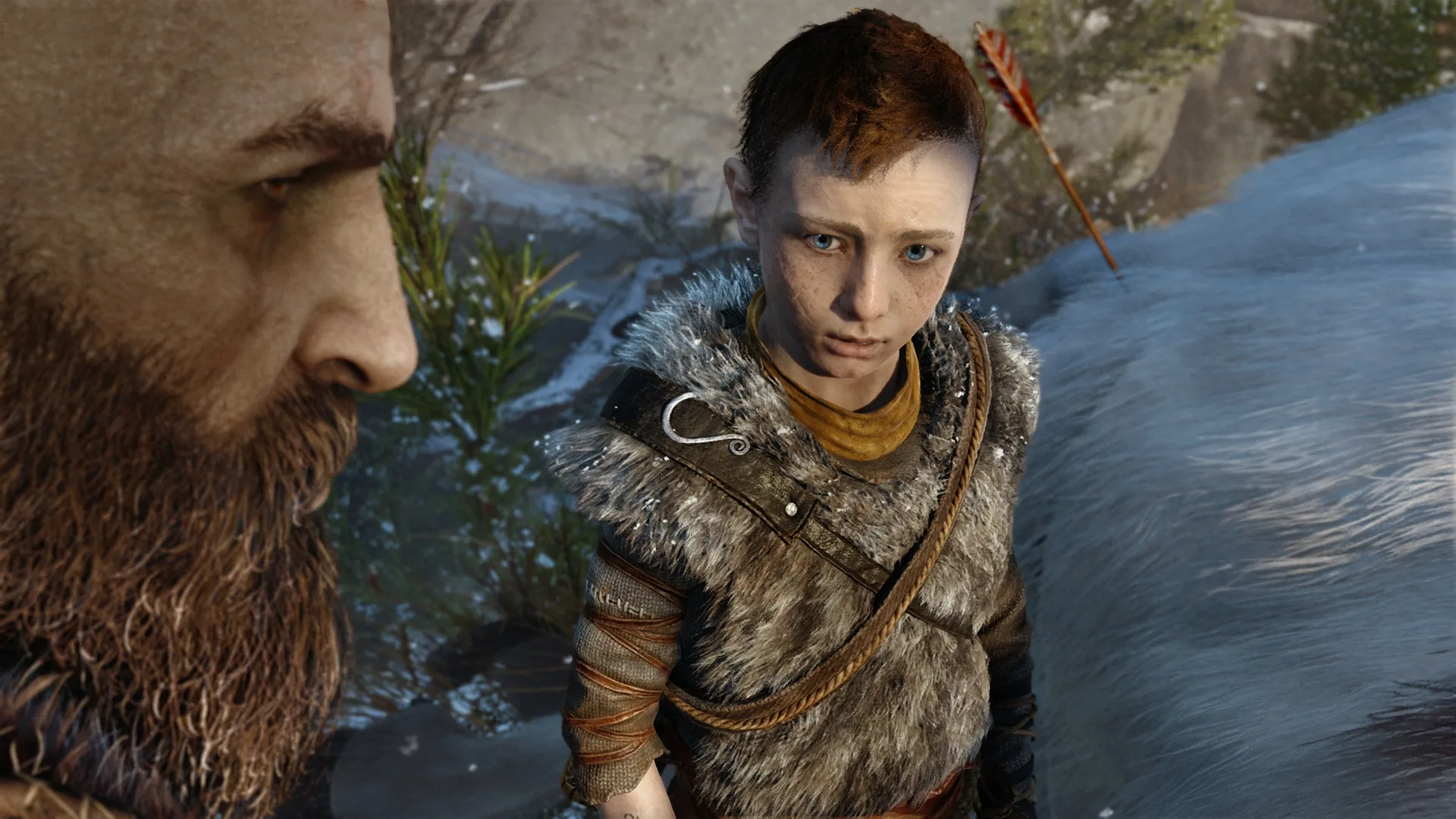
A god who learned to carry a boy on his shoulders#
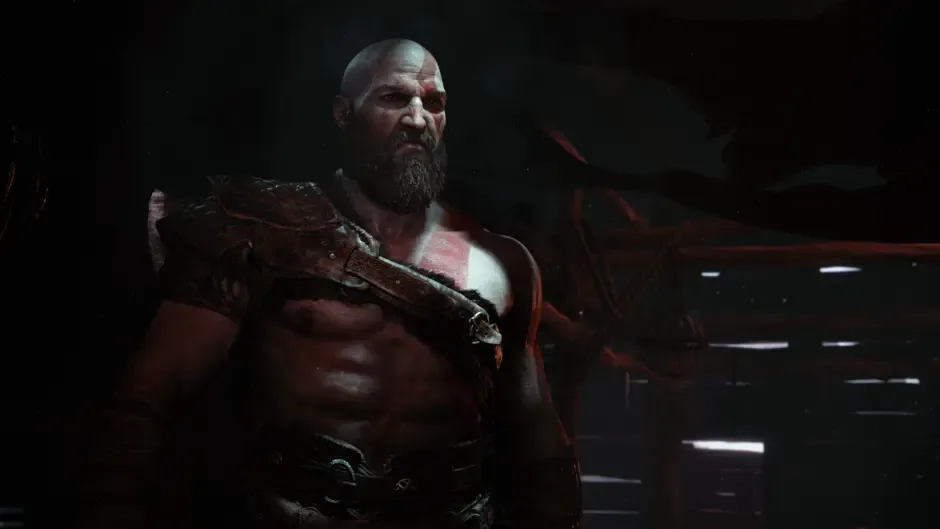
God of War is the point where Santa Monica Studio took a series built on spectacle and rage and rebuilt it around restraint. Released on 20 April 2018 for PlayStation 4, with a PC port following on 14 January 2022, it moves Kratos out of Greek mythology and into a Norse setting, swaps the old fixed-camera hack-and-slash for a single unbroken shot that never cuts away, and turns the character from a wronged god smashing his way through Olympus into a father who does not know how to talk to his son. None of that would matter if the combat underneath it were thin. It is not. The result is a game that earns its reputation as the best entry the series has produced, and it does so by trusting a slower story and a single weapon mechanic more than any God of War before it.
The premise is simple enough to state in one line: Kratos and his son Atreus set out to scatter the ashes of Faye, Atreus's mother, from the highest peak in the nine realms, and the journey there keeps getting interrupted by gods, monsters and a past Kratos has spent years trying not to mention. The Norse mythology setting gives the studio a fresh cast, Baldur, Freya, Mimir and the dwarven brothers Brok and Sindri among them, without leaning on Kratos's old rage for its drama.
What makes God of War different#
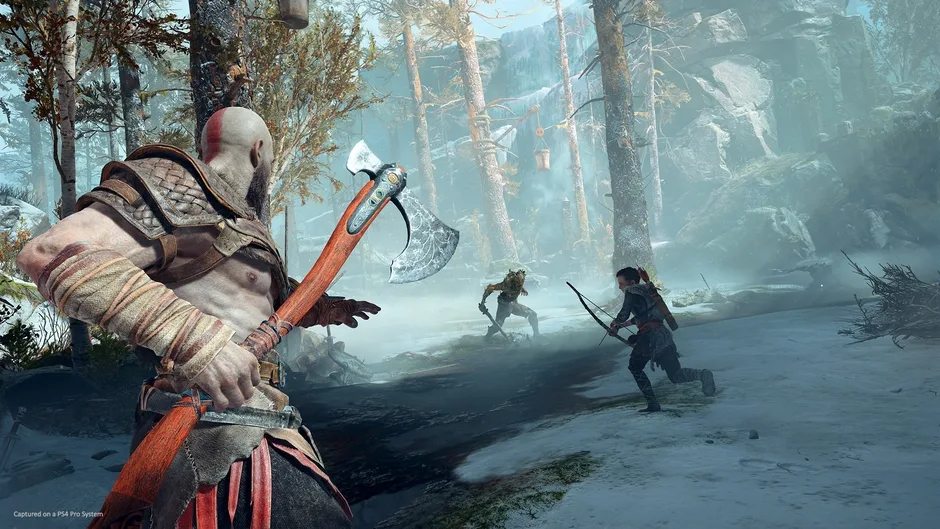
The one idea that carries the whole game is the Leviathan Axe's throw-and-recall mechanic, and it is worth dwelling on because almost everything else is built to make it matter. Throwing the axe at an enemy or a frozen mechanism coats it in ice for a few seconds; calling it back, by holding the same button, yanks it through Kratos's hand and through anything standing between him and it, dealing damage on the way home. The trick is that Kratos does not need the axe in his hand to keep fighting. He can throw it at a target across the room, turn and fight the enemy in front of him bare-handed for several seconds, then recall the axe mid-swing to interrupt whoever is about to land a hit from behind. That single loop, throw, fight empty-handed, recall, is the game's real combat system, and unlike a lot of action games that hand you a dozen new toys and quietly retire the old ones, God of War keeps building new skills, enchantments and enemy types that specifically reward getting that loop right for the entire 20-plus hour campaign.
The axe also does double duty as a puzzle tool. Frozen mechanisms, distant levers and ice-covered gates all expect a throw, and puzzles here are rarely padding: most of them gate a Nornir chest holding a permanent stat upgrade, an Idunn Apple for max health or a Horn of Blood Mead for max rage. Skipping puzzles means skipping the game's main source of permanent growth outside armor, and the story never announces that trade-off, which makes exploring the periphery of the Lake of the Nine feel like genuine discovery rather than a checklist.
Combat: an axe, a shield, and blades that arrive on their own schedule#
Every enemy carries a hidden stun meter alongside its health bar. Axe throws, bare-handed strikes and heavy attacks each fill it differently, and a maxed meter opens a context-sensitive finisher that can end a fight outright. That system rewards mixing attack types over spamming one combo, and it is where Atreus earns his place: his Shock Arrow staggers from range, and once his own skill tree fills in he starts calling out enemies about to hit Kratos from behind, turning him into something closer to a free interrupt button than an escort-mission liability.
Shields work the same way, as equipment rather than a fixed part of the kit. The starting Guardian Shield offers a straightforward block and a parry that, timed against an incoming swing rather than a raw block, staggers most regular enemies without draining the stun-resistance meter a plain block costs. Later shields change the shape of that parry window or add elemental resistance, and any of them can be swapped in once found or bought, which keeps the defensive layer from ever feeling locked in.
The Blades of Chaos, Kratos's signature weapon from the original trilogy, do not arrive until roughly a third of the way through the story, unlocked by a plot event rather than a shop or a chest. It is a deliberate choice: the game withholds them to make a point about who Kratos was and who he is trying to become, and it works, because by the time they show up, the axe has already proven it can carry the combat on its own. When the blades do arrive, they bring fast, wide, fire-based combos that work better against groups than the axe's heavier single-target hits, and the two weapons end up complementing each other rather than one making the other obsolete.
The Lake of the Nine: a hub that opens like a story, not a map#
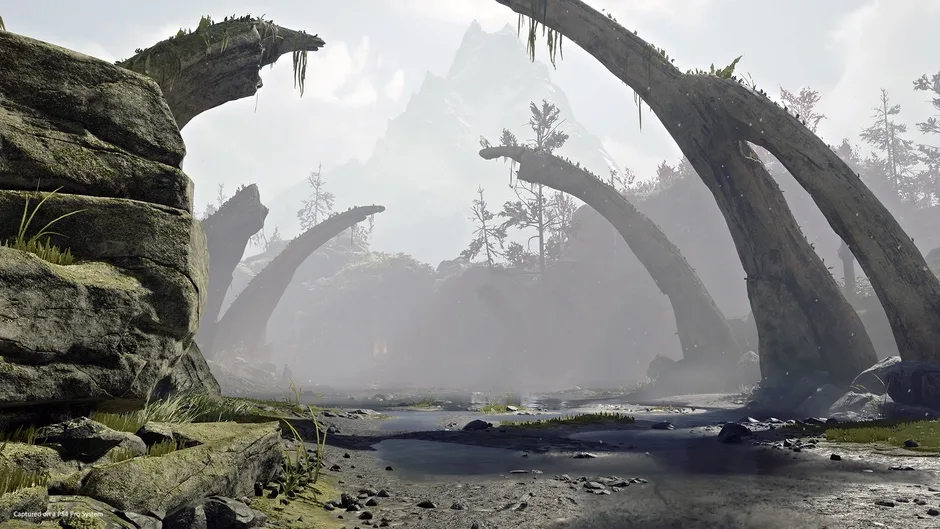
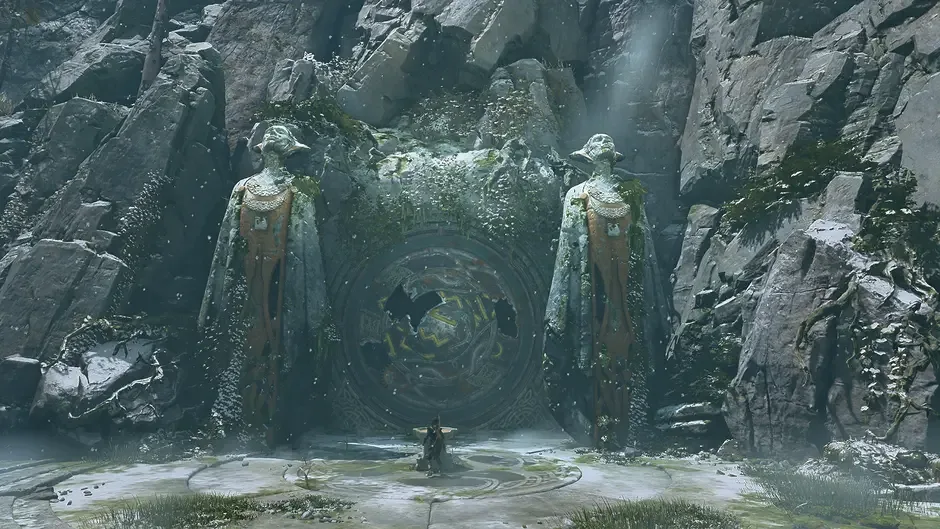
God of War is not open-world in the sense Elden Ring or Skyrim are. Its structure is one long central hub, the Lake of the Nine, that gradually opens up as the story hands Kratos new tools to reach parts of it that were visible but unreachable an hour earlier, alongside separate realms reached through the Bifröst. That structure is easy to undersell in a screenshot, because nothing about it looks unusual until you notice that a shortcut you rowed past three hours ago is now a route to a whole side area you had forgotten existed. The lake rewards paying attention to your surroundings in a way a quest marker never would, and it does it without ever pretending to be bigger than it is.
Around the midpoint of the story, reaching Tyr's Vault and Tyr's Temple opens travel through the Bifröst to additional realms, and this is the point where the game stops being purely linear. Before that, almost everything you find is optional favors, chests and lore tucked around the edges of the golden path. After it, the game hands you a reason to leave the story behind for a while, and that reason turns out to be some of its hardest, best-designed content.
Story: a quiet game about a father who does not know how to be one#
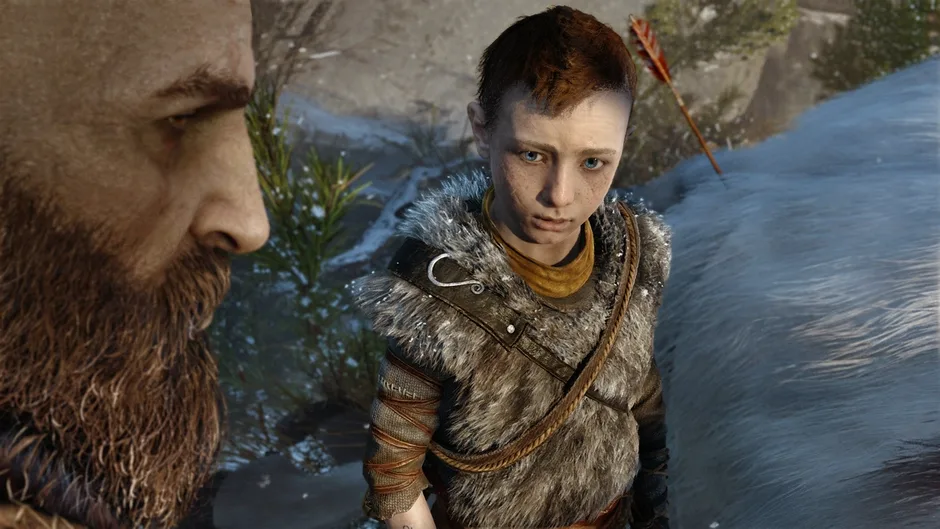
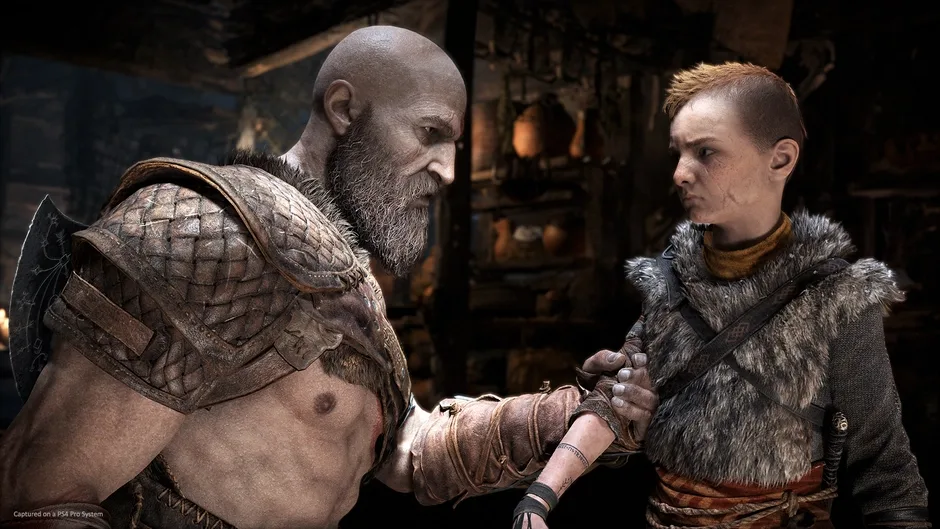
Kratos spends most of the campaign trying not to talk about his past, and Atreus spends most of it trying to become the god his father clearly does not want him to become. The writing keeps both threads restrained: there are no lengthy monologues about grief, just short, awkward exchanges rowing across the lake, a boy asking a father who does not have the words yet. Baldur, the game's antagonist, is written with his own grievance rather than as a generic final boss, and his mother Freya's arc, torn between protecting her son and recognising what he has become, gives the back half of the story a weight the marketing undersold. It is the rare AAA action game where the strongest moments are conversations in a rowboat rather than the boss fights around them, and that balance is a large part of why the reboot works as well as it does.
Skills, armor and enchantments: three systems that all matter#
Progression runs on three separate layers, and skipping any one of them makes the game noticeably harder than it needs to be. XP, earned from almost everything, buys new skills on separate trees for Kratos's axe, his blades once unlocked, and a shared shield and general-combat branch, plus a full tree for Atreus's own arrows and callouts. Armor, crafted by Brok and Sindri using Hacksilver and materials found or dropped by enemies, sets base stats across Strength, Defense, Runic, Vitality, Luck and Cooldown, and upgrading an existing set is almost always more efficient early on than saving toward a new one. Enchantments slot separately into armor sockets, adding elemental effects or stat bonuses that stack on top of the base gear, and they are easy to treat as an afterthought until a well-chosen set starts contributing as much survivability as a full armor upgrade. None of the three systems is missable or time-limited, which removes the anxiety of wondering whether an early choice locked anything out.
Difficulty: four settings, and a real curve on the higher two#
Difficulty is chosen at the start and three of the four settings can be changed later without restarting. Give Me a Story strips out most of the combat threat for players who came for Kratos and Atreus rather than the fighting. Give Me a Balanced Experience is the moderate default that still expects you to learn the stun meter, the parry timing and the skill tree, without demanding you already know them. Give Me a Challenge makes enemies hit harder and react faster from the first hour, and Give Me God of War is tuned around already knowing every mechanic, closer to a deliberate second-playthrough mode than a first-run option. The gap between Balanced and Challenge is real enough that switching mid-fight, which the game allows freely on the first three settings, is a legitimate way to find the right level rather than a concession.
Muspelheim, Niflheim and the Valkyries: the hardest game hiding inside the story#
The base game's best-kept secret is that its optional endgame is genuinely difficult in a way the story never is. Muspelheim's fire-themed combat trials, unlocked after Tyr's Vault, escalate through waves, timed fights and ability restrictions, and reward Muspelheim Cinders spent at a hidden vendor for some of the strongest armor in the base game. Niflheim answers with a randomized, fog-filled maze where a poison mist drains health, resisted only by a limited corrosion-resistant chest piece refilled at scattered braziers, and its own currency buys more of the same high-end gear from Sindri's outpost. Both are tuned for a Kratos who is close to maxed out, not a fresh one, and both are far more interesting the second time you visit than the first.
The nine Valkyries sit above both. Each is an optional boss fight scattered across the realms, individually harder than any mandatory story encounter, and defeating enough of them unlocks their queen, Sigrún, widely considered the single hardest fight in the base game. None of this is required to see the credits, and none of it should be attempted early: it assumes a maxed skill tree, high-level enchanted armor and reflexes sharpened by everything the main story has already taught. Treated as the actual endgame it is, this content gives a story-first action game a difficulty ceiling that rivals genre specialists, and it is the single biggest reason a first playthrough undersells what the game has to offer.
Alfheim and the content a rushed playthrough never sees#
Alfheim, reached once the story opens travel through the Bifröst, is technically optional the moment it first becomes reachable, and that single word, technically, hides how much a player loses by treating it as a one-time detour. The realm's Light Elf conflict has its own later chapters and its own gear, none of which surfaces if you clear the first visit and move on. The same is true of Legendary chests scattered across every realm, which look identical to Nornir chests but need a specific tool or ability Kratos only gains later in the story, meaning a realm you thought you had finished often needs a second pass once that tool is in hand. Brok and Sindri's shops behave the same way: their stock expands as the story and side content progress, so checking back after finishing a realm or a batch of favors regularly turns up enchantments and armor that were not there an hour earlier. None of this is hidden behind a wiki-unfriendly system. It is simply patient about when it shows itself, and a golden-path run misses most of it without ever being told what it missed.
Compared with God of War III and God of War Ragnarök#
God of War III, the last entry in the original Greek trilogy, is the game this one is reacting against: a fixed camera, a button-mashing combo system, and a Kratos defined entirely by rage and spectacle. It is louder and faster in the moment, but almost nothing in it lands the way a quiet conversation on the Lake of the Nine does, and the puzzle and progression systems here are simply deeper. If bombastic set pieces and a shorter runtime are what you actually want from the series, III still delivers that in a way this reboot deliberately does not chase.
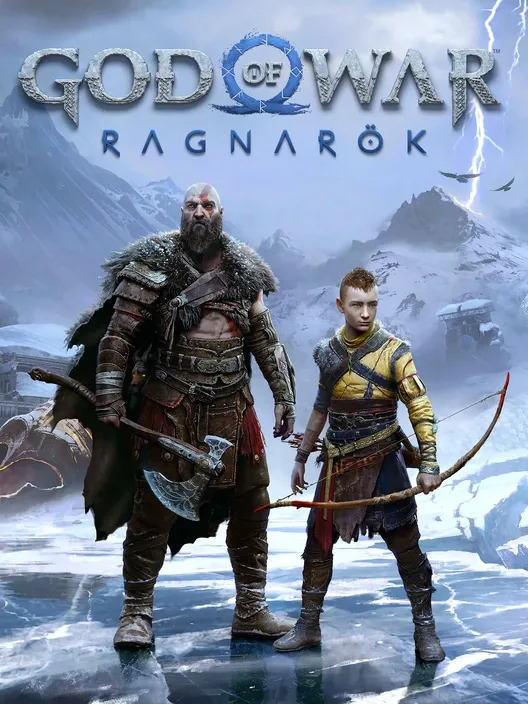
God of War Ragnarök, the direct sequel released 9 November 2022 on PS4 and PS5 and later on PC in September 2024, refines nearly every system this game introduces: more weapon variety, a second playable character, and a story that pays off the threads this one sets up. It is, on balance, the more polished game, but it assumes full knowledge of this story's ending and its final revelations, and it is not designed to be approached out of order. Playing this one first is not a suggestion; it is close to a requirement for Ragnarök to land the way it is built to.
Worth the money?#
At full price the game sits around 40 to 50 euros on PC and console, and it has been discounted well below that regularly since 2019, often for well under 20 euros during major sales. For that money you get roughly 20 to 25 hours for a golden-path run, meaningfully more once favors and chests are added, and a full second tier of content, Muspelheim, Niflheim and the Valkyries, that most players never touch on a first playthrough. New Game+ adds another layer once the story is done, letting you replay with full endgame gear against new enemy variants. Given the depth on offer even at full price, this is one of the easiest recommendations in the genre at almost any point in a sale cycle.
Best platform: PC, for an unlocked frame rate, ultrawide monitor support and DLSS or FSR upscaling on supported hardware. PS5 is the safest console option, running a free-patch Performance mode targeting a 4K checkerboard image at 60 fps, or a Resolution mode closer to the original 30 fps presentation; there is no separate paid PS5 edition, since the same disc or download simply runs better on the newer console. PS4 remains playable but noticeably softer in busy fights.
Text and voice: voice acting is English only on every platform, with subtitles and interface text available in a wide range of languages.
Play this instead if…#
Shorter: God of War (2005), the original PS2 game, delivers the series' old rage-driven spectacle in roughly 10 hours with none of this reboot's slower pacing.
Easier: Give Me a Story mode inside this same game strips out most of the combat threat while keeping every story beat intact, which is the gentlest way to see this specific game.
Cheaper: Hellblade: Senua's Sacrifice offers a similarly restrained, myth-inspired single-player story with combat at a fraction of the price and length.
Frequently asked questions#
How long does God of War take to finish? Around 20 to 25 hours for a golden-path run with light detours. Seeing most realms, chests and favors, plus tackling the Valkyries, pushes total playtime well past that.
Is God of War open world? No. It is built around one central hub, the Lake of the Nine, that opens up as the story progresses, plus separate realms reached through the Bifröst once the story allows it.
Does it have co-op or multiplayer? No. It is entirely single-player; Atreus is an AI companion controlled by the game, not a second player.
Which difficulty should you pick on a first playthrough? Give Me a Balanced Experience for most players. Give Me a Story is a legitimate choice for anyone who wants the relationship and world without a real combat challenge.
Do you need to have played the older Greek-era games first? No. The story stands on its own and gives newcomers enough context about Kratos's past to follow everything that matters.
Should you play this before God of War Ragnarök? Yes. Ragnarök is a direct continuation that assumes you already know how this story ends.
A handful of mandatory fights are also meaningfully harder than the content surrounding them, especially on Give Me a Balanced Experience or above, and they catch new players off guard precisely because nothing before them signalled a spike. None of them require anything the game has not already handed you. The fix is almost always the same: check whether the current armor set has been upgraded recently, whether unspent XP is sitting untouched in the skill menu, and whether Atreus's own gear and skills have kept pace with Kratos's, since it is easy to pour every resource into the father and forget that the son's stats matter just as much once a fight turns against you.
The GameAvant verdict#
God of War is not without friction: the fixed camera occasionally fights you in narrow corridors, the Blades of Chaos test your patience before rewarding it, and armor upgrading rarely demands the attention the skill tree does. None of that changes what the game gets right, which is nearly everything that matters. A single weapon mechanic that stays interesting for the whole runtime, a hub that reveals itself instead of being handed to you, and a story about a father and a son that earns its quiet moments rather than announcing them, add up to a reboot that improved on a beloved series by slowing it down rather than turning up the volume. The optional endgame alone, Muspelheim, Niflheim and nine Valkyries most players never see, is proof there was no need to pad the story to make the package feel complete.
9 out of 10 – a father-and-son story with one of the best-built weapon mechanics in modern action games wrapped around it.