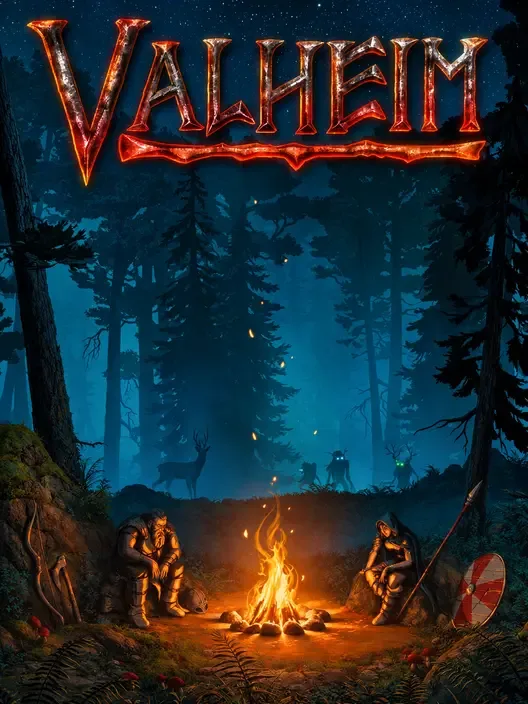
- Build a roof and four walls before your first night. A campfire under an open sky puts out its own fire in the rain, and the first skeletons and Greylings arrive after dark.
- The boss you should always fight next is the one whose trophy you already have. Hang the trophy on a Sacrificial Stone to see the summoning requirement and location hint.
- Eat three different foods, not one. Health, stamina and healing regeneration are each tied to specific food types, and eating the same meal three times wastes two of your three food slots.
- Do not carry ore through a portal. Standard portals block all raw metal, which is why a base near the coast matters more than a base near a mine.
- The Swamp is the biggest early difficulty spike in the game, not the Mountains. Poison resistance mead and a proper weapon upgrade matter more than armor there.
- Build your ship before your fear runs out. A Karve gets you off the Meadows-and-Black-Forest continent and is cheap enough to build in an afternoon.
- Kall Fimbulbringer, the Deep North's final boss, does not need to be your last fight. It is the last biome, but nothing stops a well-prepared group from visiting the Ashlands or Deep North's edges earlier for specific resources.
What kind of game Valheim actually is#
Valheim is a Viking-themed survival game built by the ten-person Swedish studio Iron Gate, and it left five and a half years of Early Access on 9 September 2026 as a full 1.0 release. That update added the Deep North, the game's eighth and final biome, a new last boss called Kall Fimbulbringer, and full crossplay across PC, Mac, Linux, Xbox One, Xbox Series X|S, PlayStation 5 and Nintendo Switch 2. Everything below applies to that finished version.
The structure never changes no matter which platform you play on: you die as a Viking, wake up in Valheim, and are tasked by Odin's raven Hugin with hunting down the "Forsaken", eight bosses tied to Norse myth, in order. Killing one grants a Forsaken power, usually tied to a stat or a resistance, that you can activate at any Sacrificial Stone. Killing one also unlocks the materials, dungeons and threats of the next biome, and pushes you toward tools you need to reach the next boss. There is no experience bar and no character level: your capability is entirely a function of your gear, your food and, less obviously, your building.
Three systems carry the entire game, and understanding them early saves dozens of frustrating deaths:
| System | What it does | Why it matters early |
|---|---|---|
| Stamina | The yellow bar. Every swing, block, dodge roll, run and jump costs stamina. At zero, you can still act, but slowly and clumsily. | Most early deaths come from swinging at zero stamina and eating a hit you could have dodged. |
| Food | You can have three active food buffs at once, each adding to your maximum health, maximum stamina, or health regeneration. | One food eaten three times wastes two slots. A balanced meal of three different foods beats a maxed-out single one. |
| Structural stability | Every building piece needs enough support underneath and beside it, shown by its colour when you hold the hammer. | A base that looks finished can still collapse days later if a support beam was placed as an afterthought. |
There is no built-in difficulty selector in the traditional sense, but a host can open the world-modifier menu from any bed or the main menu and adjust enemy damage, resource multipliers, raid frequency, portal restrictions and several other sliders per world. New players rarely need to touch them, but a group that finds a specific biome too punishing, or too easy, should know the option exists rather than assume the default settings are the only way to play.
Your first hour: what to do before nightfall#
The opening minutes decide whether your first week is smooth or miserable. Do these in order.
- Punch a tree, then punch a few more. Wood is the only resource you need before your first tools. Ten to twenty logs is enough to get started.
- Craft a Stone Axe and a workbench. The workbench is the anchor for everything else: most early crafting stations and building pieces need to be placed within its radius, shown as a translucent green circle when you hold the hammer.
- Build four walls and a roof, not a fort. A simple wood lean-to or a one-room square is enough. The goal on night one is a dry, enclosed space with a campfire that will not go out in the rain and will not set your walls on fire if you leave a gap around it.
- Place the campfire correctly. Fire in Valheim spreads to flammable material placed too close, and rain puts out any fire not under a roof. Leave a stone or dirt floor patch, or enough clearance, under and around it.
- Find Eikthyr's altar. A stag skull sits on a stone altar somewhere in the Meadows near your spawn. Interacting with it reveals Eikthyr's location on your map as a marked, roughly-drawn area. You do not fight him yet; the marker is a heads-up for later.
- Get a bow going early. A Crude Bow made from wood, leather scraps and deer hide, with wood arrows crafted at a workbench, turns Eikthyr and most of the Meadows' threats from close-range gambles into safe, repeatable fights.
You will die during your first sessions, and that is by design. Losing to a group of Greylings or falling off a cliff costs you your inventory at the point of death, marked by a tombstone you can walk back to. It does not delete your character or your base. Treat early deaths as information, not failure: walk back, recover your gear, and adjust.
Building: why stability is the actual survival system#
Building in Valheim is not decoration you add after surviving; it is one of the two or three systems the whole game is organized around. Every wall, floor, beam and roof panel occupies real space and needs real support underneath or beside it. Hold the hammer and look at any piece: green means solid, yellow means stressed, red means it is about to fail. A wooden beam can cantilever out a certain distance before it needs a support pole underneath it, and a stone structure needs a proper foundation rather than sitting on thin air. The system rewards understanding it and punishes ignoring it with a genuinely simulated collapse, complete with the pieces above the failure falling and breaking.
A few practical rules that solve almost every beginner building problem:
- Build up from the ground, not out from a wall. Long horizontal beams unsupported by a post underneath will eventually turn yellow, then red, then fall.
- Stone is stronger but needs a real foundation. Stone pieces placed directly on grass with no core wood or stone floor beneath them are the single most common cause of a "why did my wall just fall down" moment.
- A workbench, and later a forge, kiln, smelter and stonecutter, all have a radius requirement. Placing a crafting station too close to fire hazards, or a new station just outside the old one's radius, causes confusing "cannot build here" messages. Widen your first base's footprint with this in mind.
- Fire and smoke need somewhere to go. A hearth needs a floor patch that will not burn under it and, in an enclosed room, a smoke vent or gap; otherwise smoke fills the room even though the fire itself is fine.
- The Hoe and Cultivator let you reshape terrain, flattening ground for a proper foundation or raising it to block sightlines from raids. Terraforming is slow at first but becomes fast once you have a good pickaxe.
Later crafting stations unlock stronger building pieces tied to the biome you have reached: core wood from the Black Forest lets roofs span further, the stonecutter unlocked after Bonemass adds proper arches and pillars, and the Deep North's new stations extend the same toolset into cold-resistant materials and steeper, traditionally Norse roof shapes. None of that changes the underlying rule: a base is a running negotiation between what you want to build and what the physics will let stand, and a beginner's first real skill in Valheim is learning to read the colour of a beam before committing more resources to it.
Food and stamina: the numbers behind survival#
Food in Valheim works differently from almost every other survival game. There is no single hunger bar ticking down; instead, each food you eat adds a timed buff to a maximum of three active slots, and each buff contributes some combination of maximum health, maximum stamina and passive health regeneration for its duration. Eating a fourth food while three buffs are active replaces the oldest one. This is why a beginner eating three servings of the same berry is worse off than someone eating one meat, one berry and one cooked fish: three different sources cover health, stamina and regeneration at once, while three of the same food stacks duration but not variety.
A practical early-game food loadout looks like this:
| Food type | Example | What it's good for |
|---|---|---|
| Raw or cooked meat and fish | Cooked deer meat, cooked fish | Reliable health, easy to get from hunting deer and boar in the Meadows |
| Berries and mushrooms | Raspberries, blueberries, mushrooms | Fast stamina, gathered for free while exploring, no cooking needed |
| Cauldron-made meals | Mushroom stew, sausages, once you unlock a cauldron | Bigger buffs to both health and stamina once you progress past the earliest tools |
Stamina governs almost everything you do that is not walking: attacking, blocking, dodge-rolling, running, swimming, jumping and chopping. It regenerates automatically when you are not spending it, faster if you are standing still than if you are walking. New players commonly die by swinging an axe a third or fourth time with an empty stamina bar and eating a hit they had no stamina left to dodge or block. The habit that fixes this is the same one that works in most action games: hit twice, step back, let the bar refill, then re-engage.
Resting also matters. Sleeping in a bed inside a roofed, walled structure with a lit fire nearby grants the Rested status effect, which boosts stamina regeneration for a period afterward. A base you never sleep in is quietly slower to play than one you do.
The eight biomes and what gates each one#
Valheim's world is split into biomes of increasing danger, and each one is effectively gated by the boss and gear tier before it rather than by a level number. Trying to mine iron with a bronze pickaxe, or walking into the Plains in troll-hide armor, is technically possible and reliably fatal.
| Biome | What it introduces | Roughly gated by |
|---|---|---|
| Meadows | The safe starting biome: deer, boar, Greylings, flint and wood | Nothing; this is where every character begins |
| Black Forest | Real combat pressure for the first time: Greydwarves, skeletons, copper and tin deposits, Eikthyr's altar | Antler pickaxe and a Flint or Bronze weapon |
| Swamp | The game's steepest early spike: Draugr, Leeches, Blobs, poison damage, and the iron needed for the next tier | Bronze armor, poison resistance mead, a bronze weapon |
| Mountains | Frost damage, wolves that hunt in packs, Stone Golems, silver ore, Moder's peak | Frost resistance mead or Wolf armor, an iron weapon |
| Plains | Fulings throwing fire, Deathsquitos that one-shot underprepared players, black metal and barley/flax farming | Silver-tier or padded armor, a real ranged option |
| Mistlands | Permanent fog cleared only by the Wishbone's proximity ping, Seekers, Gjalls, black metal weapons, magic staves | Carapace or better armor, the Wishbone, fire and eitr-based weapons |
| Ashlands | An active volcanic warzone at the map's southern edge, Fader and the game's most aggressive enemies | Mistlands-tier gear, fire resistance, flametal weapons |
| Deep North | The 1.0 finale: sustained blizzards, glacial dungeons, jotun-scale enemies, Kall Fimbulbringer | Ashlands-tier gear, frost protection, the biome's own new materials |
The map has no invisible level gate stopping you from sailing into the Plains on day two, and a curious or overconfident group sometimes does exactly that. What stops you instead is the gear check: Deathsquitos and Fulings do damage that a bronze-tier character simply cannot survive, and there is no amount of skill that substitutes for the right resistance mead and the right armor tier. When a biome suddenly feels impossible, the fix is almost always "go back a tier and build the next one properly," not "get better at dodging."
The full boss order, from Eikthyr to Kall Fimbulbringer#
Every major boss in Valheim, called a Forsaken, has an altar somewhere in its associated biome. Interacting with the altar reveals a rough marker for its summoning location on your map; each boss then needs a specific set of trophies or items, dropped by regular enemies in that biome, placed on a Sacrificial Stone to summon it. Killing a boss grants a permanent Forsaken power you can activate for a limited time once per cooldown at any Sacrificial Stone, and always drops the item needed to unlock the next tier of crafting station.
| Boss | Biome | Roughly how tough | What it unlocks |
|---|---|---|---|
| Eikthyr | Meadows | The tutorial boss; teaches dodge timing and stamina management | Antler Pickaxe, enabling proper mining |
| The Elder | Black Forest | A stationary tree-creature that summons roots and Greydwarves around it | Bronze-tier axe upgrades and access to core wood processing |
| Bonemass | Swamp | A slow, heavily armored fight built around poison and attrition rather than speed | Iron-tier tools and the ability to mine iron scrap |
| Moder | Mountains | The first fight with a real aerial phase and frost breath | Silver-tier weapons and materials needed for the Wishbone |
| Yagluth | Plains | The last "classic" single-target fight, but with fire attacks that punish standing still | Black metal-tier gear |
| The Queen | Mistlands | A crowd-control fight against waves of Seekers rather than one health bar | Eitr-based magic weapons and staves |
| Fader | Ashlands | A lava-arena fight that punishes players who have not learned to manage the terrain | Flametal-tier weapons and armor |
| Kall Fimbulbringer | Deep North | The 1.0 finale: a jotun bound in chains, fought across several phases with a very large total health pool | Ends the main boss progression; drops the game's best late materials rather than a new Forsaken power |
A few things are worth knowing about the rotation as a whole. First, the bosses do not have to be fought strictly solo: summoning any of them with a full server present makes the fight noticeably easier per person, since Valheim scales encounters to the group that shows up rather than the other way around. Second, each boss punishes a specific mistake more than the others: Eikthyr punishes panic-rolling, Bonemass punishes fighting without poison resistance, Moder punishes ignoring the aerial phase, Yagluth punishes standing in fire, The Queen punishes trying to tank the Seeker swarm instead of controlling it, Fader punishes careless movement near lava, and Kall Fimbulbringer punishes arriving under-geared, since it resists pierce, fire, frost and lightning damage and takes essentially nothing from spirit damage. Third, unlike every boss before it, Kall Fimbulbringer does not grant a new Forsaken power on death, which fits its role as the closing fight of the game rather than a gate into a new biome.
Portals and getting around the map#
Valheim has no fast-travel menu. Movement is entirely physical: on foot, by boat, or through a portal you built yourself. A standard portal, crafted from fine wood and greydwarf eyes, teleports you and most of your inventory instantly to any other portal you have given the same matching name, which makes a small network of portals connecting your main base, your mining outposts and key resource areas one of the most valuable investments you can make early.
The one deliberate limitation is that ordinary portals refuse to teleport raw ore and metal bars. Copper, tin, iron, silver, black metal, flametal and their processed bars all have to be physically carried, by cart or by ship, back to wherever you want to smelt or craft with them. This single rule is why a base built near the coast, with easy boat access to a Karve or Longship, matters as much as a base built near a good ore vein: you will be hauling ore manually for the entire game, and the trip is shorter or longer depending on where you chose to settle.
Boats are the other half of travel. The Raft is a fragile first step, the Karve is the first real seafaring boat and cheap enough to build within your first few in-game days, and the Longship and later Drakkar carry far more cargo and survive rougher seas, which matters once you are hauling iron from the Swamp or exploring toward the Mistlands and Ashlands. A storm can capsize a boat and scatter its cargo, so watch the weather icon before setting out on a long haul.
Ten mistakes almost every beginner makes#
- Building the first shelter with no floor plan. A random collection of walls without support poles collapses the first time you add a second story.
- Eating the same food three times. It wastes two of your three buff slots. Mix a health food, a stamina food and, later, a regeneration food.
- Fighting at zero stamina. The empty bar is the single biggest cause of early deaths; step back and let it refill instead of swinging a fourth time.
- Trying to carry ore through a portal. It will refuse, every time, for every raw metal. Plan your route by boat or cart instead.
- Skipping poison resistance in the Swamp. Draugr and Leech attacks build poison stacks quickly, and no armor tier fully compensates for not eating the mead or food that resists it.
- Sleeping outside or under an open sky. Rested requires a roof, walls and a nearby fire; without it, your stamina regeneration is noticeably worse for no obvious reason.
- Placing a campfire against a wooden wall. Fire spreads to nearby flammable material. Leave a stone or dirt buffer.
- Rushing a biome ahead of gear. The Plains and Mistlands are not a skill check first; they are a gear check first. Go back a tier if a biome feels unfair rather than assuming you need to get better at dodging.
- Ignoring the world-modifier settings when playing solo. A solo player fighting content balanced around a full server can lower raid frequency or enemy damage from the world menu instead of grinding through unfair fights.
- Never building a boat. A base with no way to reach open water stalls out around the Black Forest, because the Swamp, Mountains, Plains, Mistlands and Ashlands are frequently separated by ocean.
Multiplayer, crossplay and servers#
Valheim supports up to ten players on a single world and has done so since well before its 1.0 release; the headline multiplayer change in 1.0 is full crossplay across PC, Mac, Linux, Xbox One, Xbox Series X|S, PlayStation 5 and Nintendo Switch 2, which finally lets a friend group split across different storefronts and consoles share one world. Steam, PlayStation, Xbox and Nintendo copies remain separate purchases; there is no cross-buy between them, though the Microsoft Store PC version and the Xbox console version share a single entitlement.
A dedicated server, hosted by a player leaving their machine on or through a hosting provider, keeps a world running without any one player needing to stay logged in, and is worth setting up for any group of more than two or three people. Smaller groups can rely on one player hosting the world directly, though that world is only reachable while the host is online.
The game scales combat difficulty to however many players show up rather than assigning a fixed level, which is why a boss that feels brutal solo can feel almost easy with three or four people, and why a raid tuned for a full server hits noticeably harder against one or two under-prepared players. If you are playing solo or in a duo and a fight feels unfairly tuned, the world-modifier sliders exist for exactly that situation.
Frequently asked questions#
How long does it take to beat Valheim? A focused run through all eight biomes and their bosses takes roughly 40 to 60 hours depending on group size and how much time goes into building rather than progressing. A completionist pass through every dungeon, achievement and crafting recipe adds considerably more.
Is there an easy mode? Not a preset one, but the host of any world can open the world-modifier menu and adjust enemy damage, resource rates, raid frequency and several other sliders to fit the group's preferred pace.
What should I build first? A simple roofed, walled shelter around a workbench and a safely placed campfire. Do not aim for a finished-looking base on day one; aim for something dry, enclosed and structurally sound, and expand it once you have core wood and stone tools.
Which boss should I fight first? Eikthyr, in the Meadows. His altar is usually close to your spawn point, and the fight is built to teach dodge timing and stamina management before anything more dangerous shows up.
Do I need to fight bosses in order? The game strongly assumes you will: each boss's gear reward is what makes the next biome survivable, and each biome's resources are what let you craft the trophy or item the next boss demands. Skipping ahead is possible but reliably punishing.
Can I play solo? Yes. Valheim scales its own challenge down for smaller groups, and the world-modifier sliders let a solo player reduce raid frequency or enemy damage further if a specific fight or biome feels unfair.
Does Valheim have crossplay? Yes, as of the 1.0 release, across PC, Mac, Linux, Xbox One, Xbox Series X|S, PlayStation 5 and Nintendo Switch 2. Platform copies are still purchased separately, aside from the shared Microsoft Store and Xbox entitlement.
What is the Deep North and do I need to finish it? The Deep North is the eighth and final biome added in 1.0, home to the last boss, Kall Fimbulbringer. It is the intended end of the main progression, but nothing in the game forces you to fight him the moment you unlock access; plenty of groups keep playing the same world afterward for building, farming and exploring biomes at their own pace.