

The game that had to be rebuilt to be good#
Cyberpunk 2077 is the rare open-world RPG that is worth reviewing twice: the game CD Projekt Red shipped on 10 December 2020, and the game it became after update 2.0 in September 2023 and the Phantom Liberty expansion released the same month. The two are close to unrecognizable from each other. This review covers the current version, the one anyone buying the game today will actually play, and on its own terms it is one of the strongest open-world RPGs available: a dense, reactive city, a genuinely great central story, and character systems that finally reward the kind of build experimentation the game always promised.
Night City is a fictional metropolis on the California coast, built on Mike Pondsmith's Cyberpunk 2020 tabletop setting. You play V, a mercenary voiced by either Gavin Drea or Cherami Leigh depending on the body and voice you pick at creation, who ends up with the digitized personality of Johnny Silverhand, a dead rockerboy terrorist played by Keanu Reeves, running as a corrupted program in their skull. Silverhand is slowly overwriting V's mind, and the entire game is a race to find a way out before there is no V left to save.
What makes Cyberpunk 2077 different#
The one idea that carries the game is that Johnny Silverhand is not a companion, a quest marker or a voice on a radio. He is inside V's head for the whole story, visible and audible to the player at almost all times, commenting on every decision, and eventually able to take over V's body in specific missions. No other open-world RPG puts its central relationship literally inside the protagonist's skull and then makes that relationship the actual difficulty curve: the more Silverhand's engram overwrites V, the more of V's own personality traits Johnny can pull toward his own worldview, and the ending you get depends heavily on how far you let that go and who you choose to trust with the fix. It turns a science-fiction premise about digital consciousness into something the moment-to-moment writing constantly has to justify, and it mostly does.
Night City: a world built in layers, not a checklist#
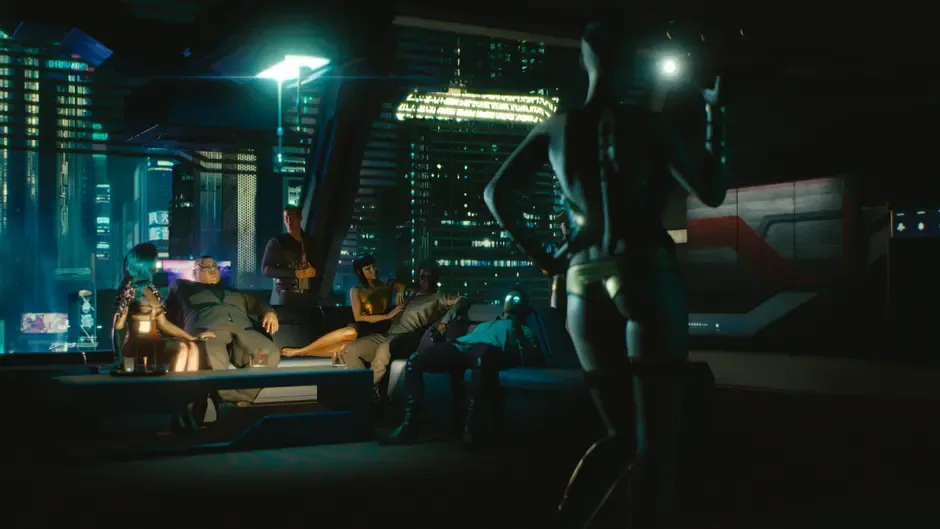
Night City is split into districts that feel genuinely different to move through rather than reskinned copies of the same template. City Center is corporate glass and drone traffic. Watson is Silverhand's old neighborhood, dense with markets and gang territory. Westbrook's Japantown is neon and nightlife. Heywood is split between Valentino gang turf and quiet suburbs. Santo Domingo is industrial and poor. The Badlands outside the city are open desert controlled by nomad families like the Aldecaldos. Phantom Liberty adds Dogtown, a walled-off district inside Pacific that the NCPD does not even patrol, run by a warlord and full of mercenaries who answer to nobody.
The density is in the details rather than in a map full of icons: overheard conversations between NPCs that reference gang politics you can later get pulled into, apartment interiors you can actually enter during side jobs, and a day-night cycle that changes which gangs control which corners. It rewards walking as much as driving, which is unusual for a game this size.

Gigs, fixers and the underworld you work for#
Below the main story sits a second layer of work handed out by fixers, local contacts who broker jobs over the phone rather than in cutscenes. Regina Jones deals in NCPD-adjacent cyberpsycho hunts, tracking down civilians whose cyberware has driven them into violent breakdowns, each one a short, self-contained horror story told through apartment scenes and audio logs rather than dialogue. Wakako Sato and Mr. Hands, and later Reed and Songbird's own contacts in Dogtown, hand out the gigs that make up most of Night City's side content: retrieving stolen data, sabotaging a rival gang's shipment, extracting a kidnapped executive. The gangs themselves, the corporate-funded cyberpsycho cult Maelstrom, the tech-focused Voodoo Boys who worship an AI trapped in the ruins of Old Night City's networks, the Tyger Claws running Japantown's clubs, and the Valentinos and 6th Street holding Heywood, each have a distinct visual identity and a handful of named lieutenants worth remembering, which keeps the city's underworld from blurring into generic checklist markers even a hundred hours in.
The best of these side jobs match the production values of the main quest almost beat for beat, which is why treating them as optional padding undersells the game. The weaker gigs are the ones that reduce to a waypoint, a locked door and a room of enemies to clear, and there are enough of those scattered through Night City's six districts that the ratio of great to average content is noticeably less consistent than in a story-first RPG. Cyberpunk: Edgerunners, the 2022 Netflix anime produced by Studio Trigger, added a small set of cosmetic items and callbacks tied to its protagonist David Martinez, but it is a companion piece rather than something the base game requires any familiarity with.
Combat, cyberware and builds: the system that finally works#
Update 2.0 replaced the original, overstuffed skill tree with five attributes, Body, Reflexes, Technical Ability, Intelligence and Cool, each with its own perk tree, and rebuilt cyberware around dedicated slots rather than a single opaque capacity stat. The result is that a build actually reads as a build again: a Reflexes-and-Cool character with a Sandevistan implant plays as a katana-wielding blur who slows time to dodge gunfire, while an Intelligence-heavy netrunner can lock down an entire combat encounter with quickhacks before drawing a weapon, and a Body-and-Technical brawler can rip doors off cars with Gorilla Arms cyberware. Weapons are split into Power, Tech and Smart types, the last of which fires homing rounds that curve around cover, and all three feel meaningfully different rather than being reskins of the same gun.
The rework also touched the police: pre-2.0 Night City's NCPD famously teleported officers directly behind the player the moment a crime started. Post-2.0, wanted levels escalate properly, cops pursue by vehicle, and it is possible to actually lose a chase by driving well rather than by leaving the area. Vehicle combat, new in 2.0, lets you shoot from cars during chases and story missions, which is a genuine addition rather than a patch-note line, even if the handling model underneath it remains the least polished part of getting around the city.

Story and choices: a small cast doing a lot of work#
The main story runs maybe 20 to 25 hours if you stay on the critical path, but almost nobody should, because the side jobs tied to companions are where the writing is strongest. Judy Alvarez's questline about a friend's disappearance in the Moxes-run Clouds club, Panam Palmer's arc reclaiming standing with the Aldecaldos nomad family, River Ward's investigation into a family member's death, and Kerry Eurodyne's attempt to reunite his old band Samurai for one more show are all fully voiced, multi-hour stories with their own endings, and each can become a romance option regardless of the body V has. Judy and Kerry are available to a female-voiced V, Panam and River to a male-voiced V, which is a narrower set of options than some RPGs offer but each relationship is written with real specificity rather than a generic flirt system.
The main ending sequence branches based on choices made across the whole game, not just a final dialogue wheel: who you trust with information about Silverhand's fix, whether you call in the Aldecaldos or go it alone, and what you tell key characters in the final act all lead to distinct endings with different final missions attached, including a secret ending that requires specific earlier choices and produces one of the bleaker outcomes in the game. It is a strong system, but the branching genuinely concentrates in the last few hours, so a first playthrough can feel linear for a long stretch before the game reveals how much it was tracking.
Phantom Liberty: the best thing CD Projekt Red has made since The Witcher 3#
The expansion, released 26 September 2023 for PC, PlayStation 5 and Xbox Series X|S only, requires the 2.0 update and is not available on PS4 or Xbox One. It drops V into a spy-thriller plot involving the President of the New United States, Solomon Reed, an FIA agent voiced by Idris Elba, and a rogue netrunner named Songbird whose survival depends on a favor only V can grant. Where the base game's story is about identity and mortality, Phantom Liberty is a tighter, more focused espionage story with a clear ticking clock, and it uses Dogtown's isolation to keep its cast small and its stakes personal. The choice between trusting Reed or Songbird at the story's climax reshapes the last several hours and unlocks a genuinely new ending for the base game as well, which is a rare thing for an expansion to pull off. Phantom Liberty also raises the level cap and adds a full new attribute-adjacent progression tree, Relic power, built around Silverhand's engram itself.

Difficulty and accessibility#
Cyberpunk 2077 does not have a traditional difficulty slider beyond four preset combat difficulties, but the real difficulty control is the build system: a stealth-and-hacking build can bypass most encounters without firing a shot, while a Body-focused brawler turns every fight into a demolition derby. Quest markers, a full map, fast travel between discovered points, and an assist option for quickhacking mean the game is far more approachable than its reputation for complexity suggests, and the driving-and-shooting sections that some players find frustrating can largely be avoided by leaning into stealth or ranged netrunning instead.
Compared with The Witcher 3 and Grand Theft Auto V#
The Witcher 3 is the fairer comparison for writing and choice design, because it is the same studio applying the same philosophy, quests with consequences that ripple into later hours, to a different genre. The Witcher 3's world is more consistently excellent across its entire length; Cyberpunk 2077's side content is more uneven, with genuinely brilliant companion arcs sitting next to repetitive gigs. But Cyberpunk's build variety and its first-person, systems-driven combat go further than anything in The Witcher 3's more traditional action-RPG combat.
Grand Theft Auto V is the fairer comparison for the open world itself, since both put a dense modern city at the center of the experience. GTA V's Los Santos is wider and its driving is more refined, but Night City is built for verticality and interior spaces GTA never attempts, with apartments, corporate lobbies and club interiors you actually walk through rather than a city meant mostly to be driven past. If you want a city to drive around, GTA V still does it better. If you want a city to live inside as a specific character with a story, Night City is the stronger choice.

Worth the money?#
The base game and Phantom Liberty are commonly sold together as the Ultimate Edition, and both the standalone base game and the bundle go on sale regularly on PC storefronts and console stores throughout the year, often at a steep discount from full price. A focused main-story run takes roughly 20 to 25 hours; a playthrough that follows the companion questlines runs closer to 50 to 60 hours; a completionist pass with every gig and side job pushes past 100. Phantom Liberty adds a further 15 to 20 hours on its own.
Best platform: PC with a strong GPU is the way to see the game at its best, including the optional path-traced Ray Tracing: Overdrive mode for high-end graphics cards, though it is entirely optional and the game runs well on more modest hardware with standard settings. PlayStation 5 and Xbox Series X|S run the current-gen version with far better performance than the PS4 and Xbox One versions, which are still supported but represent a noticeably weaker experience and cannot run Phantom Liberty at all. Steam Deck handles the game at lower settings with playable frame rates for a game this dense. Voice acting is available in several languages depending on platform and region, with subtitles in a wide range of others, so it is worth checking language support for your storefront before buying.
Play this instead if…#
Shorter: Deus Ex: Mankind Divided delivers a similar cyberpunk-noir mix of hacking, dialogue choice and augmentation-driven builds in a tighter 15 to 20 hour package without an open world to fill.
Easier: Watch Dogs: Legion offers a lighter, more accessible take on hacking-driven open-world crime, with a recruit-anyone system that lowers the stakes of any single character's build.
Cheaper or co-op: Grand Theft Auto V and GTA Online are frequently discounted far below Cyberpunk 2077's price and add the multiplayer heists and co-op missions that Night City's story does not offer.

Frequently asked questions#
How long is Cyberpunk 2077? Around 20 to 25 hours for the main story alone, 50 to 60 hours following companion questlines, and over 100 for full completion; Phantom Liberty adds roughly 15 to 20 more.
Is Cyberpunk 2077 open world? Yes. Night City and the surrounding Badlands form a single seamless open world with no loading screens between districts, including Dogtown, which is added by Phantom Liberty.
Does it have co-op or multiplayer? No. Cyberpunk 2077 and Phantom Liberty are single-player only; a separate multiplayer project was cancelled during development.
Do you need Phantom Liberty to enjoy the base game? No, but the expansion requires the free update 2.0 and is only available on PC, PlayStation 5 and Xbox Series X|S, not on PS4 or Xbox One.
Is the game still buggy? Update 2.0 and subsequent patches resolved the vast majority of the issues that defined the 2020 launch on consoles; the current version is stable on all supported platforms, though minor bugs common to large open-world RPGs can still occur.
The Game Avant verdict#
Cyberpunk 2077 is not the game it should have been at launch, and no amount of patching erases that history. What matters now is what it actually is: a dense, specific, well-acted open-world RPG with a central relationship, V and Johnny Silverhand, that gives its choices real emotional stakes, and systems that, after 2.0, finally support the kind of character builds the marketing promised in 2020. Phantom Liberty is not an optional add-on so much as the second half of the story the base game needed, and it is some of the best writing CD Projekt Red has produced. The side content is uneven and the branching consequences arrive later than they should, but Night City itself, walked through rather than glanced at, is one of the most convincingly built cities in any game.
9 out of 10 – a broken launch finally became the RPG it was always supposed to be.