
An election run as a dungeon crawl, and it works#
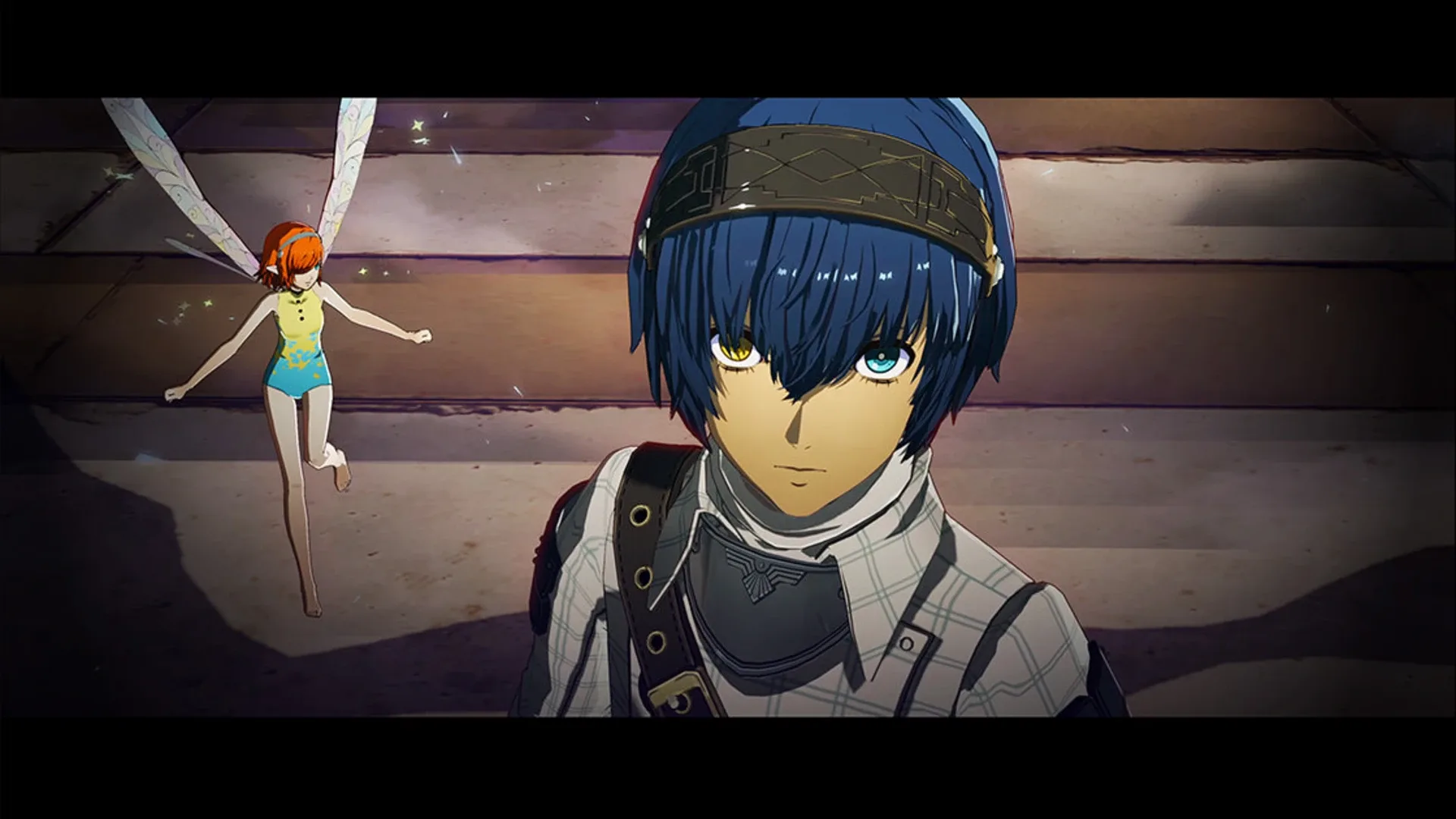
Metaphor: ReFantazio is what happens when the studio behind Persona 3, 4 and 5 sets its social-link formula and turn-based combat loose in a world with no Tokyo, no school year and no shadows hiding in the subconscious. Developed by Studio Zero, a team inside Atlus built specifically around director Katsura Hashino, character designer Shigenori Soejima and composer Shoji Meguro, and published globally by Sega, it released on 11 October 2024 for PlayStation 4, PlayStation 5, Xbox Series X|S and Windows, with a Nintendo Switch 2 version announced for November 2026. It is not a spin-off and it is not connected to the Persona or Shin Megami Tensei universes at all. It is an original dark fantasy setting, and it uses the freedom of a clean slate to be stranger, angrier about prejudice, and more mechanically ambitious than anything the studio has shipped before.
The premise is a single sentence with a lot riding on it. The king of the United Kingdom of Euchronia has been assassinated, and his final act of magic turns the royal succession into something closer to a democratic election: whoever gathers enough public support becomes the new monarch. The protagonist, an orphaned young man of the elda, a tribe openly despised by much of Euchronia's population, enters the race anyway, travelling the kingdom to build support while searching for a way to lift a curse that is slowly transforming him into a monster. It is a fantasy premise that could easily have stayed generic. It does not, because the game treats the "election" not as a plot device but as the actual structure of everything you do.
What makes Metaphor: ReFantazio different#
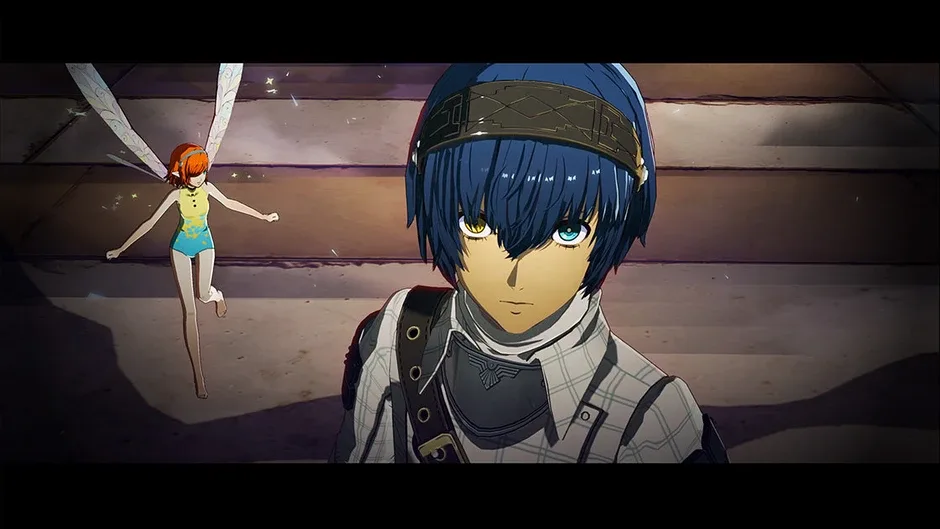
The one idea the whole game is built on is that a campaign for public office and a JRPG's social-link system are the same shape, and Studio Zero commits to that fully. In Persona, you build relationships to strengthen Personas summoned from your own psyche. In Metaphor: ReFantazio, you build relationships, called Followers, to win literal votes, and those bonds double as the Archetype system's skill tree. A conversation with a knight isn't just flavour text before a Confidant-style cutscene; it can unlock a new evolution path for the entire party's combat options. The election is not a subplot bolted onto a dungeon crawler. It is the reason the calendar exists, the reason Followers matter, and the reason exploring Euchronia's regions feels like something more than checking dungeons off a list. Nothing else on the market currently ties its social sim this tightly to its combat, and that fusion is what makes the whole 80-hour structure hang together instead of feeling like two separate games glued at the hip.
The Archetype system: a job class you fight your way into#
Archetypes replace the Persona system's collectible demons with a job-class tree that every character can move through independently. There are more than 40 Archetypes spread across roughly a dozen lineages, starting from foundational roles like the defensively minded Knight and the recovery-focused Healer, and branching upward into more specialised and eventually forbidden-feeling higher tiers as a character's rank in a given Archetype climbs. Ranking up happens through use in combat rather than through a separate grinding minigame, and each Archetype teaches skills that can then be inherited onto other Archetypes by spending a resource called Mag, so a character built as a Healer can still carry a signature buff spell over once they evolve into something more aggressive. The result is a build system that never fully locks you in. A character who starts the campaign as your tank can end it as your best physical attacker, and the game never punishes that kind of pivot, because the Archetype ranks you have already earned come with you.
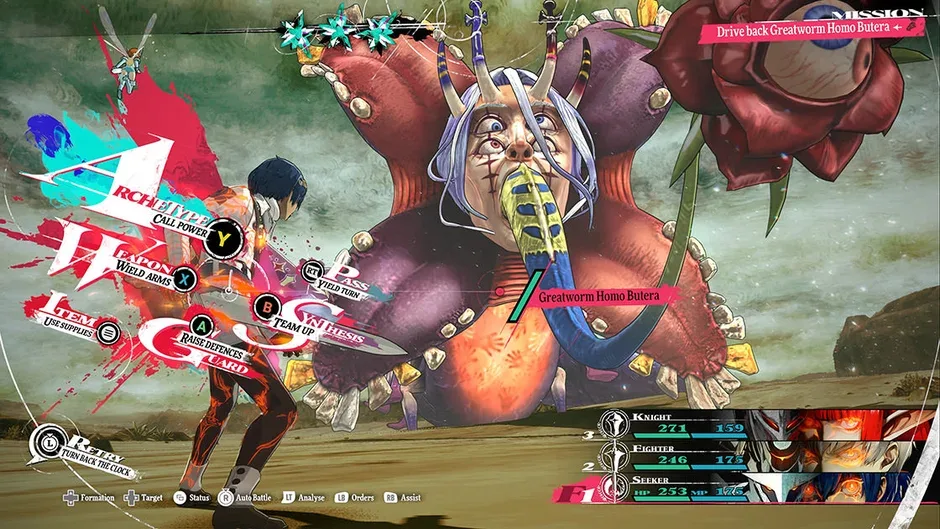
Where the system earns its keep is in how it interacts with Squad Battle's row and turn mechanics. Certain Archetype skills only function from the front row, others only from the back, and Synthesis skills let two party members combine actions for an effect neither could produce alone, which means a party's Archetype lineup has to be planned around formation as much as raw damage type. It is a genuinely deep system, and one clear improvement over the Persona games' reliance on a single collectible monster per character: here, every party member gets the same freedom to reinvent themselves that Persona reserved for the protagonist alone.
Followers and the calendar: a campaign with a deadline#
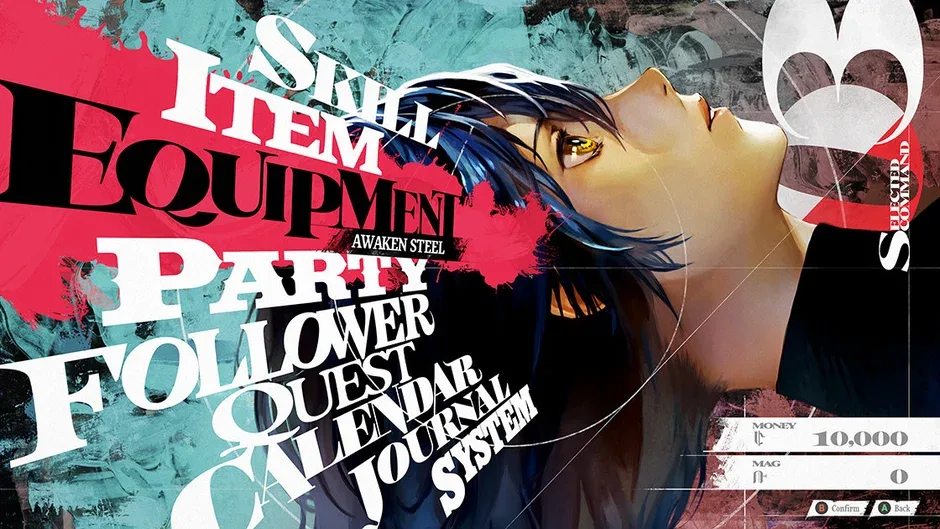
The Followers system is the game's version of Persona's social links, and it changes one important thing: instead of raising a personal relationship for its own sake, every Follower rank you build is explicitly framed as gathering support for the throne. Ranking up a Follower, whether it is a party member like the knight Hulkenberg or the swordsman Strohl, or a townsperson met along the road, unlocks new Archetype synthesis options, combat abilities, or utility outside of battle, and the game is upfront that these bonds are what wins elections in Euchronia. It is a smarter framing than it sounds: because every conversation visibly serves the plot's actual goal, spending an evening on a Follower feels purposeful in a way that some Persona social links, chosen mostly for their eventual Persona bonus, did not always manage.
The cost is the calendar underneath it. Metaphor: ReFantazio's story runs across a fixed stretch of the in-game year, and each day is split into a limited number of activity slots for Follower time, training, dungeon exploration and rest. Miss the window for a Follower's rank-up conversation, or burn too many days pushing through a long dungeon, and that relationship, along with whatever combat or story content it unlocks, can be closed off for the rest of the playthrough with no warning beyond the game quietly moving on. It is the same tension Persona players know well, but Metaphor: ReFantazio raises the stakes by tying calendar management directly to how strong your combat options can become, which makes a wasted week sting considerably more here than a missed hangout ever did in a school-life sim.
Fast and Squad: two kinds of combat on the same map#
Combat runs on a system the game calls Fast and Squad, and the split solves a problem turn-based RPGs have struggled with for years: how to keep dungeon crawling brisk without making every fight feel weightless. Wander into a visibly outmatched enemy on the field and Fast lets the protagonist and party swing at it directly in real time, often ending the encounter in a single hit with no transition to a battle screen at all. Approach something dangerous, and the game switches to Squad Battle, a full turn-based system where each party member's action consumes a turn icon, formation between front and back rows changes what skills are usable, and handing a turn to a teammate or repositioning mid-fight is a real tactical choice rather than a menu formality.
The fairy companion Gallica's Fae Sight ability is what threads the two systems together, tagging overworld enemies with a colour that signals how dangerous they are before you commit to fighting them at all: enemies coded as safe can usually be cleared with Fast alone, while anything coded as a real threat forces a full Squad Battle, and landing a Fast attack first grants an advantage once that Squad fight begins. It is an elegant compromise, and the fact that a weak wolf pack takes seconds to clear while a marked elite forces genuine tactical planning means the pacing of a dungeon rarely drags the way a JRPG with only one combat mode tends to by hour 40.
The Gauntlet Runner and travelling between towns#
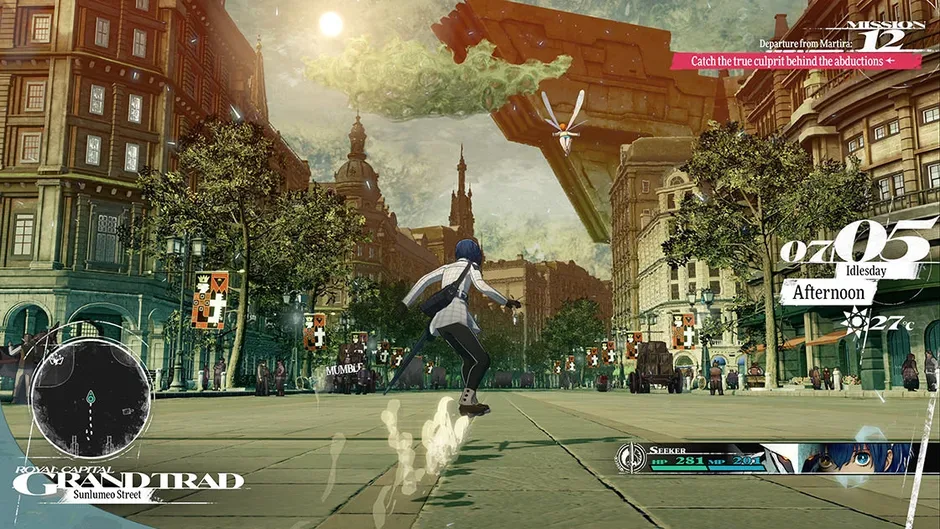
Getting between Euchronia's towns and dungeons happens aboard the Gauntlet Runner, a magic-powered vehicle that doubles as a mobile base as much as a mode of transport. Rather than a fast-travel menu with no texture to it, road segments between destinations often surface their own short events, merchant stops and Follower conversations, which keeps travel time from feeling like dead air the way overworld maps sometimes do in games this long. The Gauntlet Runner itself can be upgraded over the course of the campaign, adding new facilities that expand what can be done during a journey rather than simply making the vehicle faster, which fits the game's broader habit of turning what would be a loading screen in another RPG into one more system worth paying attention to.
Euchronia's tribes and a story about prejudice#
Euchronia is not a single culture wearing medieval-fantasy dressing; it is at least nine distinct tribes, the elda, clemar, roussainte, rhoag, ishika, mustari, nidia, paripus and eugief among them, each with its own physical traits, customs and standing in a deeply unequal society. The protagonist's elda heritage is not a footnote. He is spat at, denied service and openly threatened in the game's opening hours purely because of what he is, and the story does not soften that treatment to make him more palatable as a lead. What could have been a shallow "chosen one overcomes prejudice" arc instead uses the election itself as the mechanism for interrogating how a society decides who gets a voice: some tribal candidates for the throne campaign on protecting the existing order, others promise to dismantle it, and the game is unusually willing to let some of the people who support the protagonist do so for the wrong reasons. It gives the political plot a texture that a straightforward hero's-journey fantasy usually skips entirely.
Difficulty, New Game Plus and Regicide#
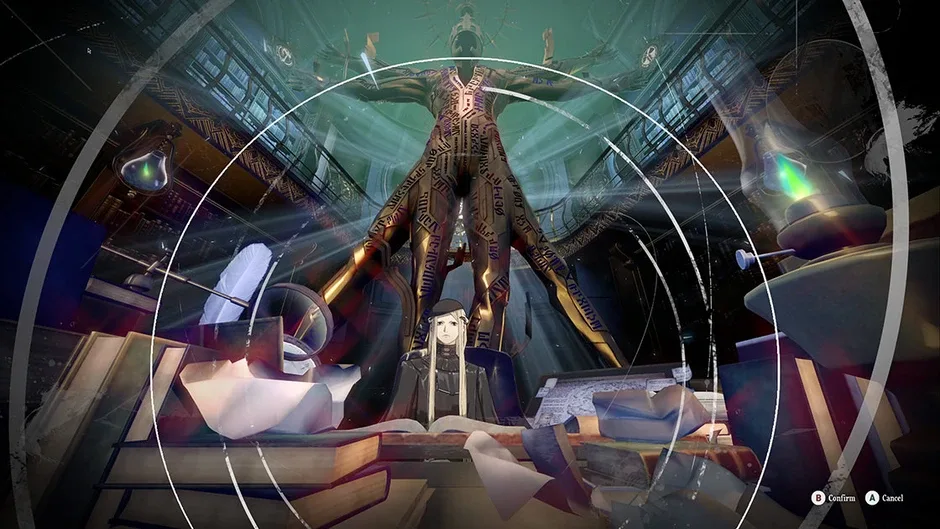
Standard difficulty options run from an accessible Explorer setting up through a punishing Regicide mode unlocked in New Game Plus, and the design philosophy is closer to Persona's approachable-but-scalable curve than to a game built around relentless failure. A retry option lets a lost Squad Battle be replayed with adjusted tactics rather than forcing a full reload, at least on any difficulty below Regicide, where retries are disabled entirely and the difficulty can no longer be changed mid-run, turning it into the mode built specifically for players who have already finished the campaign once and want the Archetype system pushed to its actual limit. New Game Plus carries over Archetype ranks, Follower progress and equipment, and adds a post-game superboss for players chasing that harder mode, which gives the 80-plus-hour investment a reason to be revisited rather than shelved the moment the credits roll.
New to this kind of RPG? Start here#
Metaphor: ReFantazio asks a fair amount of anyone who has not played a calendar-driven RPG before, and a few habits make the opening 20 hours much friendlier. Treat every Follower conversation as time-limited rather than something to save for later; the game rarely tells you a window is about to close. Prioritise the Knight and Healer Archetypes early rather than chasing a flashier option, since their skills carry over once you evolve past them. Use Fae Sight constantly on the field rather than only at a dungeon's entrance, since a colour reading can change as you move deeper in. And do not be afraid to spend a full in-game day resting rather than pushing forward when a Squad Battle has gone badly; the calendar punishes wasted time, but it punishes an exhausted, undergeared party trying to push through a boss even more.
Compared with Persona 5 Royal and Dragon Quest XI#
Persona 5 Royal is the obvious point of comparison, since it shares a director, a composer and much of a combat philosophy, and the differences are instructive. Persona 5 Royal's Tokyo is grounded and contemporary, its social links are personal rather than political, and its turn-based combat revolves around a single collectible-monster mechanic per character. Metaphor: ReFantazio trades that intimacy for scale: its fantasy setting lets it tackle prejudice and governance more directly than a story about a high school student ever could, and its Archetype system gives every party member the build freedom Persona reserved for the protagonist alone. If you want the tighter, more personal version of this formula, Persona 5 Royal is still the better first stop. If you want the same bones built for a bigger, angrier story, Metaphor: ReFantazio is the more ambitious game.
Dragon Quest XI is the fairer comparison for anyone weighing which traditional JRPG to spend 80 hours on this year. Dragon Quest XI is friendlier, more consistently paced and never asks you to manage a calendar; its combat is satisfying but comparatively shallow next to the Archetype tree. Metaphor: ReFantazio trades that ease for a combat system with genuinely more depth and a narrative willing to sit with uncomfortable material. If a warm, classic fantasy adventure is what you want, Dragon Quest XI delivers it more gently. If you want a fantasy RPG that argues with itself about who deserves power, this is the one to play.
Worth the money?#
At $69.99 for the standard edition, Metaphor: ReFantazio sits at the going rate for a full-scale JRPG, and the hours on offer justify it: roughly 60 to 65 hours for a story-focused run, 80 to 90 for a normal playthrough that engages properly with Followers and side content, and well past 100 for anyone chasing every Archetype and Follower rank. The available add-ons are cosmetic costume and background-music packs rather than story expansions, so the base game is the complete experience; a Guidebook Edition released in January 2026 bundles those cosmetics with a strategy guide and is worth it mainly for people who have not bought the game yet, since existing owners can upgrade to it far more cheaply than buying it outright.
Best platform: PC and PlayStation 5 both run the game at a steady frame rate with no notable performance complaints, and PC additionally offers ultrawide support and faster loading on solid-state storage. The upcoming Nintendo Switch 2 version is the one to watch for anyone who wants to play a calendar-driven RPG in short handheld sessions, though its exact performance profile is not yet confirmed. Voice acting is available in English and Japanese, and subtitles are available in a wide set of languages including German, though not Swedish.
Play this instead if…#
Shorter: Persona 5 Royal covers similar social-link and turn-based-combat ground in roughly the same length but with a tighter, more personal story, so it is a better use of the time if 80-plus hours on Euchronia's calendar sounds daunting.
Easier: Dragon Quest XI trades the Archetype system's depth and the calendar's pressure for a friendlier, more forgiving traditional JRPG structure.
Cheaper: Octopath Traveler II delivers a similarly large, multi-protagonist fantasy story with turn-based combat at a lower price point and without any time-management system to plan around.
Frequently asked questions#
How long is Metaphor: ReFantazio? Around 60 to 65 hours for a story-focused run, 80 to 90 hours for a normal playthrough that engages with Followers and side content, and well over 100 hours to fully complete the Archetype tree and New Game Plus content.
Is Metaphor: ReFantazio connected to Persona or Shin Megami Tensei? No. It is an entirely original setting built by the same Atlus team, sharing a director, character designer and composer but no characters, world or lore.
Does it have co-op or multiplayer? No. It is a single-player experience from start to finish.
Is there an easy mode? Yes. Difficulty options run from an accessible Explorer setting up to a demanding Regicide mode unlocked only in New Game Plus, where retries are disabled entirely.
Do you need prior JRPG experience to enjoy it? No, though familiarity with turn-based combat and social-link-style systems from games like Persona will shorten the learning curve considerably.
Can you miss content permanently? Yes. The in-game calendar means unattended Follower relationships and skipped opportunities can close for the rest of a given playthrough, which New Game Plus is partly designed to let you correct.
The Game Avant verdict#
Metaphor: ReFantazio is not a safe follow-up act for a team that could have coasted on another Persona sequel. It rebuilds the social-link formula from scratch around an election, gives every party member the build freedom the earlier games kept for one protagonist, and tells a fantasy story that is willing to be genuinely uncomfortable about who a society decides to listen to. The calendar is a real cost: a bad week can close a door for good, and the opening dungeons ask for patience before the Archetype tree fully opens up. Neither flaw comes close to undoing what the game gets right. This is a studio that spent years making the same kind of RPG and used the freedom of an original world to make a considerably better one.
9 out of 10 – Persona's team built a whole new world, and the election turned out to be the best hook they have ever written.