
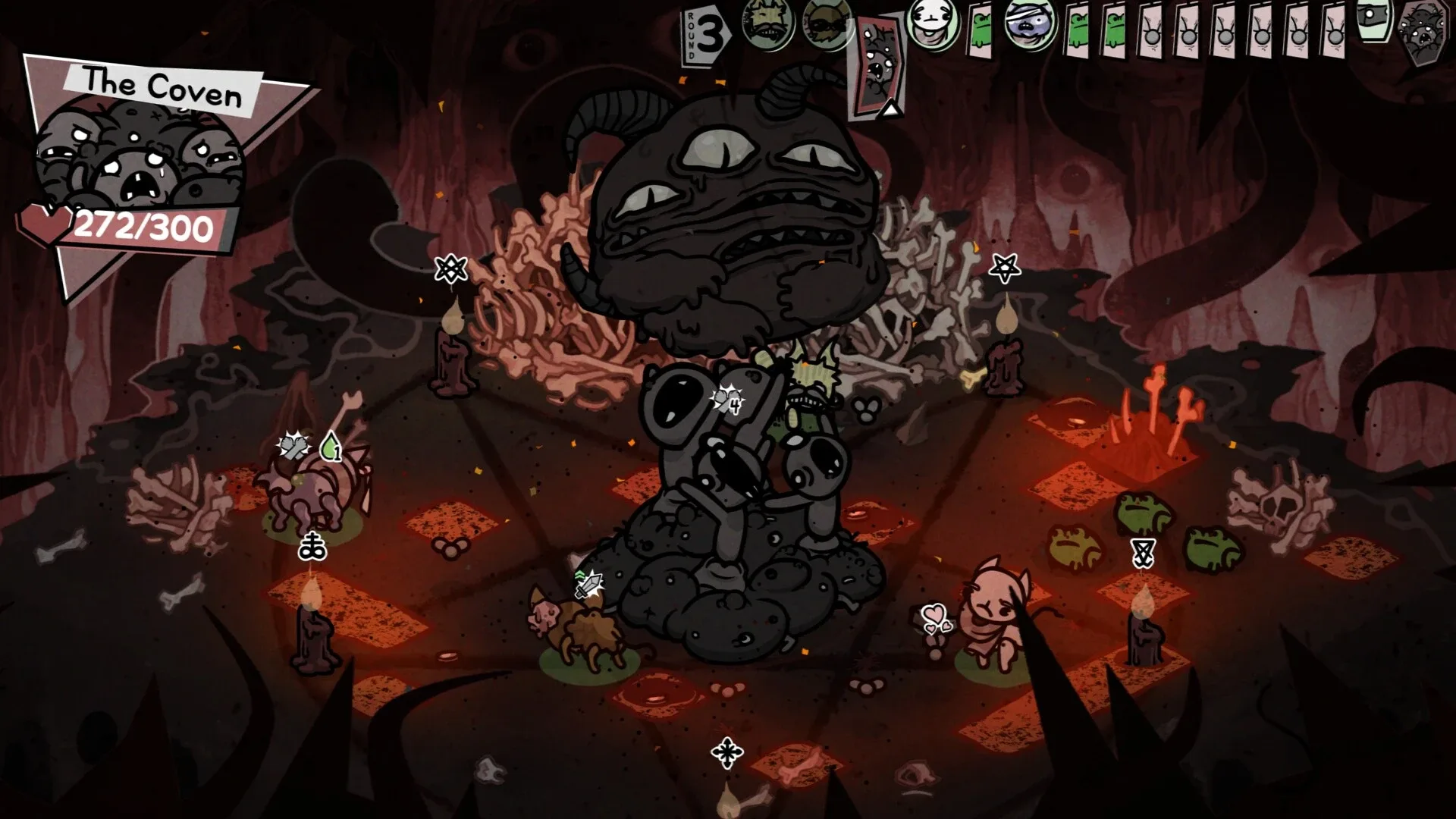
A roguelike where the build is a bloodline#
Mewgenics is the game where the core question is not "what gear did you find" but "what did you breed." Edmund McMillen, the creator of The Binding of Isaac, and Tyler Glaiel built a roguelike tactics game around a premise that sounds almost too simple to carry a whole genre entry: you assemble an army of cats, send them through turn-based adventures, and the traits they carry into the next attempt are the ones you chose to breed into them. Published by Nicalis, it launched for PC on Steam on 10 February 2026, and arrived on Nintendo Switch 2, PlayStation 5 and Xbox Series X|S on 8 September 2026. The commercial reception left no doubt that the premise landed: the game moved past a million copies in its first week alone, and its Steam user reviews have stayed strongly positive since launch. None of that popularity is why this review lands where it does, though. It lands here because genetics, treated as an actual strategic system rather than a flavour text gimmick, turns out to be a genuinely interesting thing to build a roguelike around, even when the systems wrapped around it are uneven.
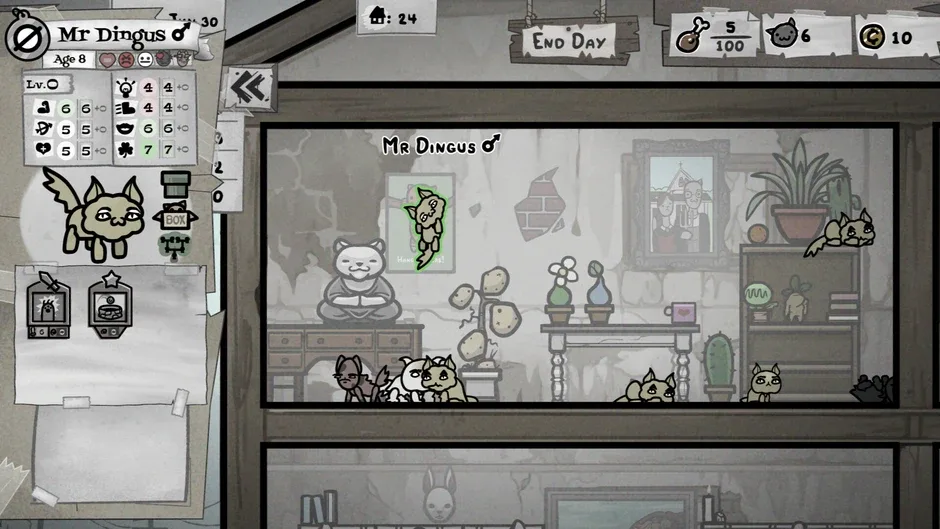
The premise is easy to state and harder to master. Instead of picking a single hero and levelling them up, you are managing a whole colony of cats across generations. Each cat that survives a turn-based adventure can be bred with another, and the traits of the parents determine what the next litter is capable of. Ability drafts, collected items and the outcomes of individual tactical battles all feed back into which cats are worth breeding and which ones are better retired. It is a loop that asks you to think two steps ahead of the fight you are currently in, which is a different kind of pressure than most tactics roguelikes apply.
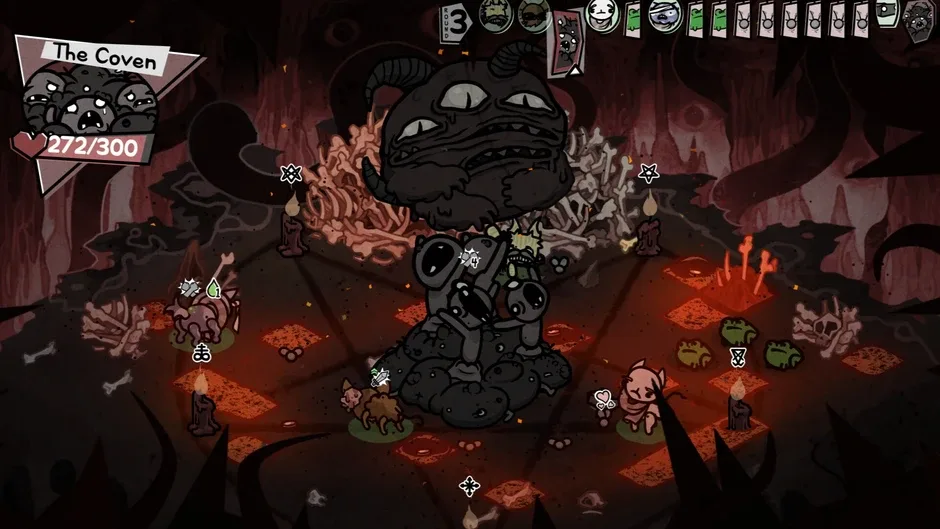
What makes Mewgenics different#
The one idea that carries the whole design is that your build is not a character sheet, it is a family tree. Most roguelikes hand you a single avatar and ask you to make good choices about what that avatar picks up along the way. Mewgenics instead asks you to make good choices about who breeds with whom, and lets the consequences of that choice show up two or three generations later, in cats you have not even hatched yet when you make the decision. A trait that looks marginal on one cat can become the backbone of an entire strategy once it is paired correctly and passed down consistently. That turns breeding menus, usually the least interesting screens in any game with an animal-collecting hook, into some of the most consequential decisions in the whole run.
This is also why the game reads as a genuine evolution of McMillen's design instincts rather than a retread of The Binding of Isaac wearing a different skin. Isaac was built on the tension of a single fragile run, where every item pickup could make or break the attempt you were currently on. Mewgenics keeps that fragility, but stretches it across generations instead of concentrating it into one character. Losing a cat still stings, but losing a cat whose traits you spent several litters cultivating stings in a way that a single roguelike death rarely does, because the investment was measured in breeding decisions rather than minutes played.
Breeding and genetics: the actual weapon#
The genetics system is the part of Mewgenics that does the most work, and it is also the part that takes the longest to click. Traits are inherited rather than randomly rolled fresh each time, which means the game rewards players who treat breeding as a long-term project instead of a one-off decision made in a menu between fights. A useful trait paired with the wrong partner can vanish from the bloodline entirely, while the same trait bred carefully across a couple of generations can become the defining feature of your whole roster. There is a real satisfaction in watching a lineage you deliberately shaped start winning fights that an earlier, less considered litter would have lost.
The cost of that depth is that the early hours ask for patience that a lot of roguelikes do not demand. Tracking which traits came from which parent, and which combinations are worth repeating, takes real attention before it starts to feel like strategy rather than bookkeeping. Players who are used to roguelikes where the run's build is disposable and forgettable the moment it ends will need to adjust to a game that wants its decisions to matter across multiple runs, not just within one.
Turn-based battles and drafted abilities#
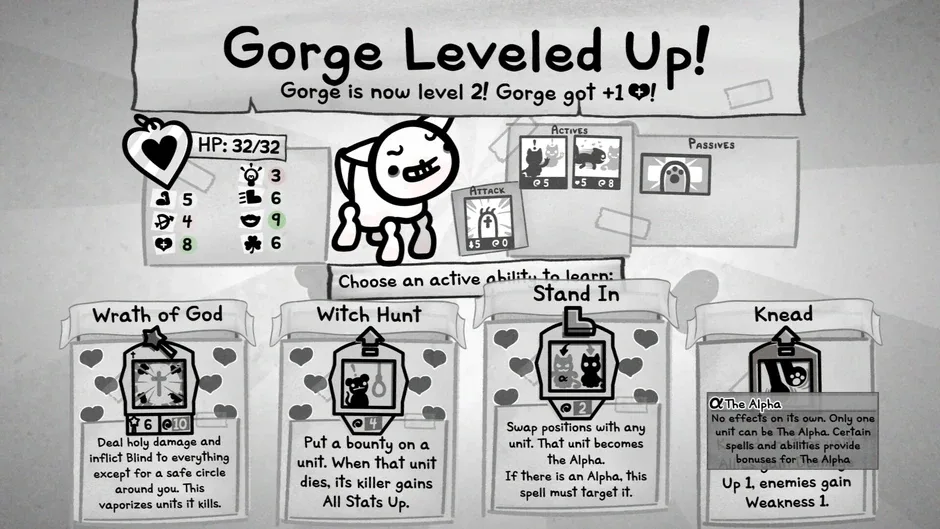
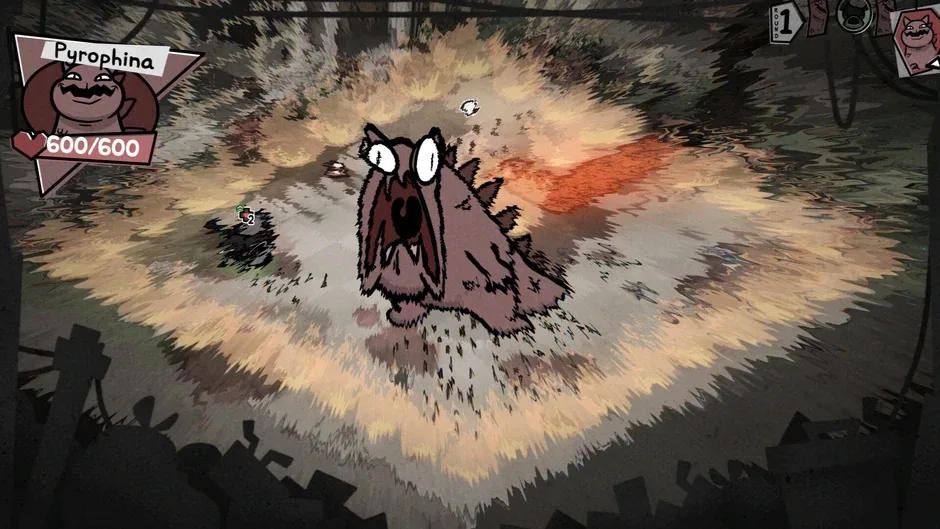
Combat happens in turn-based adventures, and the abilities available to your cats change from run to run through a drafting process rather than a fixed skill tree. That drafting is what keeps the tactical side of Mewgenics from feeling like a rehearsal of the same fight with better numbers. Because the ability pool shifts between attempts, the same bred lineage can play very differently depending on what gets offered during the draft, which forces you to adapt a strategy you might otherwise have wanted to lock in and repeat.
The turn-based structure itself rewards reading the board rather than reacting quickly, which is a deliberate change of pace from the twitch-reflex combat McMillen's earlier games are known for. Positioning, item combinations and the abilities drafted into a given run matter more than raw stats, and battles are won by setting up the right sequence of moves rather than by simply having a stronger cat. That is a good fit for a game whose central hook is long-term planning, since it means the moment-to-moment decisions inside a battle are asking the same kind of question the breeding menu is: what combination of pieces gets the best result from what you currently have.
Items and the space between runs#
Collected items sit alongside drafted abilities and inherited traits as the third layer of Mewgenics' systems, and the game leans on all three at once rather than letting any single one carry the whole strategic weight. That layering is a double-edged design choice. It means a bad draft of abilities can sometimes be offset by a strong item find, or a weak item run can be salvaged by a particularly well-bred litter, which keeps individual runs from feeling like a dead end the moment one system fails to deliver. It also means new players are absorbing three interlocking systems at once, on top of a genetics mechanic that is already asking for patience, and the game does not shorten that learning curve for the sake of a faster introduction.
Where this pays off is in the way runs stop feeling interchangeable. A roguelike with a single system to master tends to produce runs that blur together after enough repetition. Mewgenics avoids that by making sure a run's identity is set by three separate, overlapping decisions rather than one, and that variety holds up even after a considerable number of attempts.
Permadeath, generations and what a "loss" means#
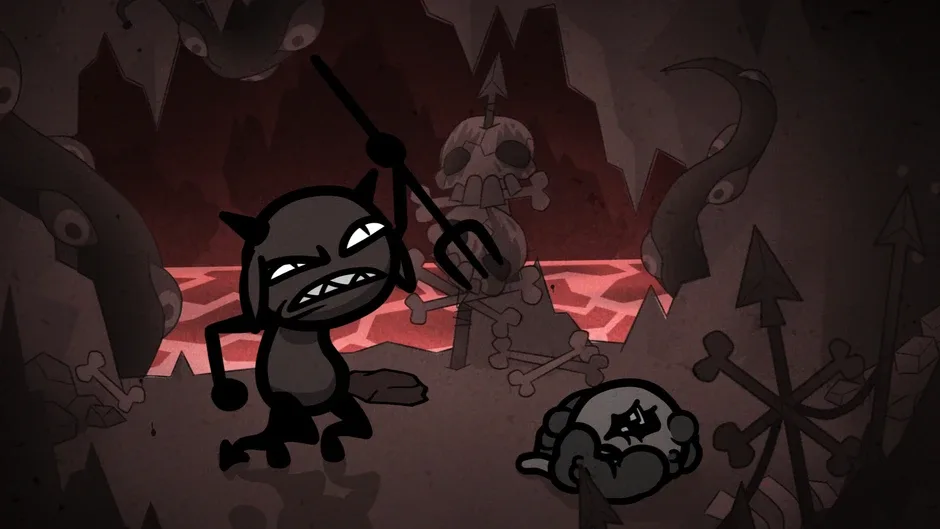
Death in Mewgenics does not simply reset a run back to a menu screen the way it does in most roguelikes. Because individual cats carry genetic value that took multiple litters to build, losing the wrong cat at the wrong moment is a setback measured in generations rather than in minutes. That is either the game's most interesting design decision or its most punishing one, depending on how much you enjoy long-term investment in a system that can be undone by a single unlucky turn. It gives the tactical battles a weight that a purely disposable roguelike character never quite achieves, because you are not just protecting a run, you are protecting a bloodline you deliberately built.
It is worth being direct about the tradeoff here: the same permadeath that makes victories feel earned also means that a promising lineage can be erased by circumstances outside your control in that specific battle. Players who want every attempt to feel low-stakes and forgettable should expect Mewgenics to ask more of them emotionally than that.
Difficulty and pacing across a long campaign#
Difficulty in Mewgenics is not a single slider so much as the sum of every decision that came before the fight you are currently in. A well-bred lineage with a strong draft can make an adventure feel almost effortless, while a rushed litter thrown into battle without a coherent plan can turn the same adventure into a rout. That is a deliberate design choice rather than an oversight: the game wants the difficulty you experience to be a reflection of the planning you did between runs, not a fixed curve applied uniformly to every player regardless of how they approached breeding.
The pacing that results from this is uneven in a way that is mostly a feature rather than a flaw. Early runs, before you have a strong grasp of which traits are worth chasing, can feel harder than they should, simply because the genetics system has not yet given you enough information to make good breeding decisions. Later runs, once a few reliable bloodlines are established, can swing the other way and feel comfortable for a stretch before the drafting system introduces an unfamiliar combination of abilities that forces you to rethink an approach you had grown confident in. That rhythm, comfortable stretches interrupted by genuine surprises, is what keeps a roguelike built around long-term systems from becoming predictable, even across a large number of attempts.
It is also worth noting that the difficulty curve rewards a kind of patience that some players will find more satisfying than others. There is no way to shortcut the genetics system by simply playing more aggressively or more skilfully in individual battles; the tactical skill on display in a single turn-based adventure matters, but it is capped by how well the breeding decisions leading up to that adventure were made. Players who enjoy a slow-burn strategic layer sitting underneath the moment-to-moment combat will find that pacing rewarding. Players who want mastery of combat alone to be sufficient for progress may find themselves frustrated that a strong bloodline matters as much as, or more than, a strong hand in any single fight.
New to tactics roguelikes? Start here#
Mewgenics is not the gentlest entry point into either roguelikes or tactics games, precisely because it asks you to hold two unfamiliar systems, breeding and drafting, in your head at the same time. The most useful adjustment for a newcomer is to treat the first several runs as scouting rather than winning: pay attention to which traits keep showing up as useful in battle before committing heavily to breeding any one lineage, and treat early losses as information about the genetics system rather than as failures to be avoided. Players coming from turn-based tactics games without a roguelike's run structure should expect the genetics layer to take longer to click than the combat does; the combat can be picked up in a handful of adventures, but breeding strategy reveals itself over several generations.
Compared to Into the Breach and Darkest Dungeon#
Into the Breach is the tighter, more deterministic tactics game, one where every enemy telegraphs its next move and a perfect player can, in theory, solve a level completely. Mewgenics is looser and more systemic: outcomes depend on genetics and drafts you only partially control, and the game is comfortable with a wider range of possible results from the same starting position. If you want a tactics puzzle you can eventually master to near-perfection, Into the Breach's precision will suit you better. If you want a system that keeps generating new problems for you to solve because your own roster keeps changing shape, Mewgenics is the better fit.
Darkest Dungeon is the closer cousin in spirit, since it also treats your roster as an evolving resource rather than a fixed party, and it also uses permadeath to make attachment to specific units a real cost. Where the two differ is in what drives that roster's evolution: Darkest Dungeon's characters change through stress and affliction accumulated during runs, while Mewgenics' cats change through breeding decisions made deliberately between them. That makes Mewgenics feel more proactive, since you are shaping the next generation on purpose, rather than reactive to whatever a run inflicted on your party. Fans of Darkest Dungeon's long-term roster management will recognise the appeal here even though the specific mechanics are quite different.
Neither comparison is quite exact, and that is the point worth making about Mewgenics on its own terms. It borrows the roster-as-resource feeling from Darkest Dungeon and the puzzle-like clarity Into the Breach applies to individual turns, but it does not fully commit to either. The genetics layer is doing something neither of those games attempts: turning the space between runs into a design problem of its own, rather than treating that space as a simple shop or upgrade screen. Whether that makes Mewgenics better or simply different from either reference point will depend on how much a player values that in-between planning phase relative to the fighting itself.
Worth the money?#
Mewgenics launched for PC first, in February 2026, with the console versions on Switch 2, PlayStation 5 and Xbox Series X|S following about seven months later in September. That gap is worth knowing about if you are choosing a platform: the PC version has had significantly more time to receive patches and community feedback, which is generally the safer starting point if you are not tied to a specific console. The strongly positive Steam user reviews and the strength of the first-week sales figures both point to a game that is landing well with the roguelike and tactics audience it is aimed at, which is a reasonable signal of value even without a specific price point to weigh against playtime, since a genetics-and-breeding roguelike is built to be replayed across many runs rather than finished once.
Given the breeding-across-generations structure, this is not a game designed around a single playthrough. Its value proposition is closer to a long-term strategy game than a story-driven one: the more runs you put in, the more the genetics system has room to pay off, and a single short session is unlikely to show what the game is actually good at.
That also shapes how the value question should be framed. A player weighing Mewgenics against a shorter, more linear game should expect the hours to arrive gradually, spread across many returns to the same colony of cats rather than a single continuous sitting toward credits. Anyone drawn to games they can dip into for a run or two at a time, then leave and return to later without losing the thread, since bred lineages carry forward between sessions, will likely get more mileage out of the purchase than someone hoping to finish it in a single concentrated weekend.
Play this instead if…#
Shorter: Into the Breach delivers a complete tactics experience in a handful of hours per run, with none of the generational planning Mewgenics asks for.
Easier: The Binding of Isaac, McMillen's earlier roguelike, trades genetics and turn-based tactics for fast, reflex-driven runs that are easier to pick up and put down.
Cheaper or simpler systems: Darkest Dungeon offers a similar sense of managing a roster you have grown attached to, with permadeath doing similar emotional work, but without the breeding layer to learn on top of the combat.
Frequently asked questions#
How long does a run of Mewgenics take? The turn-based adventures that make up a run are designed to be completed in a single sitting, though the genetics system is built to reward playing many runs in sequence rather than a single long session.
Do I need to understand genetics or breeding games to enjoy it? No prior knowledge is required. The traits and inheritance rules are specific to Mewgenics' own systems, though the underlying idea, breed for traits you want to keep, is intuitive once a few litters have been raised.
Is there permadeath? Yes, at the level of individual cats, and because traits are inherited across generations, losing a well-bred cat is a setback that carries forward rather than resetting cleanly.
Which platforms is it available on? PC via Steam since 10 February 2026, and Nintendo Switch 2, PlayStation 5 and Xbox Series X|S since 8 September 2026.
Is this connected to The Binding of Isaac? Not narratively. Edmund McMillen is the creator of both, and the tone carries some of the same visual identity, but Mewgenics is a separate roguelike tactics game built around breeding rather than Isaac's item-collecting run structure.
Does the game reward long-term play over short sessions? Yes. Because traits carry forward through breeding across many litters, the systems are built to pay off over a series of runs rather than a single attempt.
The Game Avant verdict#
Mewgenics succeeds at the one thing that mattered most for a game built on this premise: it makes genetics feel like a real strategic system rather than a theme slapped onto a standard roguelike loop. Breeding decisions carry weight because their consequences show up generations later, drafted abilities keep individual runs from repeating themselves, and turn-based battles ask you to plan rather than react. The cost of that ambition is a first few hours that ask for more patience than the genre typically demands, and a permadeath system that can occasionally erase progress that took real thought to build. Those are real friction points, not fatal ones. A million-plus copies sold in a single week and consistently strong user reception suggest the audience for a slower, systems-driven roguelike is larger than it might look on paper, and the design earns that reception rather than just riding a well-known creator's name into it.
8 out of 10 – a roguelike tactics game that treats genetics as the real build system, and mostly proves the idea was worth building a whole game around.