

A bunker where the lights are the whole game#
Amnesia: The Bunker is Frictional Games' fourth entry in the series and the first one built around a single, semi-open space instead of a chain of scripted rooms. Developed and published by Frictional Games, it released on 6 June 2023 for Windows, PlayStation 4, Xbox One and Xbox Series X|S, with a Nintendo Switch port following through Abylight Studios in 2025. It is a prequel to Amnesia: Rebirth, set on the Western Front in 1916, and it drops the sanity meter that defined the earlier games in favour of something more mechanical: a generator, a fuel gauge, and a monster that behaves differently depending on whether the lights are on. That single swap changes more about how Amnesia plays than any sequel in the series has before it.
What makes The Bunker different#
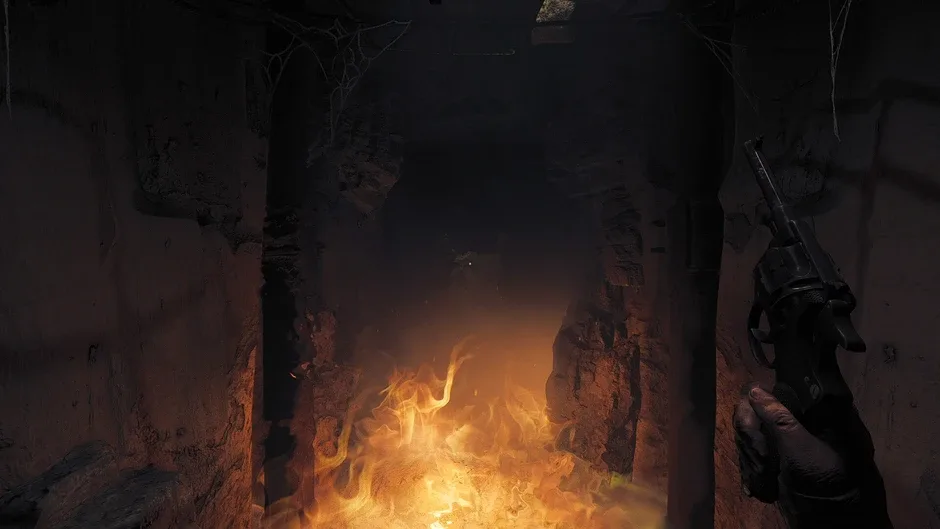
The one idea the whole game is built on is that light is a resource you manage, not a state you hide in. French soldier Henri Clément wakes up alone after an artillery blast separates him from his squad, and the underground bunker he is trapped in still has power, as long as its generator has fuel. Switching it on floods the corridors with a dim, steady light, keeps most of the bunker's rooms safe, and pushes back the creature stalking its tunnels. Fuel runs out. When it does, every light in the map dies at once, and the Beast is free to hunt through the whole bunker rather than avoid the lit sections. The tension in The Bunker is rarely "is something behind me"; it is "how much fuel is left, and is it worth spending five minutes running to the generator room to top it up before it runs dry in the room I actually need to search."
That decision runs through everything else Henri does. Fuel canisters are scattered, sometimes randomised, across the bunker's storage rooms, barracks and flooded tunnels, and every trip to refill the generator is also a trip that could end with Henri hearing the Beast's claws in the walls above him. The game never tells you exactly how much time is left before the tank runs dry; you learn to read the gauge and gamble on one more room before heading back. It is a small piece of systems design that replaces the previous games' invisible sanity number with something you can see, plan around, and, crucially, fail at through your own miscalculation rather than bad luck.
The Beast: Augustin Lambert's transformation#
The monster is not a nameless threat. Before the story begins, Henri crosses No Man's Land to rescue his friend Augustin Lambert, a fellow soldier trapped in a shell crater, and gives him water from a tunnel beneath the bunker to keep him alive. That water carries something older than either of them understands, and by the time Henri wakes up inside the bunker, Lambert has been transformed into the creature now killing everyone still stationed there. Finding letters, tags and journal entries from soldiers such as Sdt. Tremblay, Lambert's former bunkmate, and Sdt. Charles Lavoie slowly fills in what happened to the rest of the garrison while Henri was unconscious, and the reveal that the Beast used to be a specific, named friend gives the chase sequences a weight that a generic zombie or ghoul would not have earned.
Mechanically, the Beast hunts by sound rather than sight. Sprinting, gunfire, breaking down a door, even a dropped item, all draw it toward the noise, and it moves through the bunker's own structure, skulking behind walls and under floors rather than patrolling fixed routes. It dislikes light and avoids well-lit rooms while the generator is running, which means the smartest way to deal with it is rarely to fight; it is to control how much noise Henri makes and how far he is from a lit room when he makes it. Where the design falters is in the second half, once the pattern is learned. The Beast reacts consistently enough that experienced players can predict and route around it well before the credits, and by the final stretch it reads less like an unstoppable stalker and more like a hazard to be managed on the way to the next objective.
Tools, crafting and a revolver that changes the formula#
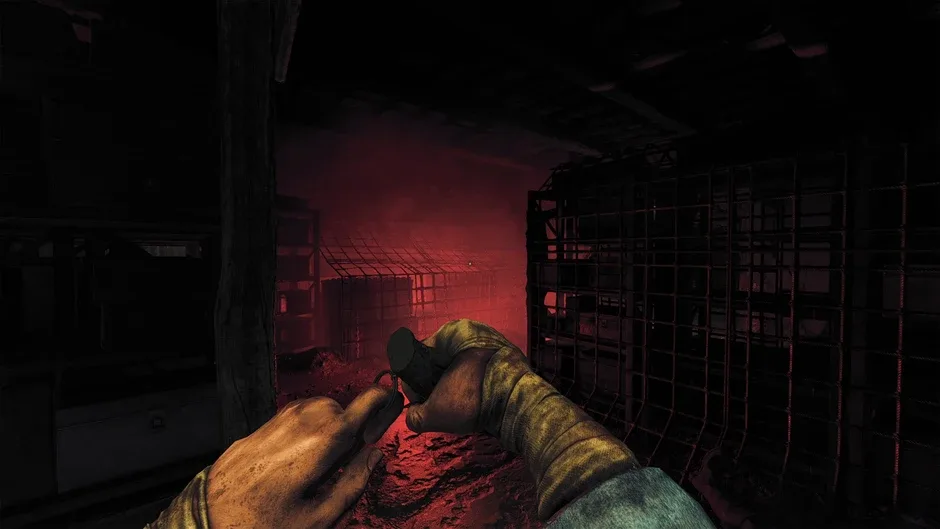
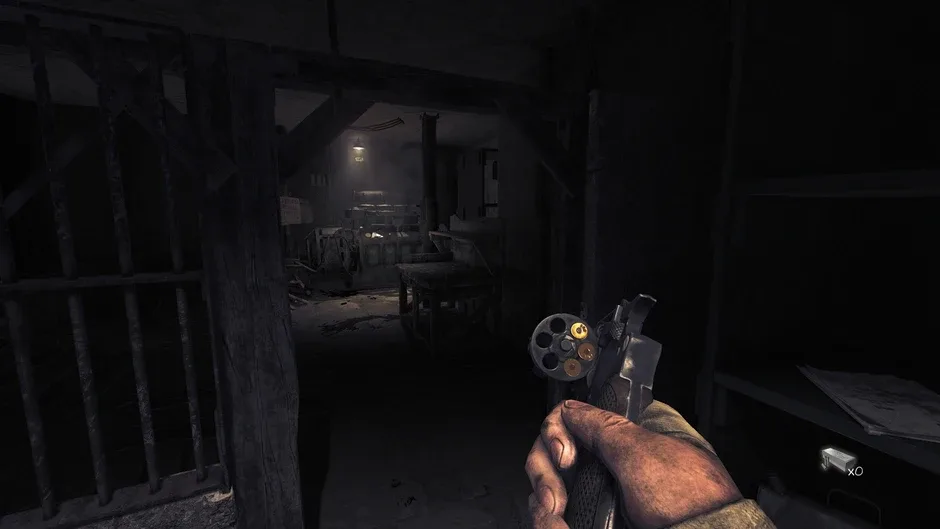
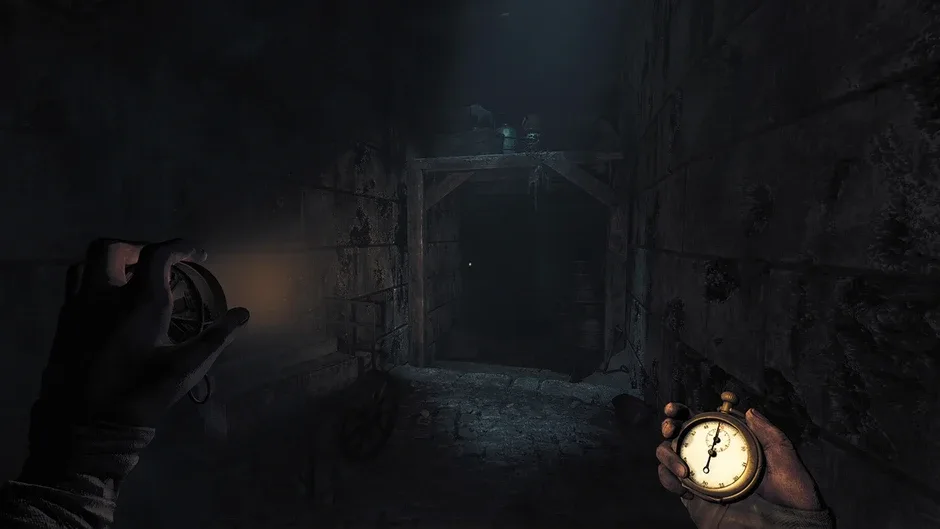
The Bunker is the first mainline Amnesia game to hand the player a working firearm from early on. Henri carries a revolver with limited ammunition, alongside flares that light an area and can be thrown to distract the Beast, molotov cocktails that can be crafted at workbenches from scavenged fuel and cloth, and grenades found in ammunition caches. None of it makes Henri powerful. The revolver can drive the Beast off for a few seconds at best, and using it is loud enough to draw every other threat in earshot, so the real skill is knowing when spending a bullet is worth the noise it makes. A hand-cranked flashlight and a lighter round out the toolkit as personal light sources that do not depend on the generator, each with its own limits: the flashlight needs to be wound by hand mid-use, and the lighter's small flame barely reaches past an arm's length.
This is where the earlier criticism of the series, that hiding under a desk for a scripted chase sequence gets old, mostly disappears, replaced by a new one: combat can tip into simple crowd control once a player has stocked up on grenades and molotovs, and a few late encounters feel more like clearing a room than surviving one. The crafting system itself is satisfying in its restraint. There is no skill tree and no upgrade path, just combinations of a handful of raw materials at a handful of workbenches, which keeps the loop focused on scavenging and decision-making rather than inventory management for its own sake.
Sound design: the ear is the real weapon#
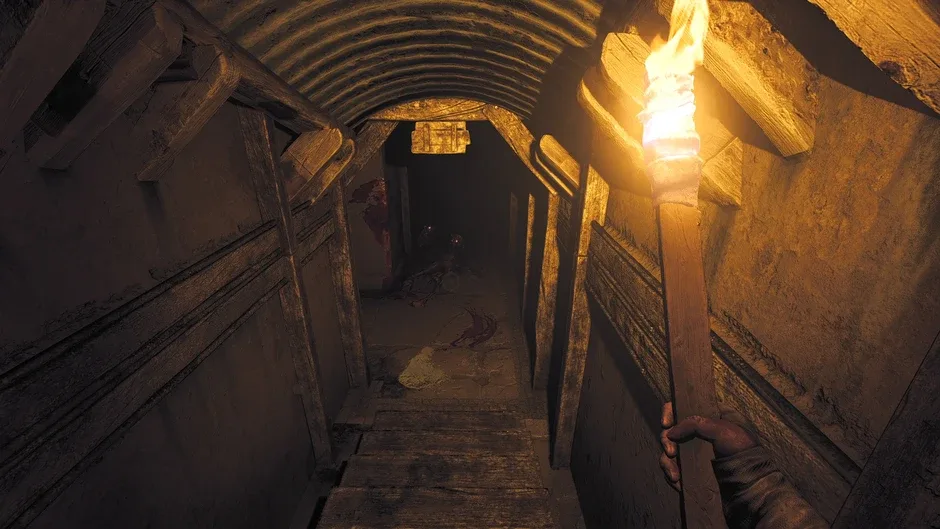
Because the Beast hunts acoustically, The Bunker's sound design is doing as much work as its lighting system, and it holds up under scrutiny. Henri's own footsteps change pitch and volume depending on surface, a wooden floor telegraphs a careless sprint far more loudly than packed dirt, and the game leans on this constantly: crouching through a flooded tunnel to avoid splashing, easing a door shut instead of letting it slam, timing a dash for the moment a nearby explosion outside covers the noise. The watch Henri carries ticks audibly, a small, constant reminder that time and fuel are both running down, and the ambient mix underground, dripping pipes, distant artillery from the war above, the occasional scrape of something moving through a wall cavity, rarely resorts to a musical sting to signal danger. Most of the time, there is no music cue at all, just the sound design telling you the Beast is close enough to matter.
That restraint is also where the tension eventually thins out. Once a player learns which specific sounds draw the Beast and which do not, the audio stops feeling unpredictable and starts feeling like a set of rules to route around, which is efficient but less frightening than the uncertainty of the first couple of hours. It is the same trade-off the AI itself makes: legible enough to be fair, at the cost of some mystery once it has been solved.
The bunker itself: a hub, not a corridor#
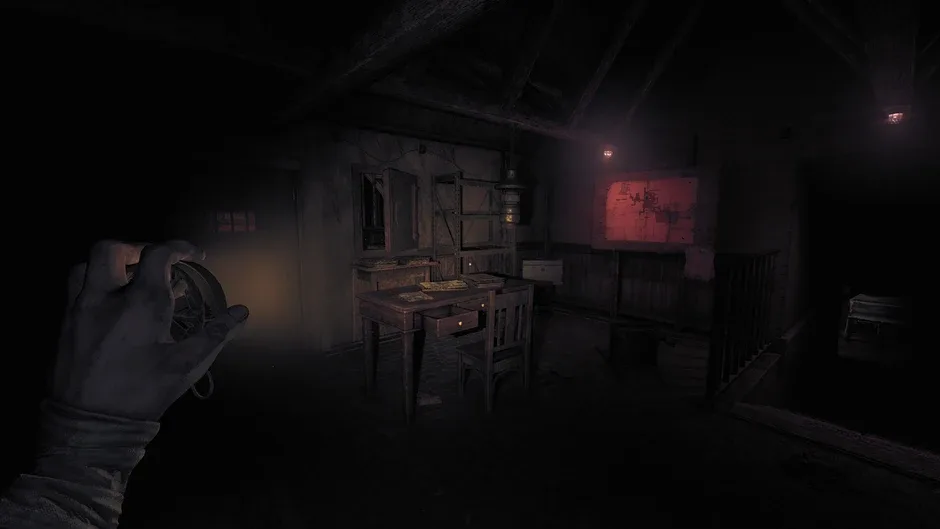
Structurally, The Bunker abandons the linear room-to-room design of Amnesia: Rebirth for a single interconnected map: barracks, a mess hall, a flooded lower level and a series of tunnels that all loop back toward a handful of safe rooms. Each safe room lets Henri save his progress, and at least one holds a storage chest for excess supplies and a wall map that fills in as new areas are explored. Because the layout is fixed but the placement of fuel, ammunition and key items is partly randomised between playthroughs, a returning player still has to search rather than simply recall a memorised route, which is a large part of why a second run through the bunker feels meaningfully different from the first.
The downside of a semi-open hub built around a handful of connecting corridors is that early exploration can feel repetitive before the map fully opens up: the first hour or so involves circling back through the same few junctions while learning where the generator, the main storage room and the first safe room sit relative to each other. Once that mental map settles in, usually inside the first hour, the space starts to feel less like a maze and more like a home base under siege, which is exactly the shift the design is aiming for.
Small touches keep the bunker itself readable as a place rather than a level. Signage on doors, painted unit numbers on barrack bunks, a mess hall with actual place settings and a chalkboard menu, all of it sells the idea that dozens of soldiers were living here days ago, not that a level designer built a horror set. A destroyed section connecting to the tunnels beneath, the same tunnels Henri drew water from before the story began, ties the bunker's geography directly back to the opening flashback rather than treating it as a separate horror-game location bolted onto a war story.
Difficulty and randomisation#
The Bunker offers a single core difficulty in the sense that there is no easy or hard mode toggle, but the randomisation of item placement functions as its own kind of difficulty variance: a run where the revolver ammunition and fuel canisters cluster near the starting safe room plays noticeably easier than one where they are scattered toward the flooded lower level. Two distinct endings are available depending on choices made in the final stretch, which gives a completed run a reason to be replayed once, though neither ending meaningfully changes what came before it. For players who found the sanity mechanic in Amnesia: The Dark Descent and Rebirth stressful in the wrong way, constantly checking a hidden meter rather than making a visible decision, The Bunker's generator and fuel gauge are a more legible, more forgiving version of the same core tension.
The two endings hinge on how Henri chooses to leave the bunker rather than on a moral scale tracked throughout the run, and both are reachable within the closing stretch without needing choices made hours earlier, which keeps the game from punishing a first playthrough for not knowing what the ending requires. That is a deliberate trade-off: it makes the endings easy to see on a second run without replaying the whole game from scratch, but it also means neither ending recontextualises the earlier hours the way a longer, more heavily branching horror game might.
Compared with Alien: Isolation and Amnesia: Rebirth#
Alien: Isolation is the clearest reference point for what The Bunker is trying to do: a single persistent stalking threat with genuinely reactive AI, hunting by noise through a mostly fixed space, forcing the player to manage resources rather than memorise scripted scares. Isolation's Alien is a more consistently terrifying threat across its full runtime, in part because it is a roughly 15-to-20-hour game with room to keep escalating; The Bunker compresses the same idea into four to six hours, which means the tension peaks earlier and cannot be stretched as far before the Beast's patterns become familiar. Amnesia: Rebirth, the previous entry and the story this game leads into, is the better choice for anyone who wants the series' traditional sanity-and-hide loop and a more heavily scripted, story-forward pace; The Bunker trades that for a shorter, systems-driven experience where the story is found in letters and tags rather than cutscenes, and where survival is a spreadsheet of fuel and ammunition as much as it is a hiding spot.
The comparison also cuts the other way. Isolation gives the player almost no tools to fight back, which keeps its Alien feeling genuinely unbeatable for its entire runtime; The Bunker's decision to arm Henri is the more generous, more approachable choice, but it is also the reason the Beast eventually reads as manageable rather than inevitable. Neither approach is simply better. A longer game can afford a threat with no counterplay; a four-to-six-hour game arguably needs to give the player some agency, or the whole run risks feeling like a string of unwinnable ambushes rather than a horror game with a real skill curve.
Worth the money?#
At its base price of $24.99, The Bunker asks for less than most full-priced horror games and delivers a tighter experience to match: a first playthrough runs four to six hours, a completionist pass hunting every dog tag and cupboard stretches to around eight, and a second run, once the layout is familiar, can be finished in roughly two. That ratio of price to focused, replayable content is a good one, especially since the randomised item placement means a second and third run are not simply faster repeats of the first. The game is regularly discounted well below its base price within a year or two of release, which makes waiting for a sale a reasonable option for anyone not planning to play at launch. It is available on PC, PlayStation, Xbox and, since the 2025 port, Nintendo Switch, and English voice acting and subtitles are standard across all versions. The Switch version in particular makes sense for a game this length: a bunker crisis fits into a commute or a lunch break far better than a sprawling open-world horror game would, and the fixed core layout means the drop in resolution on a handheld screen rarely costs the player a piece of information they actually need.
Play this instead if…#
Shorter: Visage's haunted-house sections offer a tighter two-to-three-hour scare with a similar emphasis on hiding and scarcity, without the generator and crafting layer.
Easier: Amnesia: Rebirth trades the fuel-management pressure for a more linear, story-forward horror game with a gentler resource curve.
Cheaper or co-op: Phasmophobia is built for co-op investigation from the outset, swaps the Beast for AI-driven ghosts, and is frequently available well below The Bunker's price, though its horror comes from cooperative panic rather than the Beast's solitary dread.
Frequently asked questions#
How long is Amnesia: The Bunker? A first playthrough runs roughly four to six hours, a full completionist pass around eight, and a subsequent replay closer to two once the bunker's layout is familiar, which makes it one of the shortest entries in the series to date.
Is it open world? No. It is a semi-open, interconnected bunker map rather than a fully open world, with a fixed layout but partially randomised item placement between playthroughs.
Does it have combat? Yes, for the first time in a mainline Amnesia game. Henri can use a revolver, flares, molotov cocktails and grenades, though the game is built around avoiding fights more than winning them.
Is there a difficulty option? No separate difficulty modes, but the randomisation of item and fuel placement changes how forgiving a given run feels.
Do you need to have played the earlier Amnesia games? No. The Bunker is a prequel to Amnesia: Rebirth and stands alone with its own protagonist and setting, though it rewards familiarity with the series' tone.
Is there voice acting and subtitles in English? Yes, on every platform the game has released on.
Can the Beast be killed permanently? No. It can be driven off with light, noise or fire for a short window, but it is a persistent, unkillable threat for the entire main story, in keeping with how the series has always treated its monsters.
The Game Avant verdict#
Amnesia: The Bunker takes the series' oldest trick, an unbeatable monster in the dark, and rebuilds it around a system a player can actually reason about: a generator, a fuel gauge and a revolver that turns survival into a series of calculated risks rather than a scripted gauntlet. For its first two or three hours, that combination produces some of the tensest horror Frictional has made since Amnesia: The Dark Descent. The cost of compressing an Alien: Isolation-style stalker into a four-to-six-hour game is that the Beast's patterns become readable well before the credits, and a revolver plus a stock of molotovs eventually turns a few late encounters into crowd control rather than dread. Neither issue undoes what the generator and the randomised bunker get right. This is Frictional's most replayable game, and one of its scariest for as long as the fuel gauge is doing the talking.
8 out of 10 – a systemic, replayable reinvention of Amnesia horror that runs out of new tricks slightly before it runs out of fuel, and still lands as one of the tensest few hours Frictional has ever built.