

A game about talking, made by people who understand silliness#
Big Walk is a cooperative multiplayer adventure that the Steam page sums up as a game about teamwork and talking. That sounds like a slogan until you look at what the game is made of. Proximity voice chat, a set of gestures, a handful of gadgets and a large open world make up almost the entire design. The listed feature set contains no health bar to manage and no build to optimise. The mechanic is the conversation between the people in the group, and the world exists to give that conversation something to do.
Big Walk was developed by House House, the studio behind Untitled Goose Game, and published by Panic. It released on 4 August 2026 as a full release, not early access, for Windows and macOS, with crossplay between players. It costs 18.99 euros on Steam. Game Avant scores it 9 out of 10, and the reason is simple: it commits to a single idea without hedging, and that idea is more original than most of what the co-op genre has produced in years.
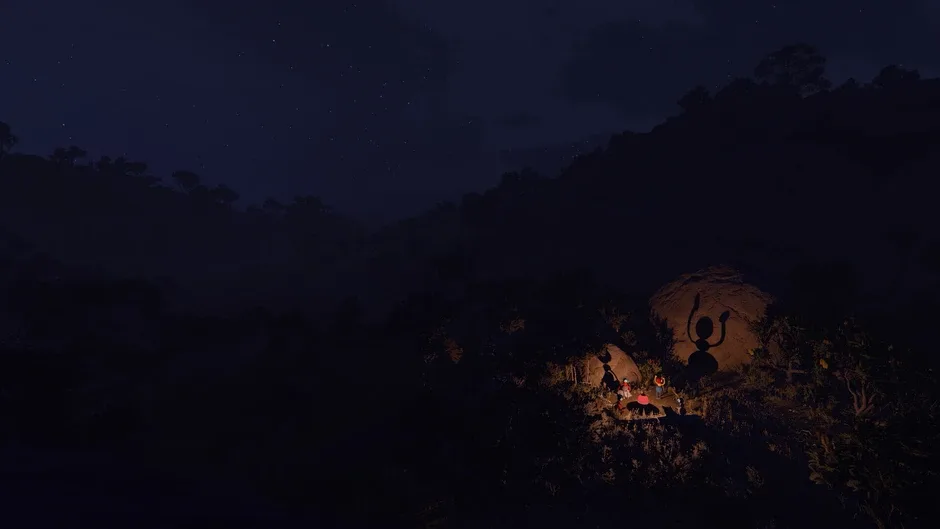
What makes Big Walk different#
Most co-op games hand a group a shared enemy and let the teamwork happen as a side effect. Someone calls out a flank, someone else shouts for a heal, and the talking serves the shooting. Big Walk reverses the order. The talking is the point, and everything else is arranged to make talking interesting. The store page describes a place to hang out and get lost with close friends in a big world, and the design follows that sentence closely.
The clearest sign is the voice chat. It is proximity based, and the game applies realistic audio effects: voices fade with distance, echo in open spaces and muffle when there is a wall in the way. That sounds like a technical detail, but it changes what a conversation is. In an ordinary co-op game, voice chat is a global channel that ignores the game world. Here, the voice channel is the game world. A friend who walks over a hill becomes quieter. A friend behind a structure becomes muffled. To reach someone who has wandered off, you have to move, shout or use a tool, and each of those choices is a small decision that the game turns into a scene.
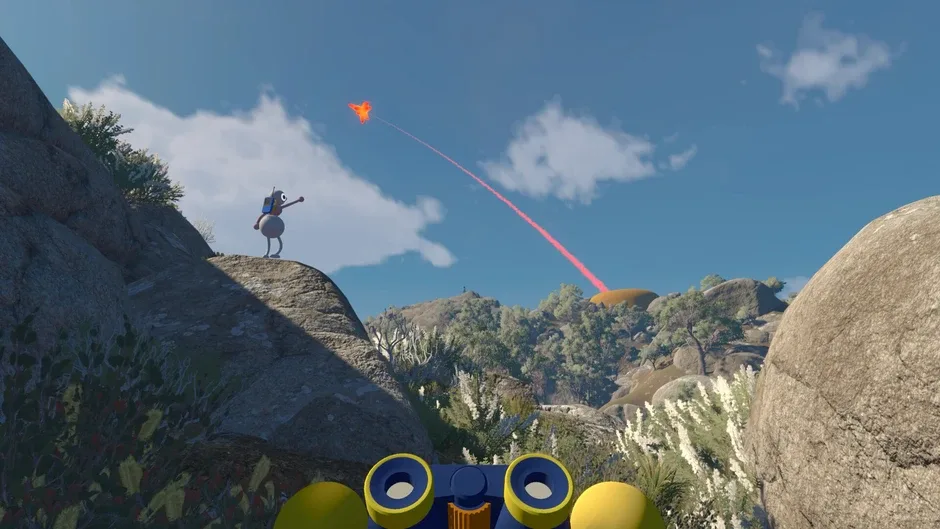
The second half of the idea is the toolkit. Walkie-talkies, binoculars, megaphones, flares, whiteboards and cowbells are all named on the store page, and together they read like a list of things a group of friends might bring on a real outing. Every one of them is a communication device. The walkie-talkie beats the distance problem. The megaphone beats the crowd problem. The binoculars turn looking into a shared job, since one person can see something the others cannot. The flare and the cowbell are signals. The whiteboard lets a group draw an idea instead of describing it. Nothing in that list is a weapon, and that absence is the design statement.
Proximity voice chat: distance as a design tool#
Proximity voice has existed in games for years, usually in horror or survival games where the goal is to make silence tense. Big Walk uses the same technology for the opposite mood. Instead of using distance to make a group feel isolated and nervous, it uses distance to make a group feel like a group in a place. Two players standing near each other talk normally. A third player fifty metres away is a voice on the wind. A fourth player inside a building is a mumble behind a wall. The audio effects the store page lists, fading, echoing and muffling, are what make that layering believable.
The practical result is that the group has a shape at any given moment, and the shape changes constantly. Players drift together to trade jokes, spread out to search, regroup when someone finds something, and drift apart again. A game that gave every player a permanent open channel would flatten all of that into a single blob of chatter. By making sound behave like sound, the game lets a group feel the difference between being together and being spread out, and it makes the reunion mean something.
There is also a quieter benefit. Proximity voice gives every player a natural way to have a private conversation inside a public group. Two friends can walk ahead and talk without the other ten hearing every word. That matters in a game meant for social hanging out, because real social time is full of side conversations, and a single global channel does not allow them.
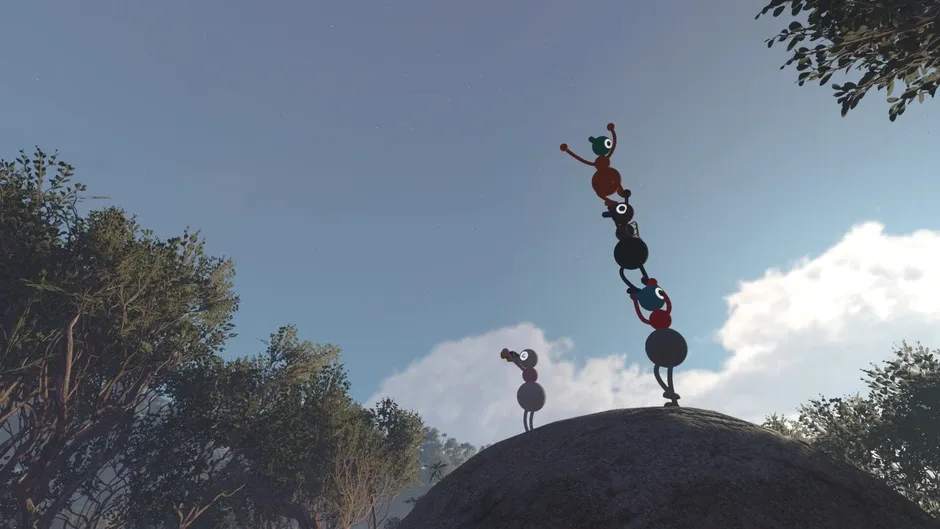
Gestures and gadgets: talking without words#
Voice is the main channel, but the store page also lists a gesture system for non-verbal communication: pointing, waving and flailing. It is easy to underestimate how much a small gesture set does for a social game. Pointing is the cheapest possible piece of information sharing: look over there. Waving is a greeting across a distance where voice will not carry. Flailing is a joke, a panic signal and a celebration in one motion. Those three verbs cover an enormous share of what people do with their arms when they talk in person, and giving them a place in the game keeps the players from feeling like disembodied microphones.
This is where the studio's background shows. House House became known for a game built almost entirely from physical comedy, and the tendency to find humour in bodies, objects and timing is visible in the description of this game as well. The tags on the store page include funny and relaxing, and the tool list backs that up. A cowbell is not a serious navigation instrument. A megaphone in a quiet field is a punchline waiting to happen. The whole toolkit is pitched at a tone somewhere between a camping trip and a slapstick routine, and that tone is a deliberate choice, not an accident.
A big open world, at your own pace#
The world is described as an open environment where players explore at their own pace. That phrase carries a lot of weight, because it rules out the structure that many open-world games fall back on: a map full of markers, a task list, a progress bar. The game is pitched around getting lost, and getting lost only works if the game does not immediately rescue you from it.
An open world built for a group rather than a single player has its own logic. A solo open world has to keep one player entertained at every step. A cooperative one can lean on the players to entertain each other, which means the space itself can afford to be quiet. A long walk across open ground is a chore for a lone player and a conversation for a group of friends. The tags on the store page, exploration, relaxing, open world and first person, all describe this approach. The first-person view is worth a mention for its own sake, because it places the player at eye level in the world, where fading voices and distant figures read more naturally than they would from a third-person camera.
The design also invites the group to make its own stories. When nothing forces a route, a group chooses one, and the choice is a source of argument and comedy. Someone insists they know the way. Someone else has a bad feeling. A third player has already wandered off alone. Those small disputes are the raw material, and the game is smart enough to stay out of their way.
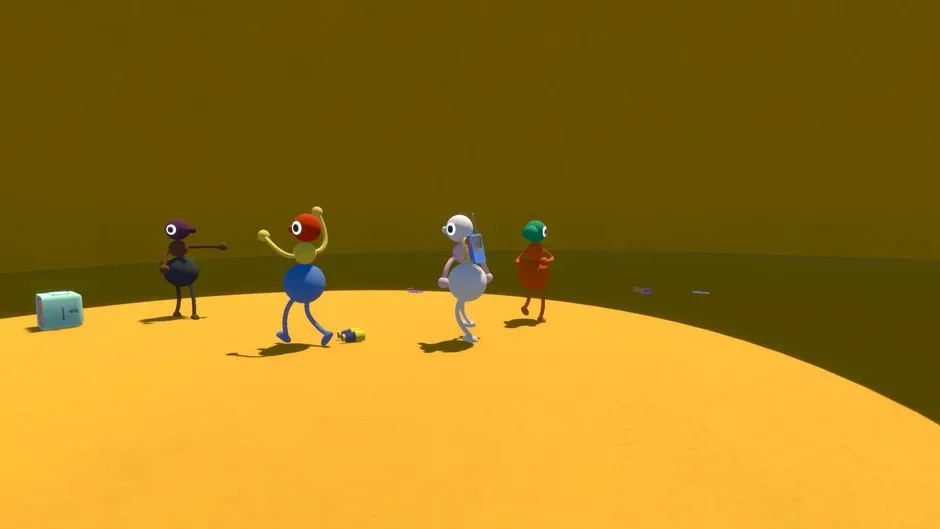
From two players to twelve#
The store page lists a flexible player count of 2 to 12, and that range is one of the most interesting facts about the game. Most co-op games pick a number and design for it: two for a duo, four for a squad. A range this wide means the same world has to work as an intimate outing for a pair of friends and as a chaotic field trip for a dozen.
At the low end, a pair has plenty of space and plenty of quiet. Proximity voice hardly matters when two people are always within earshot, but the size of the world matters a great deal, because two players can share a single long conversation and treat the landscape as a companion. At the high end, the dynamics flip. Twelve people cannot all fit into one conversation, so the group naturally breaks into clusters, and the distance-based audio starts to do serious work. A cluster can hold its own discussion while the rest of the group is a murmur in the background. A megaphone stops being a toy and becomes a genuinely useful way to address a crowd.
Crossplay support is a real advantage for a game built around friend groups. The people you want to play with rarely all own the same hardware, and a social game that splits a group by platform defeats its own purpose. The store page lists Windows and macOS as the platforms, with cross-platform multiplayer between them, which at least covers the two desktop ecosystems. Players on consoles are not covered by anything on the store page.
A hand-crafted campaign with an ending#
One detail sets Big Walk apart from a pure sandbox: the store page calls it a hand-crafted cooperative campaign with an ending. That matters. A social toy with no structure can be charming for an evening and forgotten by the weekend. A campaign with a beginning, a middle and a destination gives a group a reason to keep meeting, and it gives the open world a shape that a random scatter of landmarks could not.
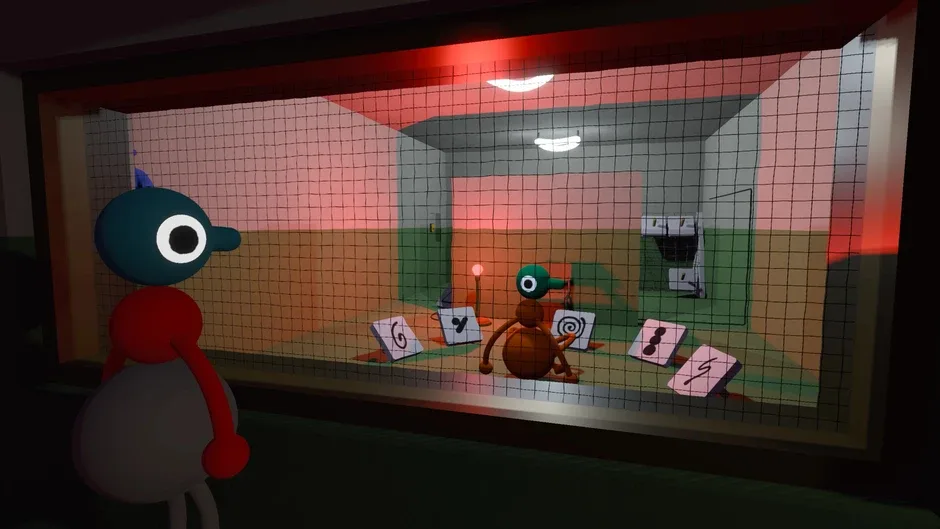
Puzzle appears among the tags, and it fits the premise. Puzzles in a cooperative game are one of the few designs where communication is genuinely required rather than optional, because each player sees or holds only part of the solution. The tool list points the same way. Binoculars imply that one player sees what another cannot. Whiteboards imply that information has to be recorded and shared. Walkie-talkies imply that players will be separated when they need to compare notes. The exact puzzles are best left for a group to discover, and Game Avant does not describe any specific one here, but the tools and tags make the general shape of the challenge clear.
An ending also means the game is finite, which is both a strength and a limit. It is a strength because a finite game can be paced, and the store page never suggests an endless live-service treadmill. It is a limit because a hand-crafted campaign does not renew itself. Once a group has seen the ending, the story is spent, although the freedom of the world and the group's own inventiveness may still make a second visit worthwhile.
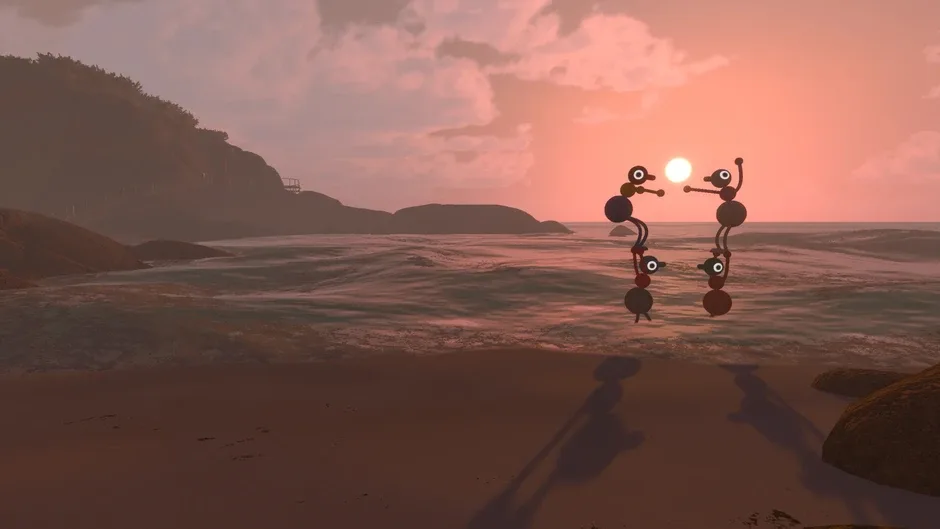
What Big Walk does not do#
An honest review has to list the things a game does not try to be, because the audience for Big Walk is narrow in a specific way.
First, it is not a solo game. Nothing on the store page positions a single-player mode as the main way to play, and the premise falls apart without other people. A lone player buying it is buying a very quiet walk.
Second, it is not a game for a group that will not talk. The listed features rest on voice chat. A group that plays with microphones off, or that has one member with a bad headset, will find that the tools cover the gap only partly. The game rewards a chatty group and offers little consolation to a silent one.
Third, it does not offer combat, loot or character builds in anything on the store page. The tags are co-op campaign, open world, puzzle, exploration, relaxing, funny, first person and casual. A reader who wants a power curve, a skill tree or a gear score is looking at the wrong game.
Fourth, it is not on consoles according to the store page, which lists Windows and macOS. That limits it as a couch game and as a party game for mixed friend groups that include console players.
Fifth, the language list is limited. The store page names 14 supported languages for interface, audio and subtitles, and Swedish is not among them. English, German, French, Italian, Spanish, Japanese, Korean, Polish, Brazilian Portuguese, Russian, Chinese and Turkish are. For most groups that is enough, but it is worth checking before buying for a group with mixed languages.
Who House House and Panic are#
House House is the Melbourne studio that made Untitled Goose Game, a 2019 comedy about a goose causing trouble in a village. That game was built on small, physical, funny interactions and a tone of gentle mischief, and Panic published it. Big Walk is a different kind of game, cooperative rather than solitary and voice driven rather than silent, but the sensibility carries over. It is a studio that finds jokes in ordinary objects and social situations, and a game about a group of friends getting lost together is a natural place for that instinct.
Panic publishing the game is also a small signal about intent. The publisher has a reputation for releasing distinctive, carefully made games instead of trend chasing, and a proximity-voice social adventure with a hand-crafted campaign fits that profile better than a live-service shooter would.
Technical notes and requirements#
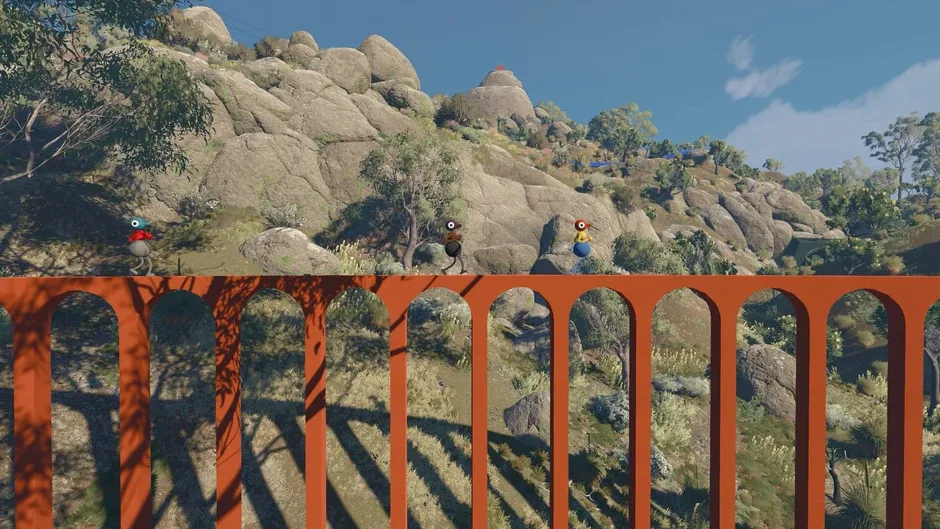
The store page gives modest system requirements. On Windows, the minimum listed is an Intel Core i7-7700K or AMD Ryzen 5 1600X processor, 12 GB of RAM and a GeForce GTX 750 Ti graphics card. On macOS, the minimum is an M1 chip with 16 GB of RAM. The game also lists online co-op, achievements, Steam Cloud and Family Sharing. Controller support, Steam Deck compatibility and any console versions are not stated on the page, so anyone planning to play on a handheld should check before buying instead of assuming.
The graphics card requirement is low by current standards, which suggests a game that is not chasing photorealism. That fits the tone, and it also keeps the barrier low for friend groups whose machines differ widely. A social game is only as accessible as the weakest computer in the group.
Compared with Untitled Goose Game and PEAK#
Untitled Goose Game is the obvious relative because it comes from the same studio. It is a single-player game about a to-do list of small pranks, built around the pleasure of being a nuisance. Big Walk is the opposite in almost every structural way: a group instead of one animal, conversation instead of silence, an open-ended world instead of a village with a list. What the two share is the belief that a game can be built out of humour and observation instead of challenge. If you loved the goose for its comic timing, you will recognise the same hand here. If you loved it for its self-contained pranks, you will find the new game looser and more dependent on the people you bring along.
PEAK is the more relevant comparison for cooperative play. The Steam page offers a bundle with it, at 21.27 euros for both, which signals that the two games are aimed at similar friend groups. Both are co-op games about a group moving through a space together and depending on each other, and both live on the chaos of friends talking over each other. PEAK is pitched around a demanding climb, where the environment pushes back. Big Walk is pitched around wandering, talking and puzzling, where the pressure is social rather than physical. Choose the game that matches the mood your group is in: PEAK for tension, Big Walk for a long, funny afternoon.
A third reference point is the wave of proximity-voice games such as Lethal Company. Those games use distance-based audio to build fear and to punish carelessness. Big Walk borrows the technology and drops the fear, which is a genuinely fresh use of it.
New to social co-op? Start here#
A game like this rewards a little preparation from the group more than from the individual.
- Agree on voice chat before anything else. Everyone needs a working microphone and headphones, because speakers cause echo when several people are playing in the same room.
- Decide on a small group first. A group of four or five is a gentler introduction than a full twelve, and it lets everyone hear how the distance-based audio behaves before the chaos scales up.
- Try each tool early. The walkie-talkie, megaphone and binoculars are worth testing in a quiet moment, so they are familiar when a real problem needs them.
- Split up on purpose at least once. The game is designed for reunions, and the fun of a reunion needs a separation to build on.
Worth the money?#
At 18.99 euros, Big Walk sits at the low end of the price range for a new game with a full hand-crafted campaign, and for a group of friends the cost per person is very small. The store lists no playtime figure, so Game Avant does not state a campaign length. What can be said is that the game has an ending, which suggests a session-based experience that a group can finish over several evenings, with the open world offering room to return.
The value calculation is unusual, because the price only makes sense for a specific buyer. For a group that talks, it is excellent value: the game supplies a shared activity that lasts as long as the friendships around it do. For someone who mostly plays alone, it is poor value at any price. Every player in a session needs access to the game, so it is worth checking who owns a copy before the evening starts, and Family Sharing is listed on the store page.
The best platform is PC, or a Mac with an M1 chip or newer, since those are the only platforms the store lists. Steam Deck status is not stated, so treat handheld play as unconfirmed. On language, English, German and French are among the 14 supported languages for interface, audio and subtitles, while Swedish is not, so Swedish-speaking groups will play in another language.
Play this instead if …#
Shorter: Untitled Goose Game, from the same studio, is a compact single-player comedy with a clear checklist, a good pick if the appeal is House House's humour rather than the group format.
Easier: Any relaxed cooperative game with a fixed route and clear objectives suits a group that finds open-ended wandering too vague. Big Walk itself is already gentle, but its freedom asks the group to create its own direction.
Cheaper or co-op: PEAK is the natural co-op alternative and shares a bundle with Big Walk on Steam, so the two together make a low-cost evening for a group that wants both tension and comedy.
Frequently asked questions#
How long is Big Walk? The store page gives no playtime figure, and Game Avant does not guess. It is a hand-crafted co-op campaign with an ending, so it is a finite game that a group can complete.
Is Big Walk an open world? Yes. The store page describes an open-world environment that players explore at their own pace, and the tags include open world and exploration.
Does it have co-op? Co-op is the whole game. It supports 2 to 12 players, with online co-op and crossplay between the supported platforms.
Is there a difficulty setting? None is listed. The tags describe it as relaxing and casual, and the challenge comes from communication and puzzles rather than from enemies or execution.
Do you need friends to play? In practice, yes. The design is built around proximity voice chat and a group, and the game is about hanging out and getting lost with close friends.
Which platforms is it on? The Steam page lists Windows and macOS, with cross-platform multiplayer. Console versions are not mentioned.
The Game Avant verdict#
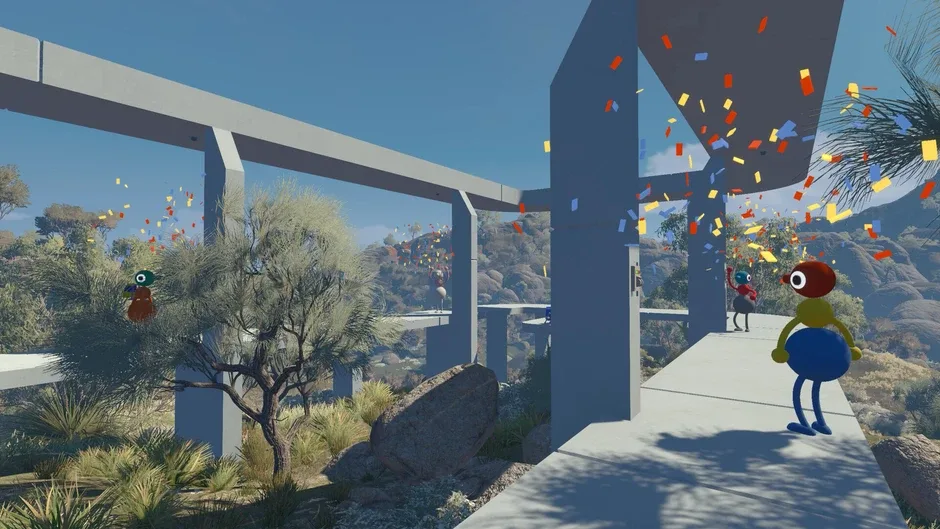
Big Walk is not for everyone, and it does not pretend to be. It depends on a group that will talk, it has no answer for a solo player, and a hand-crafted campaign will eventually run out. Those limits are real, and they are the reason the score is a 9 and not a 10. But the thing it does, building a whole game out of proximity voice, gestures and open space, is done with unusual confidence, and it produces a kind of shared experience that combat-driven co-op games almost never manage.
The honest contrarian point is this: the most impressive thing about Big Walk is what it leaves out. There is no enemy to unite the group and no loot to argue over, so all that remains is the group itself, and the game trusts that to be enough. For the right set of friends, it is.
9 out of 10 – a co-op adventure that is made of conversation, and better for it.