
A saw, a shield, and a war fought standing still#
Doom: The Dark Ages is the first mainline Doom in over a decade built around a simple, contrarian idea: what if the Doom Slayer stopped moving? Developed by id Software and published by Bethesda Softworks, it released on 15 May 2025 for PlayStation 5, Xbox Series X|S and PC. Where Doom Eternal turned every fight into a mid-air resource-management puzzle, solved by dashing, meat-hooking and double-jumping between six systems at once, The Dark Ages hands you a saw-edged shield, tells you to plant your feet, and asks you to read an attack instead of dodging away from it. It is a genuine swing of the pendulum, not a safe sequel, and after a full campaign spent blocking, parrying and countering Hell's medieval armies, the swing mostly lands.
The premise is a prequel, set generations before the events of Doom (2016) and Doom Eternal, and it finally shows the Unholy Crusade that those two games only mentioned in passing. The Slayer is a weapon handed to the Night Sentinels of Argent D'Nur by King Novik to fight a demonic invasion led by Prince Ahzrak, who wants the artifact known as the Heart of Argent to seize total control of Hell's legions. Where the 2016 reboot and Eternal kept their protagonist an almost mute force of nature wandering through environmental storytelling, The Dark Ages surrounds him with an actual court: Novik, his daughter and heir Commander Thira, and a cast of Sentinel officers who argue, plan and die around him. It is the most narrative the modern series has ever attempted, and it changes the rhythm of the whole game before a single shot is fired.
What makes The Dark Ages different#
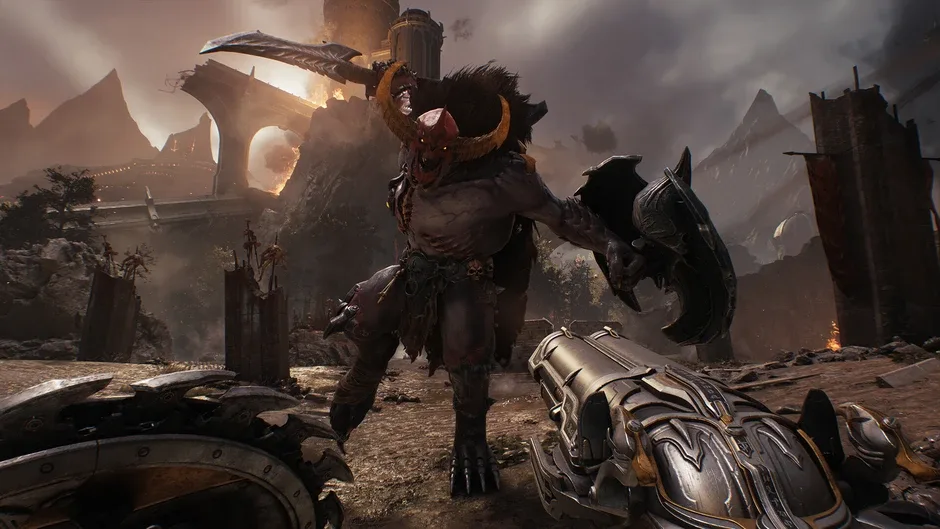
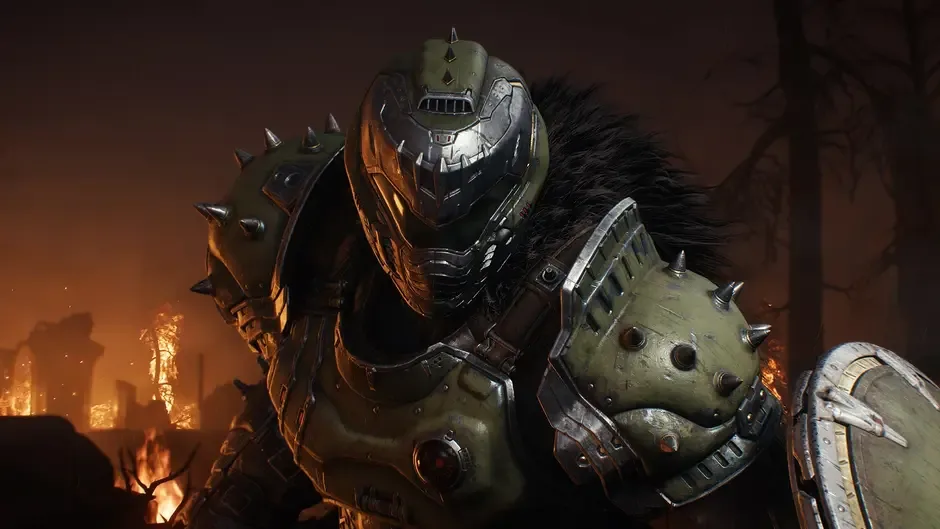
The one idea that carries the entire game is the Shield Saw, a combination shield and spinning blade that turns blocking from a last resort into the core offensive tool. Hold it up and a green flash on an incoming attack means it can be parried; time the block correctly and the Slayer staggers the attacker, opens them to a follow-up, or in the case of thrown projectiles, catches the object and hurls it straight back into whatever fired it. Against the game's rank-and-file Legionnaires, a well-timed parry chain turns a crowd into a corridor of stunned targets. Against the Cursed Prowler and other rushdown demons introduced specifically to punish players who try to play The Dark Ages like Eternal, holding ground and reading the tell is the only reliable answer.
This is the game's real gamble: Doom Eternal's identity was built entirely on momentum, on never letting your feet touch the ground for more than a second, on juggling ammo, health and armor resources gained from chainsawing, glory-killing and flame-belching your way across an arena. The Dark Ages asks you to unlearn nearly all of it. There is no air-dash. There is no meat hook. Movement is heavier, deliberate, closer to a boxer's footwork than a platformer's. It is a legitimately controversial choice, and it shows in how divided the response to the game has been: players who came to the series for Eternal's speed have been vocal that the slower, parry-based loop feels like a step backward, while players who found Eternal's juggling exhausting have praised The Dark Ages for finally letting a fight breathe. Both reactions are honest descriptions of the same design decision, and neither is wrong. What is true is that the new loop asks for a different kind of mastery, timing and positioning over movement tech, and once that timing clicks, blocking a Baron of Hell's overhead swing and returning it with a shield throw carries a satisfaction Eternal never offered.
Argent D'Nur: a world with actual scale#
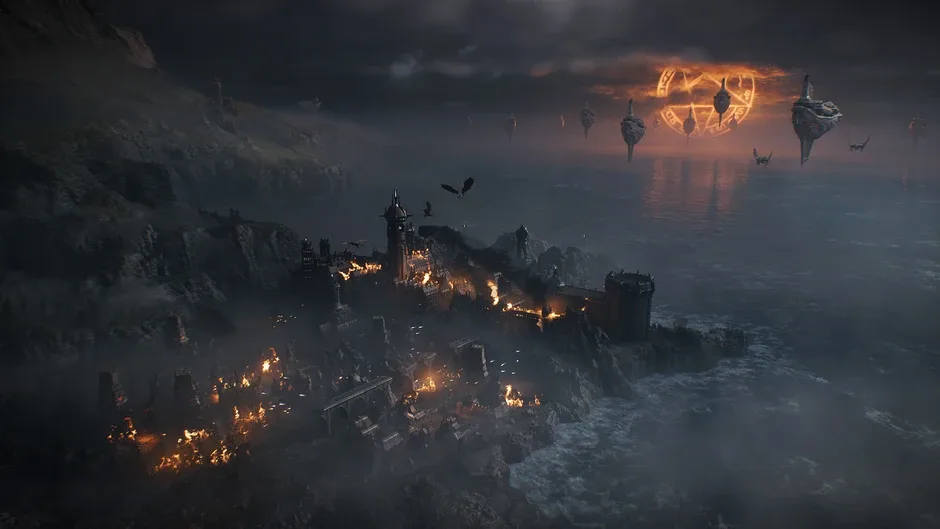
Where Doom Eternal's arenas were abstract, sci-fi boxes designed purely to host a fight, The Dark Ages builds an actual world around its combat. Argent D'Nur is realized as a medieval-fantasy kingdom colliding with industrial and cosmic-horror machinery: obsidian cathedrals with stained glass depicting past crusades, war-torn fortress walls scaled by siege towers, and Hell's armies pouring through gates that look torn out of a cathedral ceiling. It is the best-looking environment id Software has ever put together, not because of raw technical fidelity, though the game runs at a genuinely stable frame rate on consoles, but because the architecture has a point of view. A throne room lit by dying stained glass says something about the Sentinels' fading empire before a single line of dialogue does.
The larger levels lean into scale in a way the series has not attempted before. Later chapters open into wide, siege-style battlefields where the Slayer fights across a fortress under active bombardment, moving between ground combat, mounted sections and mech deployment inside a single sprawling map rather than a sequence of arena rooms. It is an ambitious structural choice, and it mostly pays off in the game's midsection, though a few of these open stretches run longer than the enemy variety on hand can sustain, and the pacing sags noticeably in the back half of a couple of chapters before the next big set piece arrives to reset the energy.
Movement across these bigger spaces is also more grounded than in Eternal. There is no monkey-bar traversal, no platforming puzzle woven between fights, and no fast-travel option once a level is underway, so getting from one end of a siege map to the other is done on foot or on a mount rather than by menu. That reinforces the game's overall philosophy, this is a world you occupy rather than a gymnasium you swing through, but it is also the traversal change players coming from Eternal have noticed and argued about the most, since it removes one of the previous game's signature skill expressions entirely rather than just slowing it down.
Weapons and the arsenal#
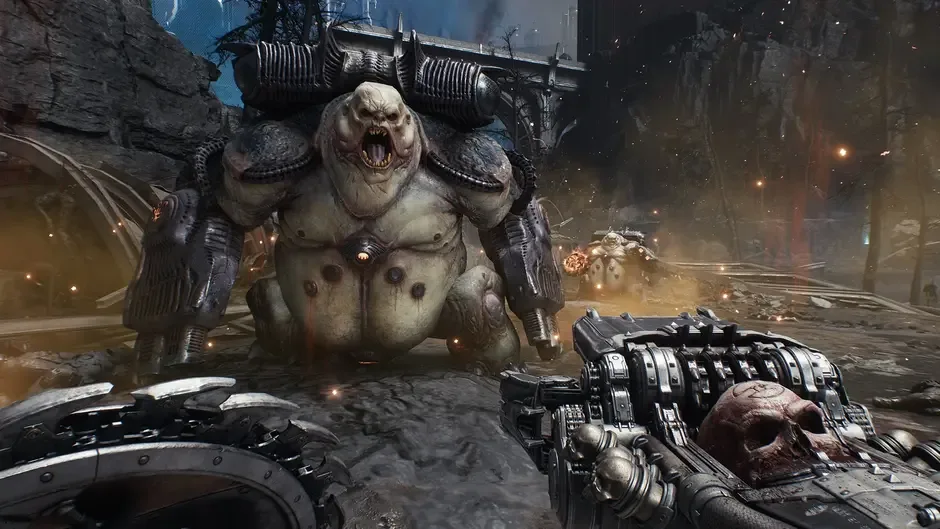
The gunplay underneath the new shield system is still recognizably Doom, and it is deep. More than twenty weapons cycle through the campaign, from a rebuilt Super Shotgun that still shreds armor at close range to the Skullcrusher, a bone-firing flail-style launcher, and the Ravager, a heavy, slow-firing cannon built for armored targets. New weapons like the Skullsplitter, a chargeable axe-like ranged weapon, and the returning Chaingun give the arsenal real texture: some guns are built to strip a Titan-scale enemy's armor plating piece by piece, others exist purely to clear a room of fodder in seconds. Ammo management still forces weapon switching mid-fight, but the tempo of that switching is calmer than Eternal's constant juggling, which fits the game's slower overall rhythm. Melee is folded directly into the Shield Saw and a set of unlockable Flame Belch-style tools, so there is rarely a reason to reach for a dedicated melee weapon the way Eternal's chainsaw demanded.
What makes the arsenal work as a whole is how clearly each weapon maps to a specific problem rather than to a general damage number. The Skullcrusher's wide arcing shot is built for clearing groups of fast, low-health Legionnaires before they close the distance; the Ravager exists almost entirely to strip a Titan-class enemy's armor plating in a fight that would otherwise take twice as long. That specificity means switching weapons mid-encounter is a tactical decision rather than a reflex, and it is one of the clearest places where the slower overall pace pays off: there is time to actually think about which of twenty-plus tools the situation calls for, instead of grabbing whatever is already selected because the fight will be over in four seconds regardless.
Mech and dragon combat: spectacle over depth#
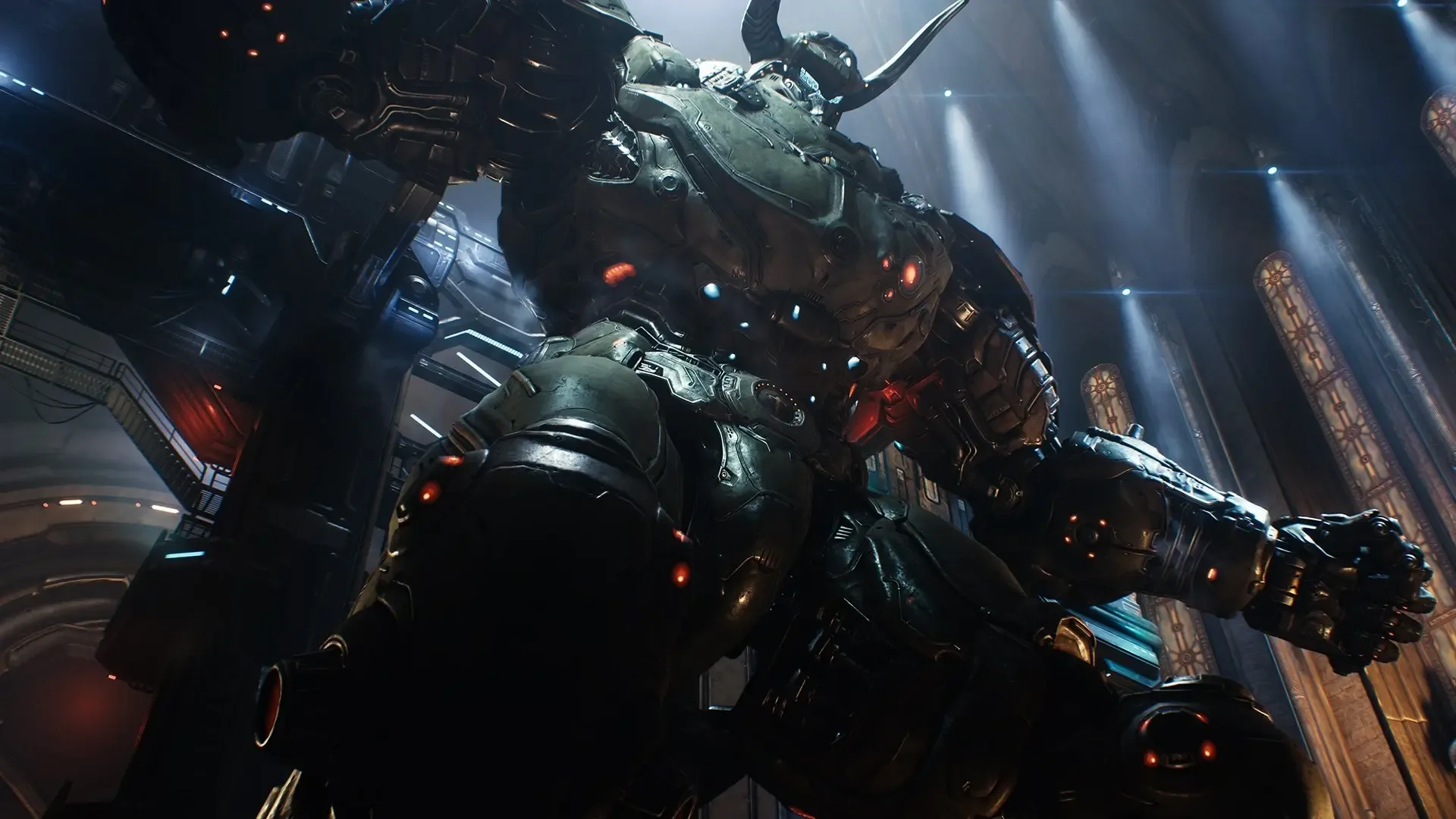
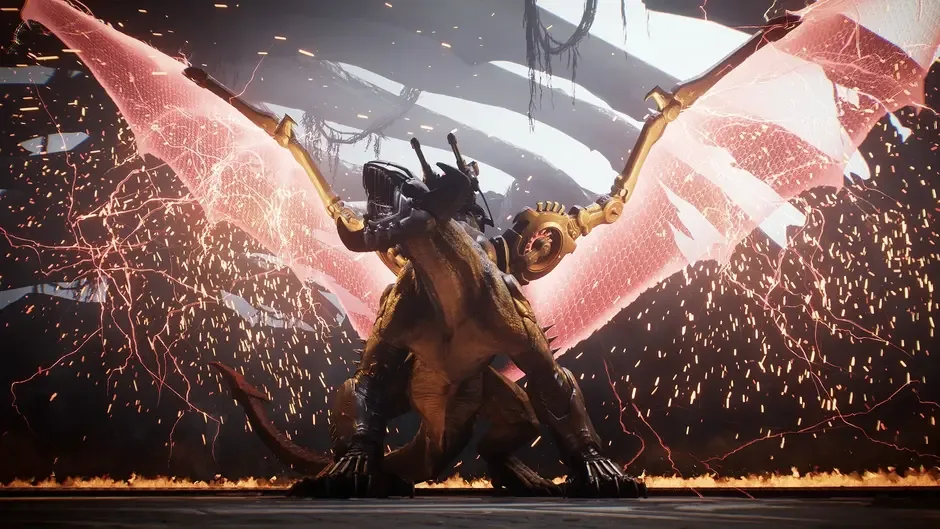
The Dark Ages' most talked-about addition is its vehicle combat: a thirty-story Atlan mech for city-scale brawls against Titans, and a cybernetic dragon for aerial dogfights against demon fleets. Both are, on first appearance, the loudest and most absurd thing id Software has ever shipped in a Doom game, and the first Titan brawl, a slow, weighty exchange of haymakers between two building-sized combatants, is a genuine highlight of the campaign. The problem is depth. Both the mech and dragon sections are built around a small, repeatable pattern, block or dodge, land the counter, repeat, and by their third or fourth reappearance across the campaign, the novelty has worn off faster than the spectacle. They work best as punctuation between the game's core shield-and-shoot combat rather than as a system in their own right, and the campaign is smart enough to keep them from overstaying their welcome for too long in any single chapter, even if a few later missions push their luck.
Story and pacing: a Doom game with an actual supporting cast#
The narrative ambition here is the most significant departure from the last two games. Doom (2016) and Doom Eternal told their stories almost entirely through environmental detail and codex entries, keeping the Slayer a near-silent cipher. The Dark Ages puts him inside an actual court, with King Novik giving him orders, Commander Thira treating him as both weapon and ally, and Prince Ahzrak positioned as a defector whose betrayal drives the back half of the plot. It gives the setting real stakes: this is a kingdom actually losing a war, not a set of ruins already lost. The trade-off is pacing. Cutscenes and dialogue exchanges interrupt the action more often than in Eternal, and players who came to Doom purely for uninterrupted combat may find themselves waiting through court politics to get back to the Shield Saw. It is a trade the game is upfront about making, and for a series entering its third modern entry, giving the world an actual voice is a defensible way to keep the formula from calcifying.
Difficulty and accessibility#
The Dark Ages keeps the series' familiar difficulty ladder from "I'm Too Young to Die" up through "Nightmare," and the parry-focused combat actually makes the lower difficulties more approachable than Eternal's ever were, since a slower, more readable attack rhythm is easier to learn than Eternal's constant aerial resource math. On higher difficulties, the game leans hard on punishing mistimed parries, particularly against the Cursed Prowler and other demons introduced specifically to counter players trying to play the whole game at Eternal's speed. There is no dedicated easy toggle beyond the standard difficulty settings, but the shield-first loop is, by design, the most beginner-friendly entry point the series has had since the 2016 reboot.
That concurrent-player gap is worth sitting with rather than explaining away, because it lines up with what the actual design change asks of returning players. Doom Eternal's fanbase was built, in large part, around mastering a specific, demanding movement system, and a sequel that removes the air-dash and the meat hook is always going to lose some of the people who fell in love with that exact skill ceiling, no matter how well the replacement plays. The Dark Ages is not a bigger, better Eternal. It is a different game wearing the same title, and the size of that Steam gap is the clearest evidence that a meaningful slice of the audience wanted the former rather than the latter.
Compared with Doom Eternal and Doom (2016)#
Doom Eternal remains the better game if pure speed is what you want from Doom: its mobility toolkit, meat hook, air dash, monkey bars, turned every arena into a puzzle solved through movement, and nothing in The Dark Ages tries to replicate that feeling. If your favorite memory of the series is juggling six resource systems while dashing through the air, Eternal still does it better because it is still the only game built entirely around that idea.
Doom (2016) is the closer comparison in tone. Both games favor weight and impact over pure mobility, and both use glory kills and shotgun blasts as punctuation rather than the entire sentence. The Dark Ages goes further than 2016 ever did by adding the Shield Saw's parry layer and building real narrative stakes around the Slayer, and in doing so it becomes the more ambitious game, even if 2016's tighter, shorter campaign has less pacing fat in its second half.
Worth the money?#
At full price around 70 dollars on console and PC, The Dark Ages is a substantial single-player package: roughly 15 hours for a focused run through its 22 chapters on a standard difficulty, and 20 hours or more if you chase secrets, collectibles and the game's harder difficulty settings. There is no multiplayer of any kind, a deliberate choice id Software has said it made to protect the campaign's scope, so the entire purchase rests on that single-player value, and for a 15-to-20-hour, big-budget campaign with this much production behind it, that math holds up. The game has since received a story expansion, Revelations, released in July 2026, for players who finish the base campaign and want more.
Best platform: PC is the strongest choice if your machine clears the recommended specs, since the game has been one of the better-optimized big releases of 2025, running smoothly even with its original Denuvo protection in place; that protection has since been removed following the Revelations update. PlayStation 5 and Xbox Series X run at a stable frame rate with no meaningful compromise. Steam Deck compatibility is present but rough: the game targets roughly 720p at 30 frames per second on the handheld, and getting there took post-launch tuning, so it is playable rather than comfortable on the go. There is no previous-generation console version; PS4 and Xbox One are not supported.
Play this instead if…#
Shorter: Doom (2016) covers similar ground in a tighter, roughly 13-hour campaign, with faster pacing and none of The Dark Ages' court-politics detours.
Easier: Doom Eternal's own opening hours, before its full resource-juggling kicks in, still teach mobility gradually and remain a gentler ramp for newcomers to fast FPS combat than The Dark Ages' parry timing initially is.
Cheaper or a different flavor of medieval combat: For a slower, shield-and-sword power fantasy without demons, a game built entirely around blocking and countering scratches a similar itch at a fraction of the price during a sale.
Frequently asked questions#
How long is Doom: The Dark Ages? Around 15 hours for a focused run through the main campaign's 22 chapters on a standard difficulty, and 20 hours or more chasing secrets and collectibles.
Is Doom: The Dark Ages open world? No, but several later chapters open into large, siege-scale battlefields that blend ground combat, mech deployment and mounted sections within a single sprawling map, closer to a big linear level than a small arena.
Does it have multiplayer or co-op? No. The game is single-player only; id Software has said the decision to skip multiplayer was made specifically to protect the campaign's scope and quality.
Is there an easy difficulty mode? The series' familiar difficulty ladder is present from a very forgiving setting up through Nightmare, and the slower, parry-based combat is generally easier to learn than Eternal's movement-heavy loop.
Do you need to play Doom (2016) or Doom Eternal first? No. As a prequel set generations earlier, The Dark Ages tells a self-contained story, though longtime fans will recognize references to the Unholy Crusade mentioned in both earlier games.
The Game Avant verdict#
Doom: The Dark Ages is a genuinely brave sequel to two games that had already found a winning formula, and it does not simply refine that formula, it replaces its central mechanic and asks players to relearn what a Doom fight feels like. That is a real risk, and it does not land perfectly: the mech and dragon sections run out of ideas before the campaign runs out of chapters, a few of the siege-scale levels sag under their own size, and the shift away from Eternal's speed will cost the game some of that entry's most devoted fans permanently. But the Shield Saw itself, the moment where a well-read parry turns an incoming axe swing into your own weapon, is one of the best single mechanics the series has ever introduced, and Argent D'Nur is a more interesting place to fight in than either of Eternal's more abstract dimensions. This is a Doom game that chose to be a different kind of good rather than a safer, faster version of the last one, and that choice deserves more credit than the loudest reactions to it have given.
8 out of 10 – a slower, heavier Doom that trades a beloved formula for a new one and mostly proves it was worth the risk.