

A mouse, a whip and a very good idea#
Mina the Hollower is the rare retro-styled game that has an original mechanic at its centre instead of only nostalgia. Yacht Club Games, the studio behind Shovel Knight, released it on 29 May 2026 as a top-down action adventure, and it moves the studio into a different genre without losing its love of old hardware. The hook is right in the title. Mina is a mouse, an inventor and a member of the Hollower guild, and her signature ability is to burrow beneath the ground. That single move carries traversal, combat and puzzle design, and it gives the game a personality that no amount of pixel art alone could supply.
Everything else supports that idea. The setting is Tenebrous Isle, a gothic 19th-century island where animals and mythical creatures live alongside humans. The story sends Mina back to repair malfunctioning Spark Generators, and the machines turn out to be tied to a conspiracy and to corruption spreading across the land. The pitch sounds like a fairy tale with fangs, and it plays like one too. That is why this review lands on 9: the design is confident, the constraints are chosen rather than imposed, and the parts that stumble are small.

What makes Mina the Hollower different#
The one idea that carries the whole game is Hollowing. Mina can sink into the ground and move underneath it for a short time, and while she is under, she is invincible. That sounds like a simple dodge with extra steps, but the distinction matters. A dodge roll in most action games is a defensive button. Burrowing here is also a traversal tool, because it lets Mina cross gaps that would otherwise block the path. It is a way to escape a bad situation, a way to reach a place that looks out of reach, and a way to reposition in a fight, all with the same input.
The consequence is that rooms can be built around it. A gap is not simply a barrier that needs a key. It is a small question about how and when to burrow. An enemy that would be trouble in the open becomes a puzzle of timing when the player can disappear beneath the floor at the right moment. Because invincibility comes bundled with movement, combat feels less like standing still and trading blows and more like a rhythm of appearing, striking and vanishing.
That is also why the game does not feel like a Zelda clone with a cute protagonist. Its inspirations are open and obvious, and the game draws on Castlevania, on the Game Boy classic The Legend of Zelda: Link's Awakening, and on Bloodborne. Those three influences describe the mood well: gothic dread, top-down exploration and combat that takes care seriously. But none of those games has a mouse who tunnels under the floor, and the mechanic gives the design a shape of its own.
Three weapons, two more later#
Combat starts with three weapons: a whip, dual daggers and a hammer. Two additional weapons unlock later. The choice of starting three is a good sign, because each weapon suggests a different way of playing before any upgrade has been bought. A whip is about reach and spacing. Dual daggers suggest speed and close pressure. A hammer suggests heavy, committed swings that reward reading an opponent first.
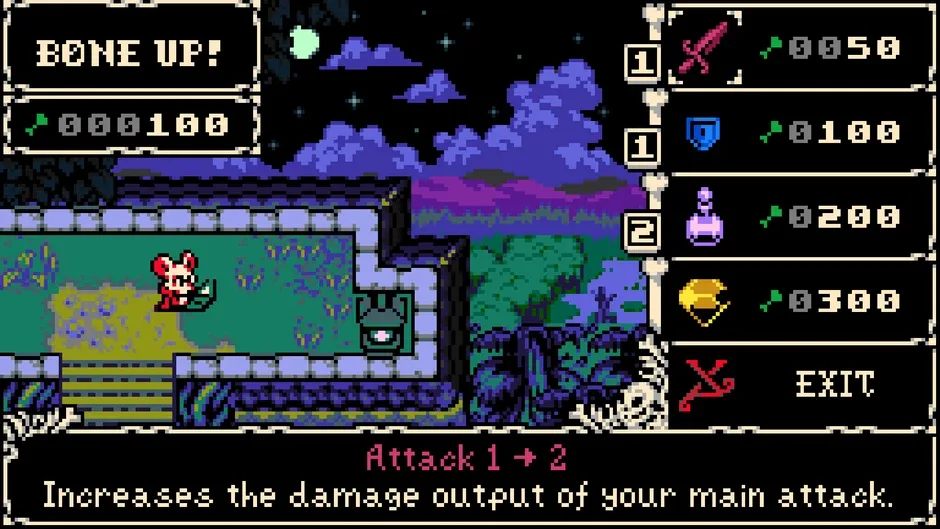
Bones are the game's currency, and they are spent to upgrade Mina's combat statistics. That keeps progression in the hands of the player rather than in a rigid skill tree, and it makes every trip back to safety a small decision about what to invest in. Trinkets add another layer: they provide permanent ability boosts, so a build is shaped both by the weapon in hand and by the small items equipped around it. The permanence matters because it separates trinkets from another category of gear, the sidearms.
Sidearms are the temporary tools. They offer combat or support roles, and they are lost when Mina dies. That single rule turns them into a risk-and-reward system. A sidearm can turn a difficult fight around, but it is not something to hoard indefinitely, and it is not a safety net either. The tension is deliberate: use it and it might save the attempt; die with it and it is gone. Anyone who dislikes losing resources on failure will find that a real drawback, and that is why it appears among the cons.

Tenebrous Isle and the hub of Ossex#
The world is organised around a hub city called Ossex, with a set of regions around it. Each region contains a malfunctioning Spark Generator and a boss guarding it, which gives the map a clear rhythm. Go out, cross a region full of hazards and secrets, reach the generator, deal with what protects it, return. That structure is familiar to anyone who has played a top-down adventure, and it is a good one, because it gives every region a purpose and every boss a reason to exist beyond being a checkpoint on a checklist.
The regions are described as diverse locales with secrets, and atmosphere is a central part of the pitch. Yacht Club Games describes the game as a descent into a frightful world, and the darkness itself is treated as a mechanic rather than only a backdrop. This is a game where the mood does actual work. A gothic setting with talking animals could easily tip into cuteness, but the point is the contrast: soft, readable character designs placed inside a world that is decaying, haunted and unsafe.
The story: a broken machine and a conspiracy#
The plot is built around the Spark Generators, machines that produce power for the island and that have begun to malfunction. Mina returns to fix them. On the way she meets the guild's leader, Lionel, and an antagonist named Thorne, and she learns that the trouble is not only mechanical. The generators themselves are causing environmental corruption, and a conspiracy sits behind it, with questions about who knew and who kept it hidden.
This is a classic structure, and that is fine. A story about an inventor whose technology is harming the world she is trying to repair gives the game a moral spine without needing a lot of exposition. It also fits the tone. The 19th-century setting suggests an industrial age with all its promises and its costs, and the anthropomorphic cast lets the story explore that without becoming heavy-handed. A game like this does not need a sprawling narrative to work. It needs a reason for each region to be broken, and the Spark Generators provide one.
A Game Boy Color game that follows the rules#
The presentation is the most talked-about part of the game, and it deserves the attention. Mina the Hollower is designed to look like a Game Boy Color game, and the developers went further than most by adhering to the original hardware's constraints: four colours per tile and no 3D assets. The only modern concession is a widescreen resolution.
Restrictions like these are a gift to a designer with a firm hand, because they force decisions. Every tile has to communicate with a tiny palette. Every silhouette has to read clearly. Nothing can hide behind lighting effects or particle systems. The result is a look that feels cohesive from the first room to the last, and it has a quality that pure pixel-art imitations often lack: it appears to belong to a real, imagined piece of hardware rather than to a filter applied over a modern game.
The cost is legibility in busy scenes. Four colours per tile is a hard limit, and dense rooms with many enemies and hazards can be harder to parse than in a modern pixel game that allows shading and glow. This is a real trade-off, not a marketing point. Anyone who wants pixel art to look as sharp and detailed as possible will find the rules restrictive, while anyone who loves the constraint will treat it as the main attraction.
Music by Jake Kaufman and Yuzo Koshiro#
The soundtrack is credited to Jake Kaufman, the composer behind Shovel Knight, with guest tracks from Yuzo Koshiro, whose name is familiar from classic action games of the console era. Chiptune-style scores can go wrong in two ways: they can be pleasantly forgettable or aggressively nostalgic. A good one becomes part of the world, and this one is built to do that, with tracks that carry the gothic mood as well as the retro flavour.
That pairing is also a signal of the game's ambition. Yacht Club Games did not hire a nostalgia act. It brought in composers who have spent careers working inside the sound of old hardware and who know how to make limited channels feel expressive. In a game where the visuals are deliberately restricted, music takes on extra weight, and here it pulls that weight.

Where it came from#
The game began as a personal side project by Alec Faulkner, a Yacht Club Games developer, under the working name Gothic. It caught the studio's attention, grew into a full project, and launched a Kickstarter campaign on 2 February 2022. The campaign raised $1,239,584 from 21,439 backers, and other crowdfunding sources pushed total funding beyond $1.4 million. Sean Velasco directed the game.
The release date moved. Mina the Hollower was originally scheduled for 31 October 2025 and was delayed to 29 May 2026 after what was described as failed play testing. That history is useful context for anyone wondering whether the finished game feels rushed. Delaying a project after a failed test is the opposite of shipping on a deadline, and the tight construction of the final game points to a team that used the time.
Difficulty and how it plays#
Precise settings and options are worth checking on the store page before buying, since the developer does not document every accessibility or difficulty toggle in the material this review relies on. What can be said with confidence is how the design pushes players. Bosses guard each Spark Generator, and the loss of sidearms on death creates a clear penalty for failure without turning the game into a punishing test of endurance. The permanent trinkets and the Bones-based upgrades give a steady sense of forward movement.
The game is rated ESRB Everyone 10+ and is single-player only. That rating is a useful signal for tone: the gothic mood is real, but it is not aimed at shocking anyone. It is closer to a storybook with teeth than to a horror game, and that is a deliberate choice that fits the animal cast.

New to top-down adventures? Start here#
Anyone new to this kind of game can approach it with a few simple habits.
- Treat burrowing as a fight tool from the first hour, not only as a way across gaps. Disappearing at the right moment is often the safest answer to a hard enemy.
- Try all three starting weapons before committing Bones to one. The whip, the daggers and the hammer play differently enough that an early preference can be wrong.
- Use sidearms freely on tough fights rather than saving them, since they are lost on death anyway.
- Equip trinkets deliberately, because they are permanent boosts and shape a build more than they appear to at first.
- Return to the hub of Ossex between regions and use it as a rhythm: explore, clear, spend, go again.
Compared with Link's Awakening and Hollow Knight#
Link's Awakening is the natural comparison, and the game invites it. Both are top-down adventures with a handheld sensibility, a strange, melancholy island and a structure of regions ending in bosses. Mina the Hollower is harder and darker in tone, and it replaces the mysterious dreamlike whimsy with gothic dread. Link's Awakening is gentler, and it relies on its tools to gate progress. Mina the Hollower relies on one mechanic that is both tool and weapon. Anyone who wants the gentler experience should stay with Zelda, and anyone who wants a tenser, more combat-focused version of the same shape will find it here.
Hollow Knight is the comparison for atmosphere and difficulty. Both games take a bleak, animal-populated world seriously and reward learning boss patterns. Hollow Knight is a side-scrolling metroidvania with a far larger map, while Mina the Hollower is tighter and more directed, with a hub-and-regions structure that is easier to keep in the head. The two also differ in scope: Hollow Knight is famously large, and Mina the Hollower is the more focused piece.
| Mina the Hollower | Link's Awakening | Hollow Knight | |
|---|---|---|---|
| View | Top-down, three-quarter | Top-down | Side-scrolling |
| Signature idea | Burrowing (Hollowing) | Item-gated exploration | Interconnected map |
| Tone | Gothic with animal cast | Dreamlike, melancholy | Bleak, insect kingdom |
| Boss focus | High | Medium | High |

What it does not do#
A review should say what a game leaves out, and Mina the Hollower leaves out quite a lot on purpose. There is no multiplayer of any kind, so the adventure belongs to one player from start to finish. There is no sprawling open world to fill with icons, because the design prefers a hub with regions around it. There is no attempt to look like a modern high-definition pixel game, since the strict palette is the point. And there is no promise of endless content: a structure of Spark Generators and the bosses guarding them is a structure with an end.
Those omissions are also what keep the game focused. Every region has a job, every boss has a place, and every tool Mina gains has a reason to exist. Games that try to do everything tend to dilute their best idea, and Hollowing is a good enough idea to deserve protection. Readers who see the missing features as a flaw should treat the list above as a warning rather than a footnote. Readers who see them as discipline will recognise the same instinct that made Shovel Knight feel so tidy.
Who it is really for#
This is a game for players who miss the era of handheld adventures but do not want a museum piece. It suits people who like learning enemy behaviour, who enjoy a compact world and who take pleasure in noticing craft. The visual restrictions are part of the joke and part of the seriousness, and they only work for players who accept them.
It is less suited to anyone who wants a large, open, checklist-heavy world. It also asks for some patience with a view that is neither flat nor fully three-dimensional. The three-quarter isometric angle takes adjustment, particularly for players raised on side-on platformers, and depth can be harder to judge at first than it is in a flat game.

Worth the money?#
The exact launch price should be checked on the store page for the platform in question, since it was not confirmed in the sources used for this review. What can be said is that the game was released on 29 May 2026 for a wide range of platforms, including PC, Nintendo Switch, Nintendo Switch 2, PlayStation and Xbox consoles. Sales passed 300,000 copies in three days and 500,000 within two weeks, which shows that the audience for this kind of design is large.
For a compact, single-player adventure built around bosses and a distinctive mechanic, value is measured less in raw hours than in how much of the design stays interesting. The lack of multiplayer means there is no need to weigh a subscription or online service, and the hub-and-regions structure suggests a game that is meant to be finished rather than lived in. Waiting for a sale is reasonable for anyone unsure, but a game this focused rewards being played close to release, while its ideas are fresh.
Best platform: portable play is the natural home for a game styled after a handheld, so Nintendo Switch and Switch 2 suit its spirit, and a handheld PC suits it as well. Language support: the developer lists English, French, Italian, German, Spanish, Brazilian Portuguese, Japanese, Korean and Chinese, so English and German players are covered, while Swedish is not on that list.
Play this instead if…#
Shorter: Link's Awakening delivers a compact top-down island adventure that can be finished in a weekend, with a gentler pace and no penalty for failure.
Easier: Shovel Knight, Yacht Club Games' own earlier work, offers a friendly, checkpoint-generous platformer with the same love of old hardware and less pressure on combat.
Cheaper or co-op: Cadence of Hyrule keeps the top-down Zelda structure and adds a rhythm layer, and its co-op mode is the better pick for anyone who wants to share a screen instead of playing alone.
Frequently asked questions#
How long is Mina the Hollower? The exact length is not confirmed in the sources used here. The structure of a hub with several regions, each ending in a boss at a Spark Generator, points to a compact adventure rather than an endless one, and the store page is the place to confirm current figures.
Is it open world? No. The game is organised around a hub city, Ossex, with regions around it, each with its own Spark Generator and boss.
Does it have co-op? No. It is a single-player game.
Can you change the difficulty? The developer does not detail difficulty options in the material used for this review. Check the settings and the store description for the platform in question.
Do you need to know Shovel Knight first? No. The game is a new franchise from the same studio and shares only the love of old hardware. The story and characters stand alone.
Is it really limited to Game Boy Color rules? Almost. The art follows four colours per tile and uses no 3D assets, and the only modern concession is a widescreen resolution.
The Game Avant verdict#
Mina the Hollower is not flawless. Sidearms that vanish on death will annoy anyone who plans carefully, the strict palette limits how readable a crowded room can be, and the three-quarter view asks for some adjustment. None of that is enough to take away what makes the game special. It has a mechanic that does real work, a set of bosses that give each region a purpose, a soundtrack with character and a visual identity that commits fully instead of hedging.
The unusual thing is the confidence. A studio known for one beloved platformer moved to a new genre, delayed the game after a failed test rather than shipping it, and came out with something that feels finished. That is the honest verdict against the grain of retro nostalgia: this is not a game that lives on memory. It works on its own terms.
9 out of 10 – a retro-styled adventure with a mechanic and a mood of its own.