
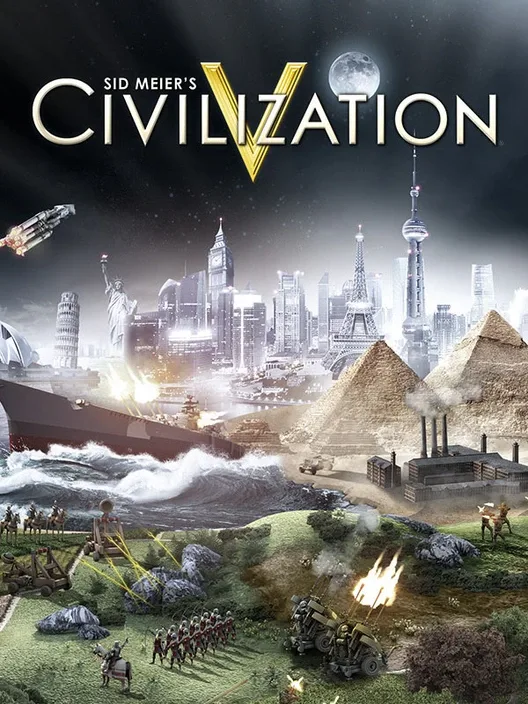
Sid Meier's Civilization V
Turn-Based Strategy · 4X · Strategy · Turn-Based · 4X (explore, expand, exploit, and exterminate)
Game page →
Game profile
The 2005 Firaxis Games turn-based 4X strategy game, where players guide a civilization from the ancient era to the space age through research, city-building, diplomacy and war. Is it your kind of game?
Choose what matters to you
Every question is optional.
How do you want to play?
What suits you better?
How long do you usually play at a time?
Based on your choices
Pick what matters to you above and the result shows up here.
IGDB
90%
310 ratings
Steam:
92%
2,796 reviews
Fits you if
you enjoy slow-building strategy games where decisions compound over centuries and every turn matters.
Skip it if
you want fast matches or a modern interface rather than a 2005-era turn-based classic.
Availability
Steam
$19.99
Sid Meier's Civilization IV is the fourth entry in Firaxis Games' turn-based strategy series, released in 2005 for Windows and later Mac OS X. Players take control of a civilization from its earliest city-state origins through the ancient, medieval, industrial and modern eras, all the way to a potential space-age victory, guiding its growth across a procedurally generated or hand-crafted map shared with other civilizations controlled by the AI or other players in multiplayer. The core loop revolves around founding and expanding cities, each of which works surrounding tiles for food, production and trade, and choosing what to build in each city on a given turn: settlers to found new cities, workers to improve terrain, military units to defend or expand borders, or buildings that boost science, gold, culture or happiness. A technology tree drives long-term progress, unlocking everything from early tools like Bronze Working and Pottery to late-game breakthroughs like Genetics and Robotics, with each new technology opening new unit types, buildings, wonders and strategic options. Civilization IV introduced two systems that came to define the series' identity going forward. Religion lets several founded faiths spread organically between cities and civilizations through trade routes and proximity, with each civilization's state religion shaping diplomacy, happiness and access to religious buildings and units; founding a religion first, or converting a rival's population to your own faith, becomes a quiet form of soft power alongside military strength. Civics work alongside religion as a broader governance system: at various points in the tech tree, players unlock new government, legal, economic and religious civics, and can swap between them (at a cost) to reshape how a civilization is run, trading off, for example, a civic that boosts production against one that boosts happiness or military strength. Diplomacy runs on an AI that reacts to borders, religion, trade relationships and past conflicts, offering treaties, trade deals, open borders agreements and eventually full alliances or declarations of war depending on how relations have developed. Combat uses a straightforward strength-and-terrain model where unit type, promotions earned through experience, and terrain bonuses from hills, rivers, and fortifications all factor into the outcome of a battle, with great generals occasionally appearing to grant bonus promotions to nearby units. Victory can be achieved through several distinct paths rather than a single win condition: conquering every other civilization's capital, building a technological lead that culminates in a spaceship launch, accumulating enough Culture through Wonders and buildings to achieve a Cultural Victory, winning a Diplomatic Victory through the United Nations, or simply having the highest score when a set number of turns runs out. Random Events, added as the game progresses, periodically present a civilization with a dilemma — a plague, a surprising discovery, a border dispute — that asks for a choice with lasting consequences rather than simply advancing the turn counter. The game also shipped with a full map and scenario editor, letting players design or download custom maps, rulesets and total-conversion scenarios built on the base game's engine. Multiplayer supports both simultaneous and sequential turns across several game modes, letting human players compete or cooperate on the same map the single-player campaign uses.
Turn-Based Strategy · 4X · Strategy · Turn-Based · 4X (explore, expand, exploit, and exterminate)
Game page →
Turn-Based Strategy · Strategy · 4X · 4X (explore, expand, exploit, and exterminate) · Historical
Game page →
4X · Turn-Based Strategy · Strategy · 4X (explore, expand, exploit, and exterminate) · Historical
Game page →
4X · Turn-Based Strategy · Strategy · 4X (explore, expand, exploit, and exterminate) · Turn-Based
Game page →
Turn-Based Strategy · 4X · Strategy · 4X (explore, expand, exploit, and exterminate) · Turn-Based
Game page →
4X · Strategy · Turn-Based Strategy · 4X (explore, expand, exploit, and exterminate) · Turn-Based
Game page →