
A fogbound island that finally feels like Silent Hill again#
Silent Hill: Townfall is the first mainline entry in the series told entirely in first person, and it is also the first time in over a decade that the fog has felt genuinely dangerous rather than merely decorative. Developed by Screen Burn Interactive, the Scottish studio formerly known as No Code, and published by Konami, it released on 24 September 2026 for PlayStation 5 and PC. It does not reinvent what a Silent Hill game is about: a stranger arrives somewhere that should not exist, carrying guilt he cannot fully remember, and the town rearranges itself around what he has done. What changes is the vantage point, and after a dozen hours inside it, the closer view mostly earns its keep, even when the game around it does not always keep pace.
What makes Townfall different#
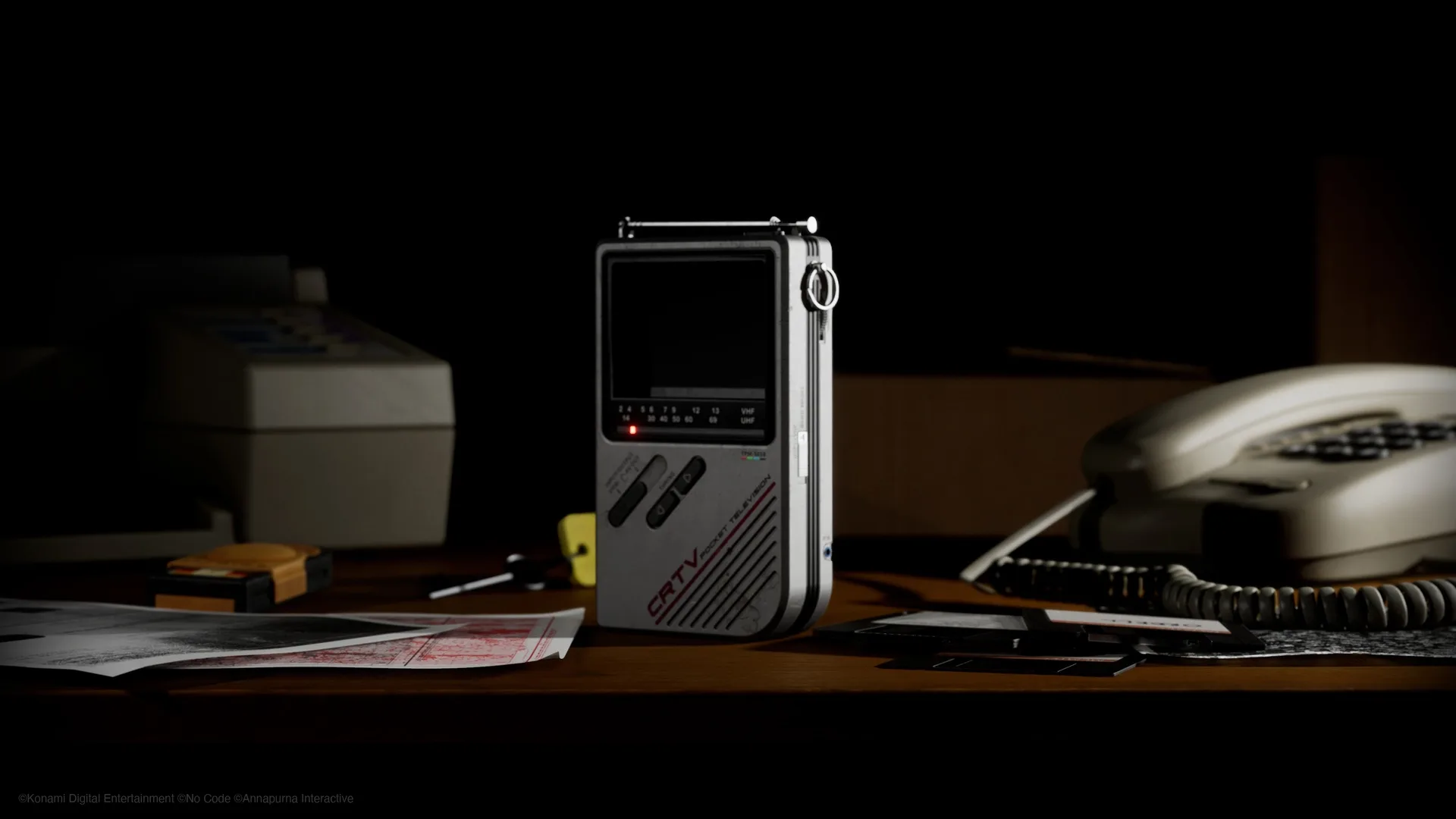
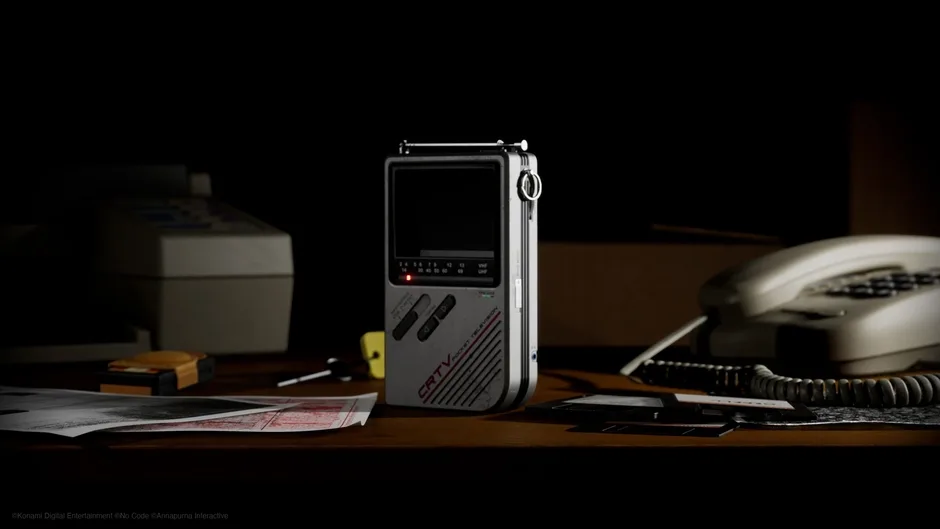
The one idea the whole game is built on is that guilt should be navigated, not just narrated. Simon Ordell wakes up ashore near the docks of St Amelia, a remote island settlement off the coast of Scotland, with an IV bag still taped to his arm and no clear memory of why he was called back to "put things right." Rather than dropping that mystery into cutscenes and letting the player walk between them, Townfall hands Simon a battered analog device called the CRTV and asks the player to physically point it at the environment to reveal what fog and memory are hiding: a hazard glowing where none should be, a symbol scratched into a wall, a door that only exists when viewed through the screen. It is a puzzle tool, a flashlight substitute and a narrative device at once, and because it is diegetic and handheld, first person is not a stylistic flourish here so much as the only viewpoint that makes the CRTV make sense. Holding the device up to a wall of static and slowly making out a shape behind it is the game's best trick, repeated with enough variation across St Amelia's docks, chapel and eventually the Otherworld that it never quite wears out its welcome the way some of the game's other systems do.
St Amelia and the Otherworld#
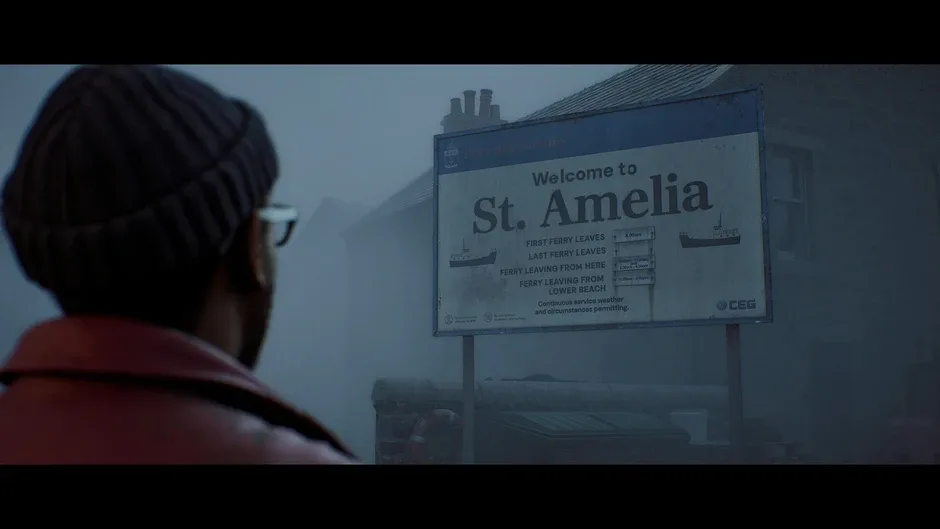
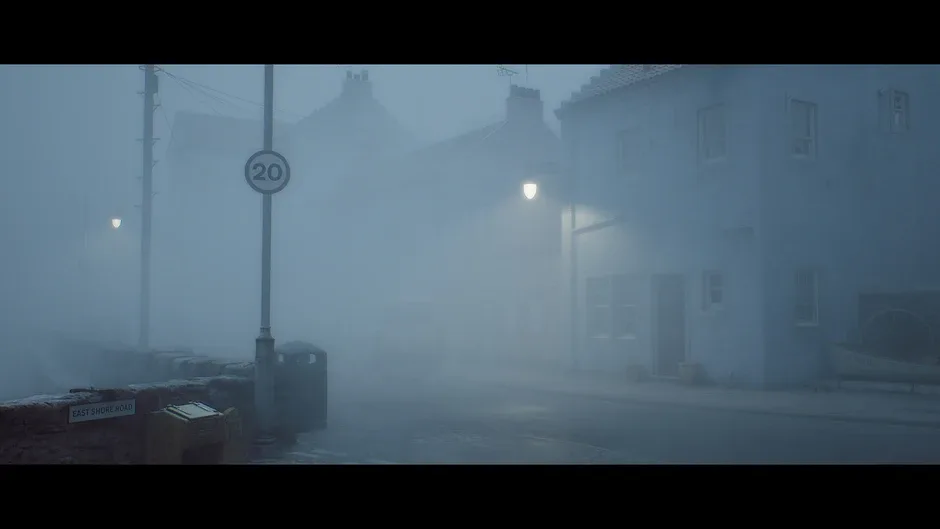
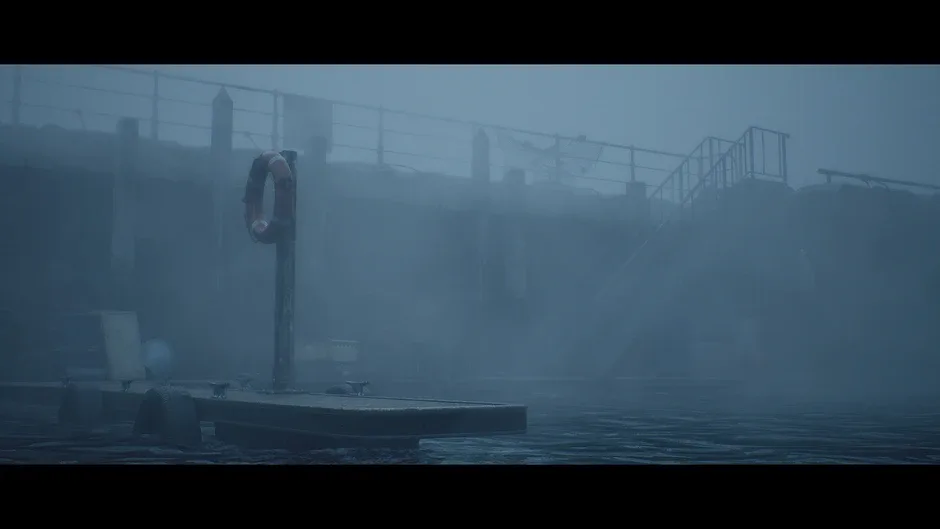
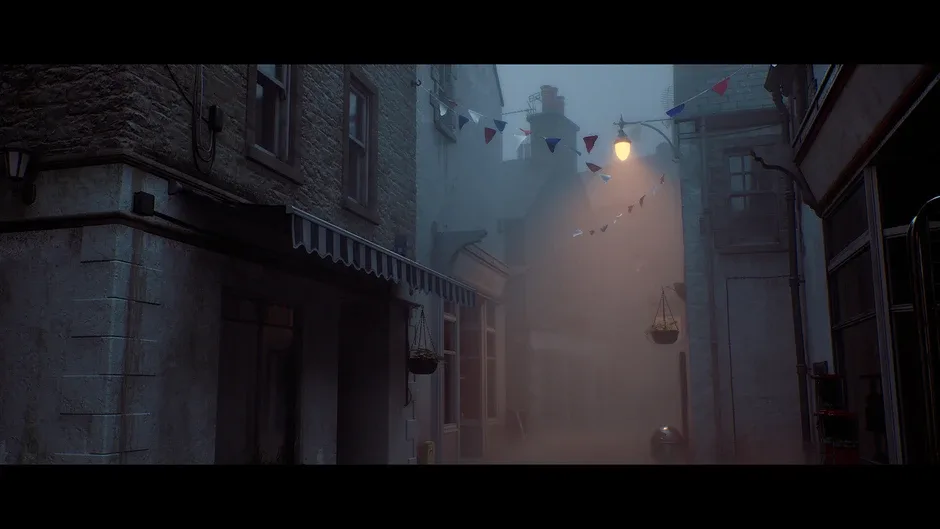
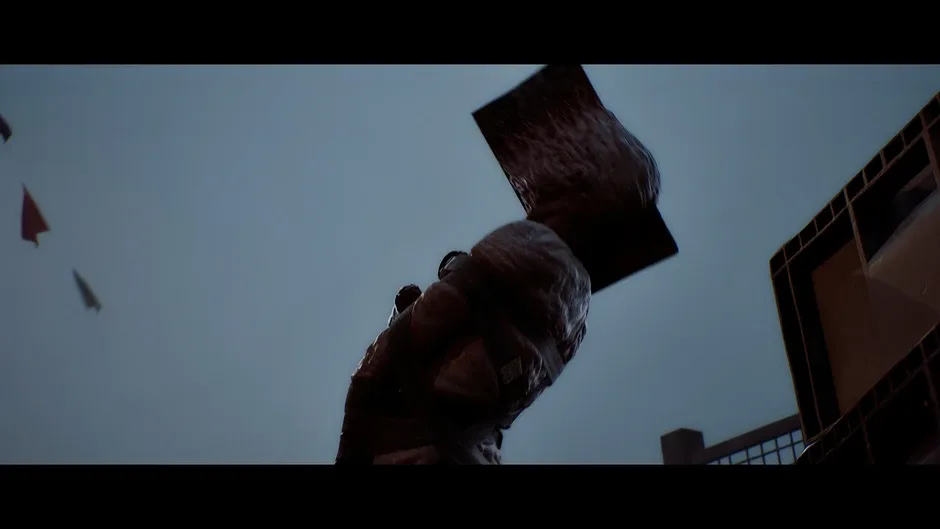
St Amelia itself plays it comparatively straight for the first few hours: a fishing settlement with a handful of named residents, a church, a harbor and the kind of persistent fog that swallows sightlines a few metres out. The turn, when it comes, is where the game shows its ambition. The Otherworld does not simply darken St Amelia's existing spaces; it replaces them with an industrial, brutalist nightmare of exposed pipework and towering concrete under a red sky, closer in tone to the series' original Otherworld concept than the more surreal, abstract interpretations later games experimented with. Interiors combine harsh red light with bare concrete and the rusted metal the series has always leaned on, and the transition between the two states of the island, sometimes triggered by a story beat and sometimes by simply lingering too long in the wrong room, is unnerving specifically because it rarely announces itself with a loading screen or a clear visual cue first.
St Amelia is small enough to walk end to end in a few minutes on a clear day, which is precisely the point: the fog rarely lets you see that far, so the settlement's dock, general store, chapel and the handful of homes scattered along its single road have to be learned by feel rather than by map. Early exploration rewards patience over urgency. A locked shed by the harbor, a boarded window at the back of the chapel and a keypad on the fisherman's cottage all eventually open, but only once Simon has picked up the specific memory or object that explains why they matter, which keeps backtracking from feeling like padding even in a settlement this compact. The Otherworld, once it starts intruding, does not confine itself to interiors either: stretches of open dockside can flip into rusted, fog-choked wreckage mid-walk, and because the CRTV can partially reveal an Otherworld hazard before the full transition happens, a careful player gets a few seconds of warning that a corridor is about to become considerably more dangerous, which rewards actually using the device rather than treating it as a cutscene trigger.
Combat, stealth and scarcity#
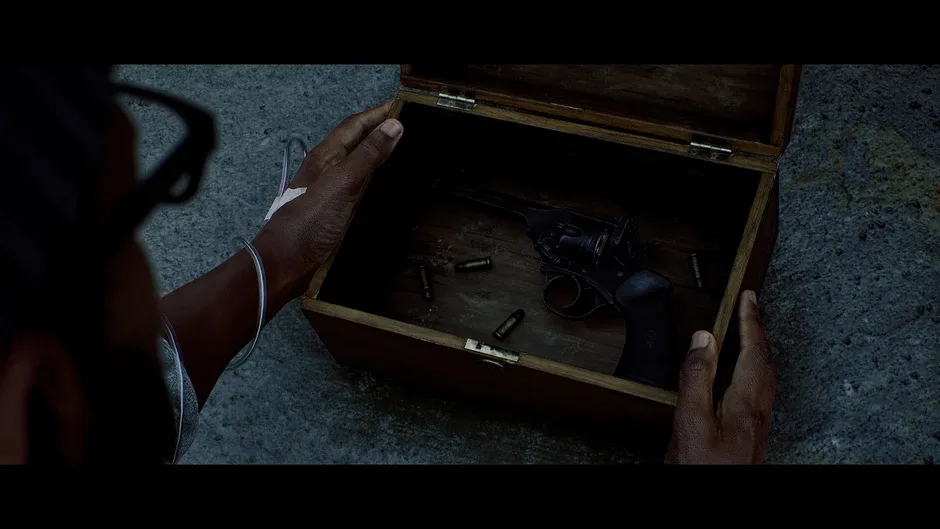
Simon fights the way someone who has never been a soldier would fight: badly, and only when there is no other option. Melee weapons are scavenged rather than carried, wooden planks and iron pipes that break down with use, and firearm ammunition is rationed tightly enough that most encounters are built to be avoided through cover-based evasion rather than won outright. This is where the first-person perspective works against the game as often as it works for it. Swinging a plank at a lunging enemy from a first-person camera lacks the readability a third-person angle gives you to judge distance, and more than one death in St Amelia's tighter corridors comes down to misjudging a swing rather than misreading a threat. The stealth side fares better in the early game, where a pursuing presence in the fog forces genuine route-planning and a held breath around corners, but the design leans on that same cat-and-mouse structure for long enough in the game's middle stretch that the tension it built in the first few hours has largely drained out by the time a new mechanic finally arrives to replace it.
Structure: six parts and a shrinking safe zone#
Townfall is broken into six numbered parts rather than open-ended free roam, and each one narrows St Amelia a little further, closing off an area that felt safe in the previous part and opening a new one in its place. The docks and general store that anchor the opening hours are effectively sealed off by the midpoint, and the sense of a map that keeps contracting around Simon does more to sustain dread through the middle stretch than the stealth encounters themselves do. It also means Townfall never asks the player to backtrack across the whole island the way some earlier entries in the series did once new equipment opened up an old area; every part hands you a smaller, denser space instead, which keeps pacing tight even when the moment-to-moment stealth loop inside that space repeats itself.
Simon Ordell and the shape of guilt#
The writing keeps its ambitions narrow and mostly delivers on them. Rather than a mystery about the town's history, Townfall is a mystery about one man's specific failure, doled out through fragmented memories, other residents who each carry a piece of what happened at St Amelia, and environmental storytelling that rewards actually reading the notes and listening to the tape recordings scattered through the island rather than skipping past them. Simon is a difficult protagonist to like in the early hours, which is clearly deliberate, and the slow reveal of exactly what he needs to "put right" lands with more weight than a jump scare would. The game's five distinct endings are not cosmetic variations on the same scene; they represent meaningfully different readings of whether, and how, Simon can accept what he has done, which gives the back half of the story a genuine sense of consequence rather than a single predetermined outcome dressed up as a choice.
Puzzles and the CRTV beyond the first hour#
The CRTV's job expands well past its introductory use as a hazard-finder. By the second act it doubles as the game's puzzle interface: static resolves into hidden symbols that need to be matched against markings found elsewhere on the island, faint outlines only visible through the device's screen reveal safe routes through rooms that look identical to the naked eye, and one late chapel puzzle asks the player to slowly pan the CRTV across a stained-glass window while cross-referencing a hand-drawn diagram found earlier, a sequence that plays like a physical, diegetic take on the item-combination puzzles the series has used since the original game. None of the puzzles lean on the moon-logic obscurity older Silent Hill entries were sometimes accused of; the difficulty slider mentioned above can soften them further for players who came for the story rather than the brain-teasers, and the game is generally good about seeding the answer somewhere nearby rather than expecting outside knowledge.
Five endings, one town#
The five endings are unlocked through a combination of specific choices, optional conversations completed earlier in the run and items found rather than a single binary flag near the credits, which mirrors how the series has handled multiple endings since the original game rather than reinventing the idea. What makes the approach work here is that none of the five feel like a joke ending bolted on for a laugh; each represents a genuinely different answer to whether Simon deserves, wants or is capable of forgiveness, and the game is content to let some of those answers be bleak. Because several of the choices that steer toward a given ending happen well before the credits, actually seeing more than one requires a deliberate second playthrough rather than a quick epilogue replay, which is the main reason the full-completion time roughly doubles the length of a single run.
Sound design and Pilotpriest's score#
Composer Pilotpriest, the alias of Anthony Scott Burns, takes over scoring duties from Akira Yamaoka for the first time in a mainline entry, and the choice pays off. Rather than a fixed, looping soundtrack, the score reacts in something close to real time to what Simon is doing: a held breath during a stealth sequence carries a different texture than the ambient hum of an empty corridor, and the industrial clang that creeps in as the Otherworld asserts itself never quite resolves into a melody, which keeps it unsettling rather than merely moody. It is a clear homage to Yamaoka's industrial-ambient style rather than an attempt to replace it, and it is one of the clearest signs that Screen Burn Interactive understood which parts of the series' identity were worth protecting.
Performance: the part that needs a patch#
The version that shipped on 24 September 2026 has real technical problems on both platforms. Shader-compilation stutter, a familiar complaint on Unreal Engine 5 titles, interrupts otherwise tense sequences on PC even on capable hardware, and traversal through St Amelia's tighter streets produces noticeable hitching that a pre-generated shader pass has not fully solved. The PS5 version fares somewhat better but still drops frames during the game's more demanding combat and Otherworld transition sequences. A small number of players have also run into an unsolvable puzzle state and a black screen during one key cutscene, both serious enough to interrupt a run outright rather than merely look rough. None of this makes the game unplayable, and a day-one-adjacent patch is a reasonable expectation given Konami's track record with the Silent Hill 2 remake, but anyone sensitive to stutter should wait for at least one round of patches before buying at launch.
Compared with Silent Hill 2 and Alan Wake 2#
Silent Hill 2's 2024 remake is the obvious point of comparison, and Townfall deliberately does not try to out-do it on the same terms. Where the remake is a third-person reinterpretation of a known story with combat closer to a traditional survival-horror loadout, Townfall commits fully to a new protagonist, a new setting and a first-person view that trades some of that combat readability for a much tighter, more claustrophobic sense of place. Alan Wake 2 is the better comparison for tone: both games are more interested in a fractured, guilt-driven psychological mystery than in monster variety, and both use an unconventional narrative device, Alan Wake 2's manuscript pages, Townfall's CRTV, to turn environmental storytelling into an active puzzle rather than a background collectible. Townfall's Otherworld transitions have more raw dread in them than either game manages at its best, but its combat is noticeably weaker than either, and its pacing in the middle act is the one place both of those other games handle their slower stretches with more control. Resident Evil Village is worth a mention too, since it is the other recent horror game built primarily around a first-person camera, but the comparison mostly highlights how differently the two approach the perspective: Village leans into first-person combat with a genuine arsenal and boss fights that would work in third person as well, while Townfall treats the first-person view as inseparable from the CRTV's puzzle-and-hazard function, and its combat suffers for not getting the same amount of design attention Capcom gave Ethan Winters' shotgun.
Worth the money?#
At $49.99 for the standard edition and $59.99 for the Digital Deluxe Edition, Townfall sits at a normal price for a mid-length narrative horror game rather than a full-priced blockbuster, and the 12 to 14 hours it takes to see one ending, with 20 to 25 hours needed to see all five, is a reasonable amount of content for that price if the story pulls you in. It is available only on PlayStation 5 and PC through Steam and the Epic Games Store, with no Xbox version at launch and no confirmed date for one.
| Platform | Price | Launch condition |
|---|---|---|
| PlayStation 5 | $49.99 / $59.99 Deluxe | Occasional frame drops in combat and Otherworld transitions |
| PC (Steam, Epic Games Store) | $49.99 / $59.99 Deluxe | Shader-compilation stutter and traversal hitching, most noticeable on launch |
| Xbox Series X|S | Not available | No confirmed release date |
Buying now means accepting the current patch state; waiting a month or two for the shader and stability issues to be addressed is the safer option for anyone who plays primarily on PC, where the stutter is currently most noticeable.
Play this instead if …#
If you want a shorter scare, Visage's haunted-house loop delivers a tighter two-to-three-hour fright without Townfall's pacing dip. If you want something easier and more forgiving, Alan Wake 2 trades some of Townfall's claustrophobia for a more traditional third-person camera and a more generous combat loadout. If you want a cheaper way into modern Silent Hill, the Silent Hill 2 remake is frequently discounted and delivers a tighter, more consistently paced horror story with a combat system built around its third-person perspective from the start. And if none of those quite fit, Resident Evil Village offers a similar first-person vantage point with a far more generous combat loadout for anyone who wants the dread without the scarcity.
Frequently asked questions#
How long is Silent Hill: Townfall? The main story runs 12 to 14 hours, with 15 to 20 hours for a thorough first playthrough and 20 to 25 hours to unlock all five endings.
Is it an open world? No. St Amelia is a linked set of explorable areas rather than an open map, closer in structure to earlier entries in the series than to a modern open-world game.
Does it have co-op or multiplayer? No. Townfall is a single-player experience from start to finish, with no co-op or competitive modes of any kind.
Is there a difficulty option? Yes, with separate sliders for combat difficulty and puzzle difficulty, letting players lean harder into the story if the stealth encounters or CRTV puzzles prove too demanding.
Do you need to have played earlier Silent Hill games first? No. Townfall introduces an entirely new protagonist and setting with no direct narrative link to earlier entries, though longtime fans will recognise the series' visual and tonal fingerprints throughout.
Is the PC version stable at launch? Not entirely. Shader-compilation stutter and traversal hitching affect the PC version more than the PS5 version at launch, and players sensitive to frame pacing issues should wait for a patch.
Is Simon Ordell a returning character from an earlier Silent Hill game? No. Simon is an original protagonist created for Townfall, with no ties to Harry Mason, James Sunderland or any other established Silent Hill character, though the town of St Amelia sits within the same fictional world as the rest of the series.
The Game Avant verdict#
Silent Hill: Townfall proves the series still has genuinely new places to go, and St Amelia's slow slide into its rusted, red-lit Otherworld is some of the most effective horror atmosphere the franchise has produced in years. What keeps it from greatness is everything around that atmosphere: a middle act that repeats its stealth-chase idea long after it has stopped working, combat that the first-person camera never quite makes comfortable, and a launch build that stutters on the platform, PC, where you would most want a horror game to run smoothly. It is a game worth playing for what it gets right, but not one that needed to ship exactly when it did. Screen Burn Interactive has clearly earned the right to make a second Silent Hill game; whether Townfall itself earns a place next to the series' best will likely depend on how much of its middle act a patch can tighten after the fact.
7 out of 10 – a bold, unsettling return to form that a rough middle act and a shaky launch keep from becoming essential.