
Five years, eight biomes, one longhouse that finally stands up#
Valheim left Early Access on 9 September 2026, roughly five and a half years after Iron Gate Studio's Viking survival game first appeared on Steam in February 2021 and sold faster than a ten-person indie team could plan for. Version 1.0 adds the Deep North, the eighth and final biome, a new last boss called Kall Fimbulbringer, full crossplay across PC, Mac, Linux, Xbox One, Xbox Series X|S, PlayStation 5 and Nintendo Switch 2, and a price increase from $19.99 to $29.99 for anyone buying in fresh. None of that would matter if the five years in between had not already proven the core idea. What 1.0 does is close the loop: the climb from a driftwood raft to a warship, from a dirt lean-to to a fortified hall, from Eikthyr's antlers to a chained jotun in a blizzard, now has an actual ending, and it is a better one than most survival games ever manage to write.
What makes Valheim different#
The one idea the whole game is built on is that building is not decoration bolted onto survival, it is the survival. Every wall, beam, floor and roof panel in Valheim occupies real physical space and needs real structural support: a wooden beam can only cantilever so far before it needs a column beneath it, a stone wall built without a solid foundation eventually collapses under its own weight, and fire genuinely spreads across thatch roofing if a hearth is placed carelessly. That single design decision changes what "building a base" means. It is not a creative-mode flex; it is an engineering problem that has real consequences, and the game tells you about those consequences with a groaning sound and a support-beam highlight rather than a pop-up. A longhouse with a working roof, load-bearing pillars and a stone foundation that keeps out Greylings is not just a place to store loot. It is proof that a player understood the game's actual central system, and nothing else in the survival genre rewards that kind of literacy as directly.
Building: structural integrity as the actual game#
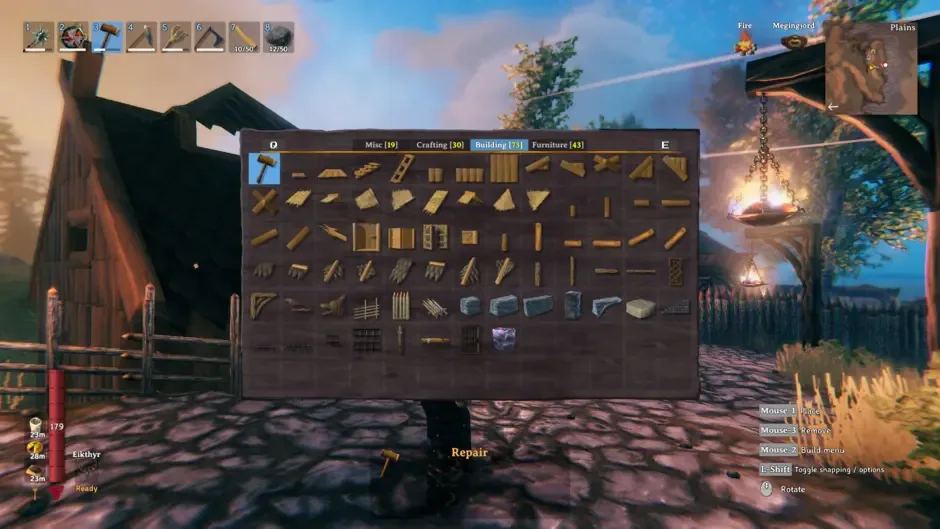
Building in Valheim starts from a hammer, a stake and whatever the current biome's wood or stone will allow, and it never really stops being the thing players do between everything else. The Hammer's piece list grows with every biome and every crafting station unlocked, from Core Wood beams that let roofs span further in the Swamp, to the Stonecutter's arches and pillars once Bonemass falls, to the Deep North's new Scalewood pieces and the steeper, more traditionally Norse roof angles introduced in 1.0. What has not changed since the earliest builds is the structural integrity system underneath it: pieces are colour-coded by how much stress they are under, a wobble animation warns before a section fails, and a genuinely overloaded structure will come down in a satisfying, physically simulated collapse rather than simply vanish. The new Frost Foundry and Ice Maker crafting stations, added with the Deep North, extend that toolset into cold-weather food and gear production, but the underlying appeal is unchanged: a base in Valheim is a running argument between what a player wants to build and what the game's physics will actually let stand, and winning that argument is one of the most quietly satisfying loops a survival game has ever offered. Building never stops at the structures themselves, either. The Cultivator and Hoe let a player flatten a hill for a proper courtyard or lay out rows of turnips and flax in straight fields, and the Cart and the increasingly large ships, from the humble Karve to the Ashlands' Drakkar, make it practical to actually haul home the ore and timber that bigger builds demand. Together, terraforming and transport turn a base into more than a house: a farm, a harbour and a logistics chain a player has designed themselves.
Exploration and the eight biomes#
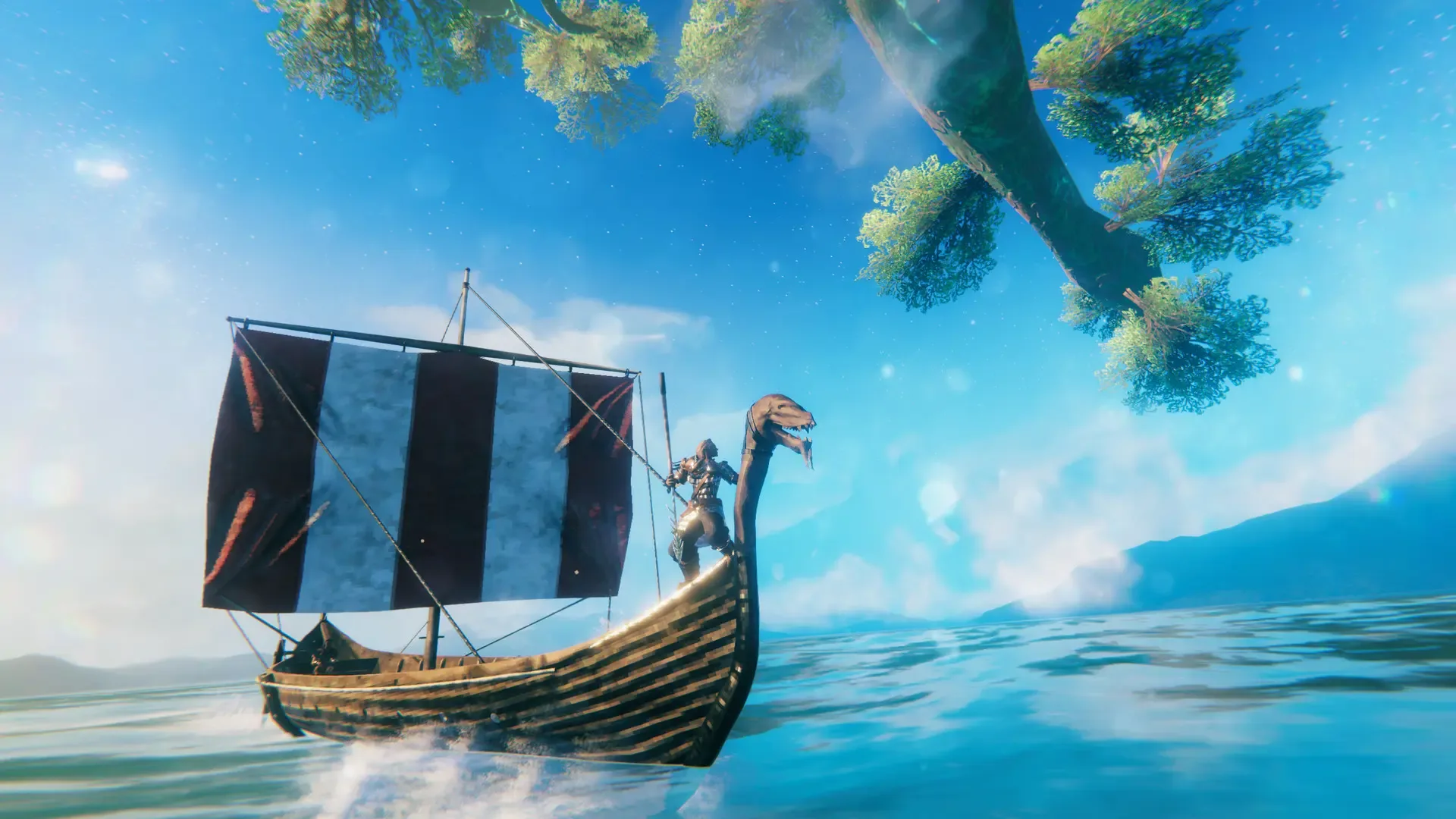
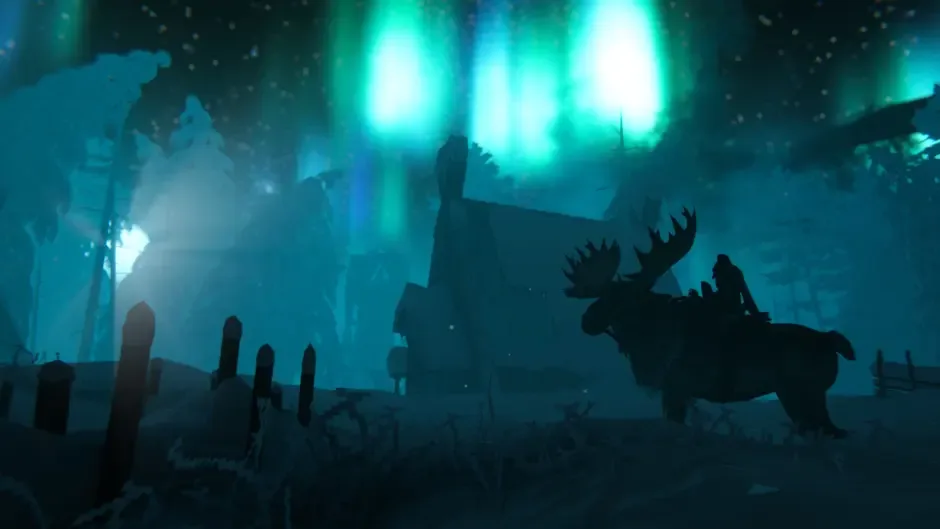
The map is procedurally generated per world seed, and the core idea, unchanged since launch, is that a boat and a compass are the only navigation tools a player gets. Meadows, the starting biome, is gentle enough to teach the basics without threatening a fresh character; Black Forest introduces the game's first real combat pressure and the Elder, its second boss; the Swamp is the game's most infamous difficulty spike, a rot-and-leech gauntlet that guards Bonemass and the iron needed to progress; the Mountains bring frost damage and wolves that hunt in packs around Moder's peak; the Plains, guarded by Yagluth, punish anyone who has not yet built proper defences against Fulings throwing fire; the Mistlands, added in December 2022, replaced blind stumbling with the Wishbone's beeping proximity detection and introduced The Queen, a boss fight built around a swarm of seekers rather than a single health bar; the Ashlands, added in May 2024, turned the map's southern border into an active lava front defended by Fader and the game's most aggressive enemy roster. The Deep North, arriving with 1.0, closes the loop at the world's northern edge: a biome of glacial peaks, sustained blizzards and snow-buried Viking settlements, gated behind the resources and gear the previous seven biomes hand out, and ending at Kall Fimbulbringer's lair. Sailing between all of them, watching a coastline resolve out of fog with no marker telling you what is over the next ridge, remains the single best reason to play Valheim over almost anything else in the genre.
Combat: axes, bows and a boss rotation eight names long#
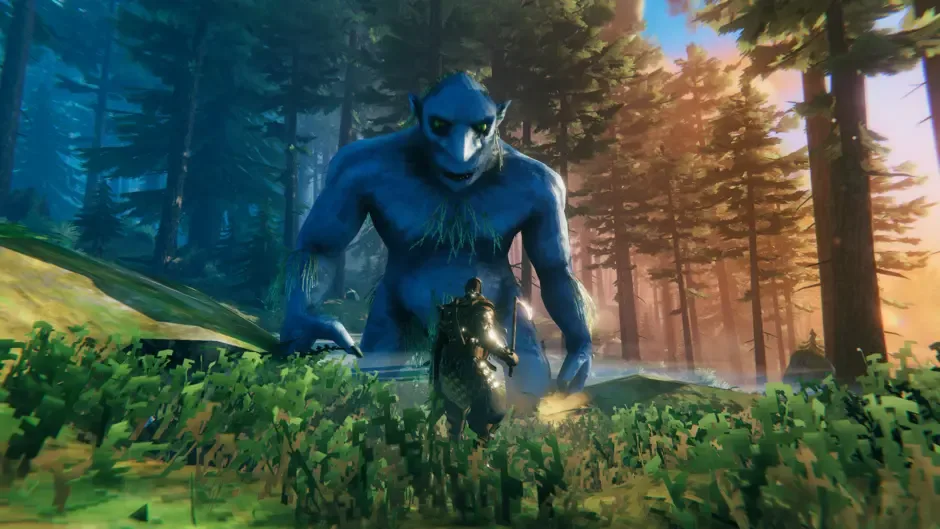
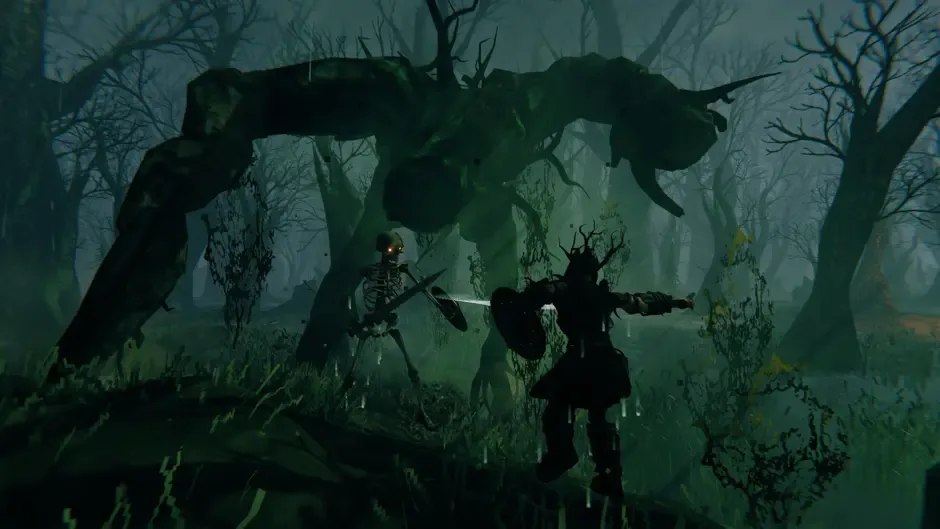
Combat in Valheim has always been stamina-managed and deliberately unglamorous: a swing, a block, a dodge roll, and a stamina bar that punishes greed far more than it punishes caution. Version 1.0 rebalances the late game specifically so magic, added properly with the Mistlands' Blood and Elemental staves, does not simply outclass melee and ranged builds in group content, and it adds a genuine arsenal alongside that fix: Nord-style axes, greatswords, a heavy Frostfire crossbow and more than forty new weapons and tools across the update, most of them tied to the Deep North's frost-and-jotun theming. What still carries the system, five years on, is the boss rotation: Eikthyr in the Meadows teaches the dodge-roll basics, The Elder in the Black Forest introduces area denial, Bonemass in the Swamp is a war of attrition against poison, Moder in the Mountains adds an aerial phase and frost breath, Yagluth in the Plains is the last "classic" single-target fight, The Queen in the Mistlands turns the fight into crowd control against dozens of seekers at once, Fader in the Ashlands punishes anyone who has not learned to manage a lava arena, and Kall Fimbulbringer in the Deep North closes it all out as a jotun bound in chains, a figure lifted straight from the part of Norse mythology that precedes Ragnarök. Each fight demands a build check as much as a mechanical one, and the escalation from Eikthyr to Kall Fimbulbringer is the clearest evidence in the game that Iron Gate always knew where this story was going, even during the years when Early Access left the ending unwritten.
Progression: no levels, just gear checks#
Valheim has no character level and no experience bar tied to killing things; instead, progression is entirely a function of what a player has built, mined and cooked. A new arrival with a flint knife and a torch is not weaker than a Deep North veteran because of a hidden number, but because the veteran is wearing Fenris armour, wielding a weapon forged from black metal, and eating three food types that push their health and stamina pools well past what raw hide armour and boar meat allow. That makes every biome transition a genuine checkpoint rather than a soft recommendation: walking into the Swamp in Bronze gear is technically possible and often fatal, and walking into the Ashlands without Mistlands-tier armour and fire resistance mead is close to a guaranteed wipe. The food system reinforces this by capping a player at three active effects at once, which forces a real choice between health-focused, stamina-focused or balanced eating rather than letting a player simply stack every buff available. Skills level up individually through use, so a player who fights exclusively with a sword and never blocks will end the game mediocre with a bow and excellent at parrying, which is a quieter kind of character build than a skill tree but arguably a more honest one, since it reflects how the game was actually played rather than a menu a player scrolled through once at the start.
Multiplayer and co-op: built for a longhouse full of friends#
Valheim has supported up to ten players on a dedicated server since Early Access, but 1.0's headline multiplayer change is crossplay, finally uniting a playerbase that spent five years split across Steam, Xbox and PC Game Pass, and now extends that unified pool to PlayStation 5 and Nintendo Switch 2 as well. The game was designed around groups from the start, and it shows in ways that go beyond simply letting more people log in: base building scales naturally to however many hands are hammering nails, boat crews genuinely need a second person to row while a first person steers during a storm, and boss fights are tuned around the assumption that a full server will show up, which is why a solo or duo attempt on Fader or Kall Fimbulbringer is a considerably harder proposition than a ten-person raid would suggest. None of that makes solo play unviable, since Valheim scales its own pressure down for smaller groups by letting a patient player out-prepare a fight rather than out-gun it, but the game's best moments, a longhouse raised over a weekend by four people who each specialised in a different part of the build, a night sail through the Ashlands with someone on lookout duty, remain the ones built for a group.
The Deep North and five years of biomes closing#
The Deep North is the biome Iron Gate has been building toward since the original roadmap, and 1.0 treats it as the genuine finale rather than one more content drop. It brings its own equipment tier, ten-plus new creatures adapted to a blizzard environment, new dungeons carved into glacial ice, more than eighty new buildable pieces, thirty-plus new crafting materials, twenty-plus new food items, new music and a full new event cycle, alongside a grappling hook that finally solves the vertical-traversal problem the game's cliffs have posed since launch. The bigger change is structural rather than content-based: defeating a boss now triggers a handcrafted, animated cutscene that recaps the run so far and hints at what is coming, Hugin the raven's dialogue has been expanded and reworked to actually track a player's progress rather than repeat generic lines, and the runestones scattered through every biome now read as a connected account of what happened to this world rather than isolated flavour text. Valheim was never going to become a story-driven game, and it has not tried to; what 1.0 does instead is make the sparse mythology that was always there feel authored rather than incidental, which is a better outcome for a game whose real narrative has always been told through longhouses, not dialogue trees.
Compared with Minecraft and Enshrouded#
Minecraft is the inevitable comparison for anyone describing a building-and-survival game, and the honest answer is that they solve different problems. Minecraft's building is essentially unconstrained: blocks float, structures never collapse, and the appeal is purely creative freedom across an effectively infinite, blocky world. Valheim's building is the opposite proposition: every piece obeys weight and support, so the reward is not freedom but competence, the feeling of having actually engineered something that would stand up in the real world if physics behaved slightly differently. Minecraft also has no true difficulty ceiling without deliberate self-imposed rules; Valheim's eight-boss gate means a player cannot simply out-build their way past Bonemass or Fader, which keeps its progression far more disciplined at the cost of some of Minecraft's total freedom. Enshrouded is the closer modern rival, since it borrows Valheim's biome-gated boss structure and voxel-based building directly, but it swaps Valheim's boat-and-open-water exploration for a more traditional fantasy map and leans further into RPG skill trees than Valheim ever has. Anyone who wants Valheim's building discipline with more combat customisation should look at Enshrouded; anyone who wants the specific, unhurried thrill of sailing toward an unmarked coastline should stay with Valheim, because nothing else in the genre has matched that particular feeling since 2021.
Worth the money?#
At $29.99 for a new purchase, Valheim covers a genuinely complete game for less than most single-player campaigns half its length, and anyone who already owned it before 1.0 keeps that copy without paying the difference. A focused run through all eight biomes and their bosses takes somewhere in the range of 40 to 60 hours depending on group size and how much time goes into building rather than progressing; a completionist pass through the Deep North's new dungeons, achievements and crafting tree adds considerably more on top of that, and a dedicated server with a stable group of friends can easily turn Valheim into a game played in short sessions for a year or more. It is best played on PC or a current-generation console with at least a duo, since solo play is viable but noticeably slower and less forgiving in the later biomes; a dedicated server is worth setting up for any group larger than three, since it keeps the world running without one person's console needing to stay online. Buying now at full price is a reasonable choice given the finished state of the game, though anyone with no urgency should expect the usual seasonal sales to bring the price back toward its old Early Access level within a few months.
Play this instead if …#
Shorter: Raft delivers a tighter, more focused survival loop, ten to fifteen hours to its ending, without Valheim's biome-spanning scope or its boss-gated combat.
Easier: Minecraft trades Valheim's structural physics and boss difficulty for a gentler, more forgiving building sandbox where nothing collapses and nothing forces a fight.
Cheaper or co-op: Core Keeper is a cheaper, more compact take on the same biome-progression idea from a top-down perspective, built from the start for four-player co-op sessions shorter than a full Valheim raid.
Frequently asked questions#
How long is Valheim? Roughly 40 to 60 hours for a focused run through all eight biomes and bosses, considerably more for a completionist pass through the Deep North's dungeons and achievements, and effectively open-ended for a group that keeps a dedicated server running.
Is Valheim open world? Yes. Each world is procedurally generated per seed, explored primarily by boat, and split into eight biomes gated by boss difficulty rather than an invisible level requirement.
Does it have co-op? Yes, up to ten players on a single server, with full crossplay across PC, Mac, Linux, Xbox One, Xbox Series X|S, PlayStation 5 and Nintendo Switch 2 as of the 1.0 launch.
Is there a difficulty setting? Yes, a set of world-modifier sliders let a host adjust enemy damage, resource rates and raid frequency independently, which is the closest thing to an easy mode without changing the core structural-building system.
Do you need to have followed Early Access to enjoy 1.0? No. A new world starts identically for a returning veteran and a first-time player, and the biome-gated boss structure teaches its own systems as a player progresses regardless of history with the game.
Is Valheim actually finished now? As of 9 September 2026, yes: the eighth and final biome, the last boss and full cross-platform crossplay are all in the base game, closing a roadmap Iron Gate has been executing since 2021.
The Game Avant verdict#
Valheim's 1.0 release does the thing very few five-year Early Access games manage: it ends, and the ending is good. The Deep North is not a victory lap tacked onto a game that had already said everything it wanted to say; it is a biome built with the same structural-building depth, the same stamina-managed combat and the same "sail toward the fog and find out" exploration that made the game a phenomenon in February 2021, closed out by a boss that actually earns the mythological weight of being the last one. The grind for late-game ore has not gotten shorter, group combat still rewards a bow or a staff more than an axe, and world generation can still be unkind to a player hunting for one specific resource. None of that outweighs what Valheim gets right, which is a building system nothing else in the genre has matched, an exploration loop that still rewards curiosity over checklists, and now, finally, crossplay and an ending that were both worth the wait.
9 out of 10 – the best building game in the survival genre finally has a finish line, and the finish line was worth the five-year walk.