
A card game that turns into an equation#
Balatro takes a game everyone already knows, five-card poker hands, and asks a question nobody had quite asked before: what if a pair was not a hand you win with, but a number you build. Developed solo by the pseudonymous LocalThunk and published by Playstack, it released on 20 February 2024 for PC via Steam, PlayStation 4, PlayStation 5, Xbox One, Xbox Series X|S and Nintendo Switch, with a macOS version following on 1 March and an iOS and Android release on 26 September of that year. A dedicated Nintendo Switch 2 edition arrived on 25 February 2026. None of that explains why it works. What explains it is that Balatro replaces a card game's win condition with a scoring engine, chips times mult, and then hands you a shop full of Jokers whose entire purpose is to make that number as absurd as possible.
What makes Balatro different#
The one idea that carries the whole game is the formula itself: score equals Chips multiplied by Mult. Every card has a base chip value, every poker hand adds a chip bonus and a multiplier on top of that, and every Joker you buy modifies one side of that equation or the other, sometimes both at once, sometimes only under a condition you have to notice yourself. A pair of Jacks is worth very little on its own. A pair of Jacks played through a Joker that adds Mult for every face card, discarded into a hand rebuilt with a second Joker that doubles Mult on a scoring flush, and scored with a deck that has been quietly mutated by Tarot cards into mostly high-value suits, is worth a number with six or seven digits. The game never explains that this is possible. It only gives you the pieces and trusts you to notice that Blueprint, a Joker that copies whatever sits to its right, does something different next to Brainstorm, which copies your leftmost Joker instead, and that placing both next to a strong effect Joker turns two mediocre cards into a duplication engine. Finding that kind of interaction yourself, the first time, is the best moment the genre has to offer, and Balatro produces it constantly.
The ante, the blinds and the shop#
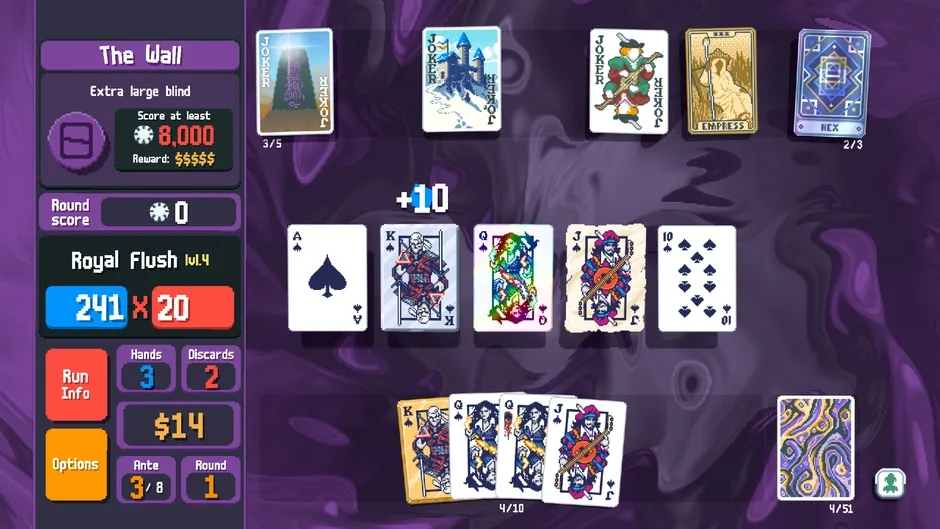
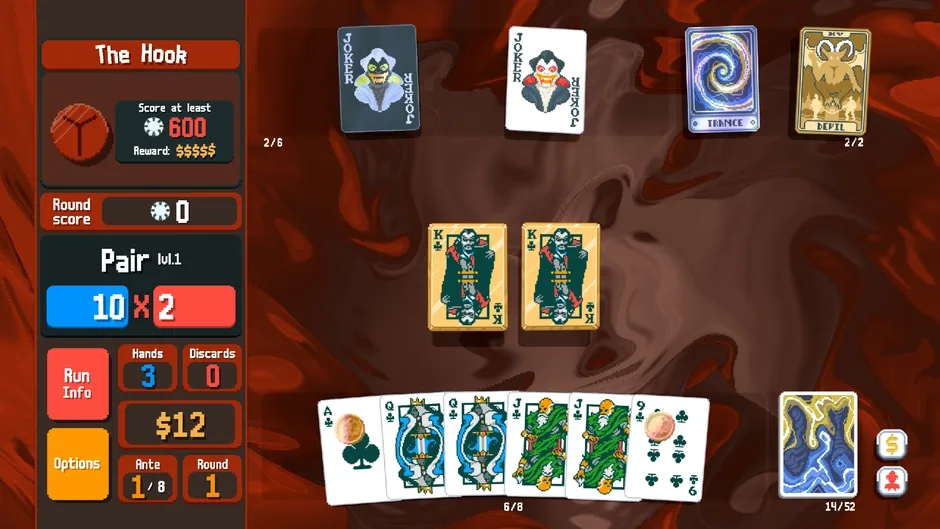
A run is built from eight Antes, and each Ante has three Blinds in sequence: a Small Blind, a Big Blind, and a Boss Blind. The first two are optional to fight, skipping one for a Tag reward instead, but the Boss Blind is mandatory and always carries a modifier that actively works against your plan rather than simply raising a target score. The Wall doubles the score you need. The Ox sets a hand type to zero chips for the round the first time you play it. The Needle halves the number of hands you are allowed to play. The Manacle shrinks your hand size by one card. None of these are difficulty spikes in the traditional sense; they are constraints that force you to notice what your build actually depends on. A Joker engine built entirely around playing Flushes falls apart the moment a Boss Blind bans Flushes for a round, and the run's tension comes from whether your other cards and Jokers can cover the gap.
Between Blinds, the shop is where a run is actually won or lost. It sells Jokers, Tarot and Planet cards that permanently upgrade a hand type's base chips and mult, Spectral cards with rarer, riskier effects, and Vouchers that unlock permanent shop and hand upgrades for the rest of the run. Money is tight enough in the early Antes that every purchase is a real decision, and the difference between a run that snowballs into six-figure scores by Ante 5 and one that dies at Ante 3 is very often which two or three Jokers happened to be on sale in the first shop. That randomness is the single biggest thing to know going in: Balatro does not promise a fair fight every time, and it does not need to, because a lost run costs fifteen to forty minutes rather than an evening.
Jokers: the system inside the system#
There are over 150 Jokers, and they range from straightforward chip or mult bonuses to Jokers that rewrite how scoring works entirely. Baron multiplies the score of every King still held in hand. Perkeo, one of the rarest Jokers, creates a negative copy of a random consumable card at the end of every shop visit, quietly building toward the kind of exponential scoring the game's most dedicated players chase. Most Jokers are legible the moment you read them; the depth comes from combining several at once and noticing what order they trigger in, since Jokers resolve left to right and that order is something you control by dragging them around your row. The result is a card game where deckbuilding barely means choosing which fifty-two cards to keep; it means choosing five or six Jokers whose effects compound in the right sequence, and rearranging that sequence the moment a Boss Blind punishes your current one.
Decks and Stakes: one card game, eight difficulty settings#
Balatro ships with a dozen or so unlockable Decks, each one changing the starting rules of a run rather than just its cosmetic back: the Red Deck starts with an extra discard, the Blue Deck an extra hand, the Checkered Deck replaces every Club and Spade with a Heart or Diamond before you draw a single card. Layered on top of every deck is a set of eight Stakes, White through Gold, each one adding a permanent, cumulative penalty once unlocked by beating a deck's current highest Stake. Red Stake removes the money from Small Blinds. Green Stake raises how fast score requirements scale. Black Stake introduces Eternal Jokers that can be destroyed but never sold, forcing harder choices about what to keep. Blue Stake removes a discard. Gold Stake, the hardest, gives a chance for Jokers to arrive with a Rental sticker that charges you every round just for owning them. None of this changes the core formula. It changes how much room you have to make mistakes while chasing it, and clearing a deck on Gold Stake is a genuinely different, much harder game than clearing it on White.
Challenges and the long tail of content#
Beyond the standard eight-Ante climb, Balatro includes a set of fixed-seed Challenge runs that impose specific starting restrictions, a banned Joker, a locked deck composition, a shop stripped of certain rarities, that push a player to solve the scoring formula from an unfamiliar angle rather than repeating a proven strategy. These are entirely optional and do not gate any of the game's main content, but they are where a lot of the deepest system knowledge actually gets tested, since a Challenge that removes a player's usual crutch Joker forces a genuinely different read on what the shop is offering. Combined with the golden-sticker collection system, which rewards using every Joker to win a run at least once, Balatro's late-game content is less about a harder final boss and more about a checklist that quietly asks a player to master tools they would otherwise ignore in favour of a handful of proven favourites.
Difficulty and the shape of a run#
Balatro's difficulty does not come from reflexes or from a boss with a health bar; it comes from a run's economy. Early Antes are forgiving if you understand basic hand math, but the difficulty ramps sharply from Ante 5 onward, where score requirements start outpacing what a slow, unfocused build can produce. The honest way to describe it is that the game punishes indecision more than it punishes bad luck. A run that commits early to a scoring strategy, high-card spam with the right multipliers, a Flush engine, a small hand built entirely around Pairs, usually survives longer than one that buys whatever Joker looks strongest each time without a plan. There is no difficulty slider in the traditional sense, but the eight Stakes function as one, letting a player choose exactly how much margin for error they want a run to have.
Presentation: a small, confident aesthetic#
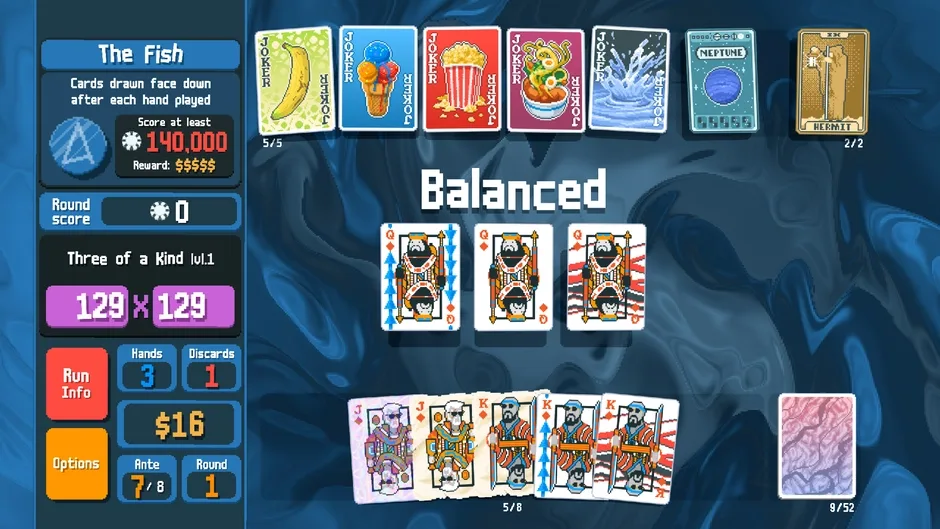
Balatro's look, a warm CRT-style scanline filter over hand-drawn cards and a jazzy, moody soundtrack, does a lot with very little. It never changes dramatically between a run's start and its ending scoreboard, and that consistency is deliberate: the game wants your attention on the numbers stacking up in the corner of the screen, not on shifting visual noise. It is a smart choice for a game meant to be replayed dozens of times, since a look that stayed interesting for exactly one playthrough would wear out fast at this length of engagement.
Tarot, Planet and Spectral cards: the second currency#
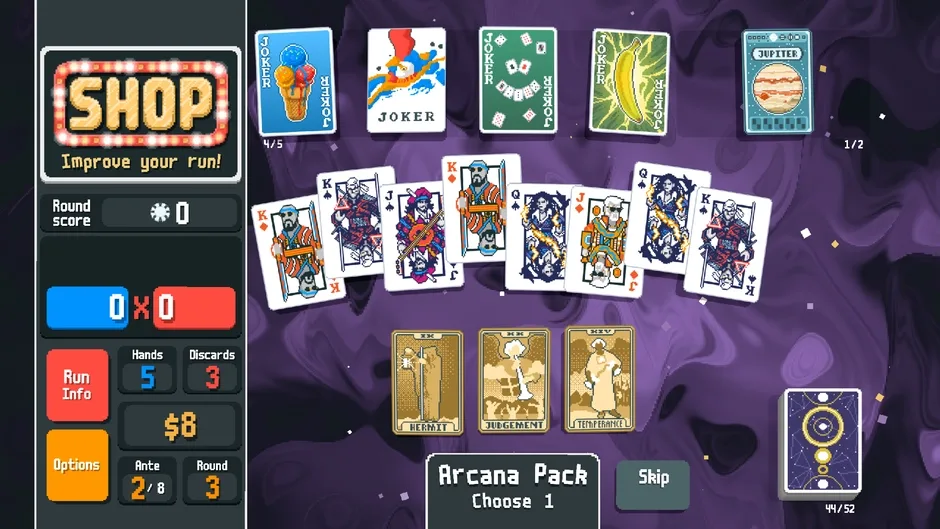
Jokers get most of the attention, but a large share of a run's actual scoring power comes from consumable cards bought or found between hands. Planet cards are the quiet backbone of the system: each one permanently levels up a specific poker hand type's base chips and mult, so repeatedly playing Flushes and feeding the shop's Planet cards back into that hand turns a mediocre starting hand into one of the strongest scoring tools in the run. Tarot cards work on the deck itself rather than on hand types, converting a handful of cards into a chosen suit, adding Enhancements like Steel or Glass to specific cards, or destroying cards outright to thin a deck down to its highest-value core. Spectral cards are the rarest and riskiest of the three, capable of transforming an entire hand's suit in one use or duplicating a card with a downside attached. None of these show up as a neat tutorial list; the game trusts a player to notice, a few Antes in, that a Planet card spent on a hand type nobody is playing is a wasted purchase, and that a Tarot card used to thin a deck down to eight or nine cards changes the odds of drawing a scoring hand more than any single Joker could on its own.
Vouchers and the shop as a second game#
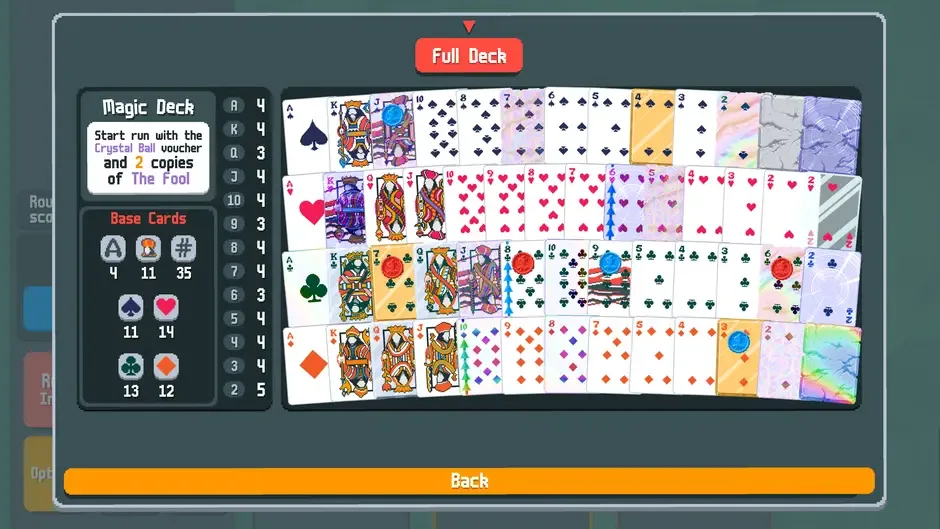
Underneath the shop's rotating stock of Jokers and consumables sits a second, quieter system: Vouchers, permanent upgrades that unlock more shop slots, cheaper rerolls, bigger hands, or extra card draws for the rest of a run. Vouchers only appear once per shop and only in a fixed order per category, which means a run's early Vouchers effectively decide how generous the rest of it will feel. A run that finds the Voucher granting an extra card in hand early can afford to build toward a five-card scoring hand that would otherwise be out of reach; a run that never sees it has to make do with tighter margins throughout. Because Vouchers, Jokers and consumables are all drawn from the same limited shop currency, most of Balatro's actual decision-making happens not during a hand but in the thirty seconds before one, deciding whether to bank money for a Voucher, gamble on an unproven Joker, or reroll the shop's stock outright at an increasing cost.
Compared with Slay the Spire and Balatro's own imitators#
Slay the Spire is the game every roguelike deckbuilder gets compared to, and the comparison is fair here because Balatro borrows its bones, deckbuilding, run-based structure, escalating difficulty, and does something genuinely different with them. Slay the Spire's tension comes from combat: every fight is a puzzle about surviving an enemy's specific attack pattern with the cards in your hand. Balatro removes combat entirely and replaces it with pure arithmetic; there is no enemy to read, only a target score and a shrinking set of hands and discards to reach it with. That makes Balatro considerably faster to learn, since there is no monster roster to memorise, but it also means the tension is quieter and more internal: the game never threatens you, it just asks whether your Jokers add up in time. Players who want the drama of a close fight will find Slay the Spire's combat more viscerally satisfying. Players who want the specific pleasure of watching a number compound past anything reasonable will find Balatro does that better than almost anything else in the genre, including the wave of card-and-dice roguelikes it has since inspired.
Worth the money?#
At $14.99, Balatro is one of the cheapest entries in its own genre, and the value case is not subtle: a first win against Ante 8 typically takes a couple of hours of actual play once the basics click, and unlocking the full roster of Jokers, Decks and Stakes is a project that comfortably runs past a hundred hours for anyone chasing full completion. Sales have followed the value: the game passed 3.5 million copies sold by the end of 2024 and crossed 5 million within a year of launch, on top of the separate mobile release. Free content, released under the "Friends of Jimbo" name, has added new deck skins and small extras since launch at no cost, and LocalThunk has publicly discussed a larger 1.1 content update, adding new Jokers and a new scoring trigger, that had not shipped as of this writing after being delayed from an earlier planned release. Best platform genuinely depends on how you want to play: it runs at a locked, comfortable frame rate on essentially any hardware, is officially Steam Deck-verified, and translates naturally to a phone screen on iOS and Android, since a single run rarely needs more than short, attention-sized sessions. Interface text is available in a range of languages; there is no voice acting to speak of, since the game has almost no dialogue.
Play this instead if…#
Shorter: Luck be a Landlord gives a similarly quick, math-driven roguelike loop built around a slot machine instead of a card hand, with runs that finish in ten to fifteen minutes.
Easier: Balatro's own lower Stakes, White through Green, already function as an easier mode without needing a different game; starting there and raising the Stake only once a Deck feels solved is the intended difficulty curve.
Cheaper or a longer single session: Luck be a Landlord and similar browser-adjacent roguelikes are frequently available for less than Balatro's asking price and scratch a similar itch for a shorter shopping list.
Frequently asked questions#
How long is Balatro? A single run to Ante 8 typically takes well under an hour once the rules click, and a first full win across a whole Ante 8 run usually comes within a couple of hours of total play. Unlocking everything, every Joker, every Deck and every Stake up to Gold, is a much longer project that regularly runs past a hundred hours.
Is Balatro an open world or story-driven game? No. There is no story, no dialogue and no world to explore; the entire game is the shop, the Blinds and the scoring formula, repeated across escalating runs.
Does it have co-op or multiplayer? No. Balatro is entirely single-player, run by run, with no online or local multiplayer mode.
Is there a difficulty option? Not a slider, but the eight Stakes function as one, each adding a new, permanent restriction once unlocked, from White up to the considerably harder Gold Stake.
Do you need to know poker to play it? Basic familiarity with poker hand rankings helps for the first few minutes, but the game teaches its own scoring system quickly enough that knowing how to play actual poker is not required.
Is it available on mobile? Yes, on iOS and Android, released after the original PC and console launch, with the same rules and content as the other platforms.
The Game Avant verdict#
Balatro is not a big game, and it does not pretend to be one. There is no story, no combat, no map to explore, and the loop of playing a hand, checking a shop and pushing toward the next Blind repeats hundreds of times before the credits of a single Ante 8 win even arrive. What it has instead is one of the cleanest, most quietly ambitious systems built inside a video game in years: a formula simple enough to explain in a sentence, and deep enough that finding a genuinely broken Joker combination two hundred hours in still feels like discovering something the game never told you existed. The randomness of the shop means not every run is winnable no matter how well it is played, and the audiovisual identity barely shifts across a hundred sessions, but neither of those complaints touches what the game is actually trying to do. It is a card game that turned itself into a spreadsheet, and then made that spreadsheet the most compelling thing about it.
9 out of 10 – a small, obsessively engineered system that makes an old card game feel newly dangerous.