

A mountain that has to be read before it can be climbed#
Cairn is a climbing game in the most literal sense. There is no sword, no jump button that solves problems and no double jump to cover a mistake. Aava, a professional mountaineer, wants to reach the summit of Mount Kami, a fictional peak that borrows from the Himalayas, the Alps and the Vercors massif, and the game hands over the one thing that makes that possible: control of her limbs. The result is a slow, tense and unusually physical adventure that treats every reach as a question and every ledge as a place to think.
The game was developed and published by The Game Bakers, the French studio behind Furi and Haven, and it arrived on PlayStation 5 and Windows on 29 January 2026 after a delay from its original November 2025 date. A Nintendo Switch 2 version has been announced for a later release. The score is an 8, and the reasons are straightforward: the climbing system is one of the most convincing ideas in recent action-adventure design, and its weaknesses are the ordinary ones, a story that stays quiet, a few technical seams and a survival layer that not everyone will want.

What makes Cairn different#
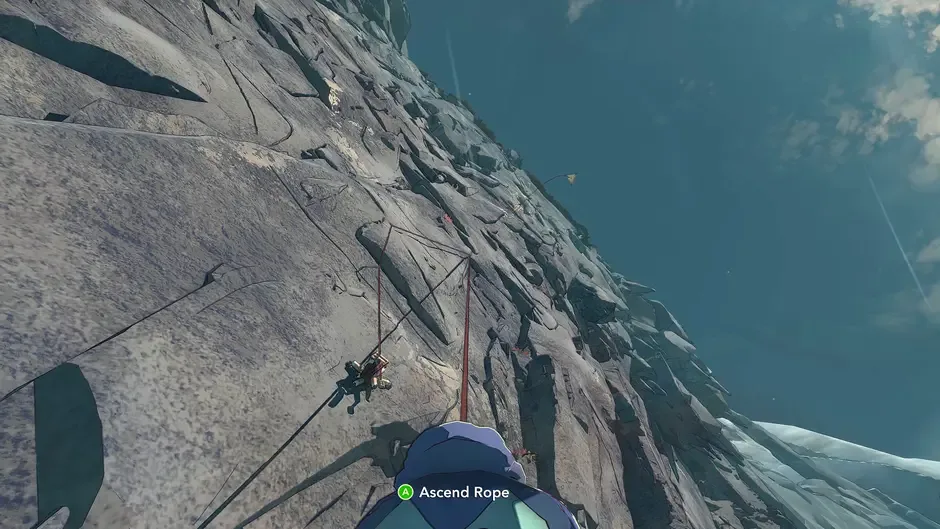
The one idea that carries the game is that climbing is not a movement mode but the entire game. In most adventures, climbing is a short interlude between fights, a scripted animation triggered when Lara Croft or Nathan Drake nears a ledge. Here it is the loop. Aava's hands and feet are placed one at a time on holds the player picks out of the rock, and posture and stamina decide whether a position can be kept for a second or for ten. A good route is one where each move sets up the next, and a bad one is where a reach ends at a hold that cannot carry the weight.
That sounds like a gimmick until the rock starts to matter. Each face is handcrafted rather than generated, and the climbing rules come from a physics and mathematics model that the studio spent three years refining, with input from the alpinist Élisabeth Revol and the Chamonix mountain guide Loan Giroud. The practical effect is that the mountain reads like a set of real problems. Where the body can lean, where a foot can rest and where a fall will begin are all things a player learns to see before touching the rock.
Two smaller ideas hold the structure together. Pitons function as checkpoints, so a fall costs only the distance since the last one was placed, and chalk raises grip so a difficult stretch can be attempted with better odds. Those two items, and the fact that both can run out, are what turn a series of moves into a plan. Nothing in the game asks for anything more complicated than that, and nothing needs to.
Every limb is yours: the controls#
The controls are the part that will decide whether Cairn works for a given player. Aava does not climb automatically. Each hand and each foot is moved separately, and the player chooses where it goes. Body position matters too, so a foothold that looks fine can become useless if the weight is on the wrong side. Stamina drains as the body holds tension, and posture decides how much of that tension a position costs.
This is a system that rewards patience and punishes haste in a way that is easy to describe and hard to internalise. A quick, greedy reach can leave Aava stretched and unable to recover, while a small step sideways that looks pointless can set up two clean moves. The best stretches of the game come when a route resolves in the head before the hands ever touch the rock, and the climb itself becomes execution of a plan. The worst come when an awkward camera angle or a stiff animation makes a move harder to judge than it should be.
There is also a rhythm to it. Short bursts of movement, then a rest to recover, then another burst. That rhythm gives the game a physical texture that fast action games rarely have, and it is the reason that a long ascent can feel like effort rather than progress on a bar. The tension comes from the body, not from enemies.

Survival on a vertical map#
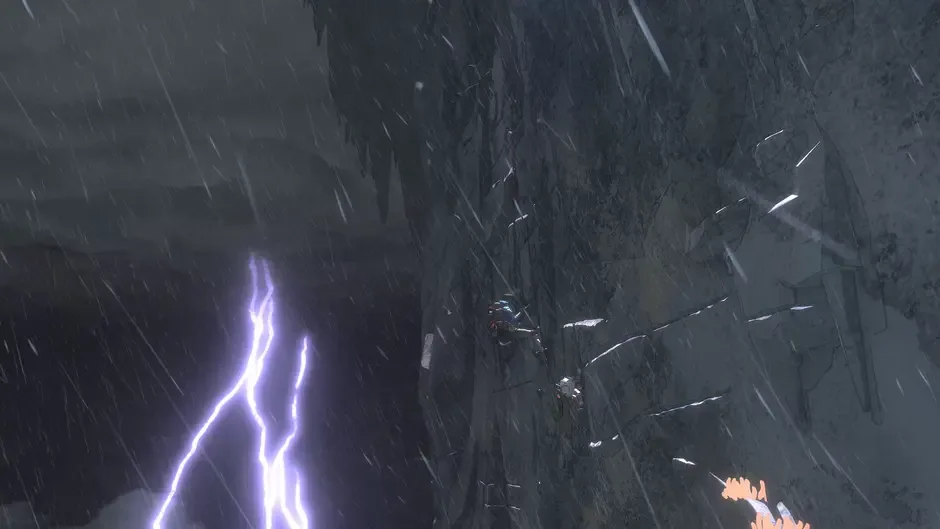
Around the climbing sits a survival layer built from hunger, thirst and temperature. Aava has a limited backpack, and what goes in it matters: food, water, pitons and chalk all compete for the same small space. Weather and the day-night cycle change how hard a wall is to climb, so the same route can be a manageable problem in good conditions and a serious one when the light fades or the temperature drops.
The bivouac is where the survival loop resolves. These shelters double as save points, and they are the places where Aava can rest, cook, bandage herself and repair equipment. That gives the mountain a pattern of push and recover that suits the material, and it means each rest is a small victory rather than a menu. Climbing to the next bivouac becomes a goal in itself, and reaching one after a difficult stretch has a relief that few games manage to produce.
The Climbot, a robot companion, ties the resource side together. It recycles pitons and makes new chalk, and friends also leave messages for Aava through it. That is a smart piece of design, because it gives the two most important consumables a clear source and a clear limit. It also gives the story a channel that does not require cutscenes.
The survival layer is also the most divisive part of the game. Some players will find that it deepens the climbing by adding pressure and consequence. Others will find that it pulls attention away from the rock, and that a moment of quiet becomes a chore of checking meters. Assist mode exists for exactly that reason, and it is the honest answer to the objection.
Mount Kami and the routes up it#
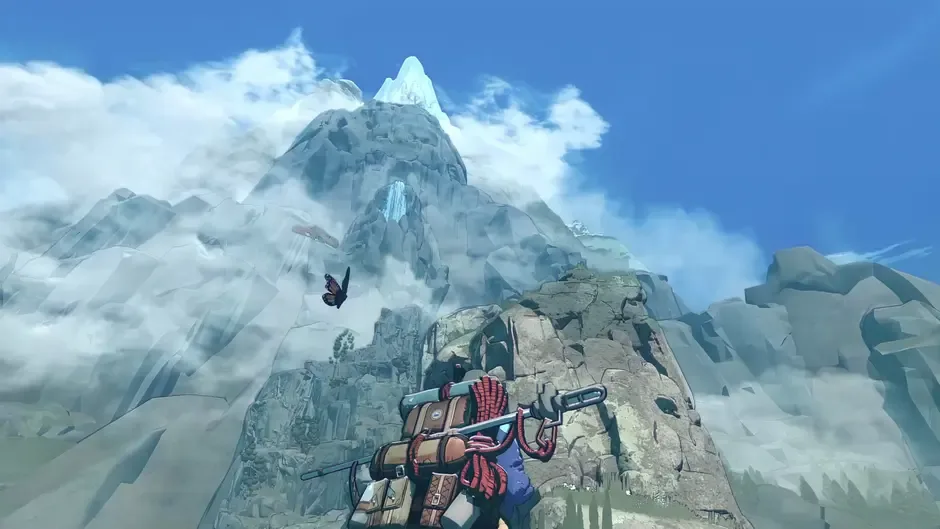
Mount Kami is a fictional mountain built as a real one would be, with faces, ledges and weather that make some lines harder than others. There is more than one path to the summit, and that freedom is central to the game. Choosing a route is part of the play, and the choice is shaped by resources, conditions and how much risk a climber is willing to take on a particular day.
That structure makes the mountain feel like a place rather than a series of levels. Aava can encounter other climbers, remnants of past expeditions and traces of a lost civilization of cave dwellers, and those discoveries are placed along the ascent rather than delivered in a hub. The world is designed to be read from below and re-read from above, which is one of the great pleasures of a climbing game. A wall that looked impossible from a ledge looks different from the top, and the sense of having earned the view is real.
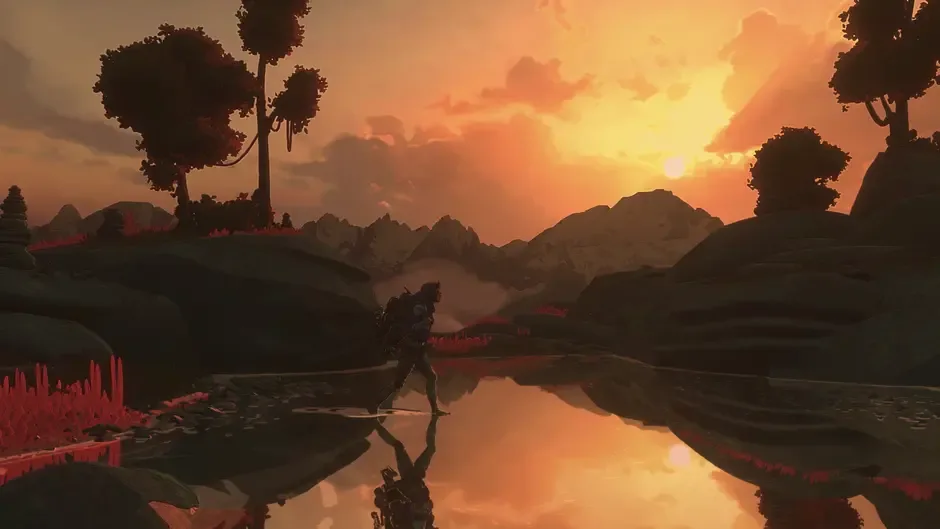
The art and sound support this. The comic book artist Mathieu Bablet served as art director and lead writer, and the sound design, led by Martin Stig Andersen, uses a dynamic system that shifts the soundscape based on where the camera looks. Looking down a long drop sounds different from looking up at the next pitch, and that small trick adds a lot to the feeling of exposure. Gildaa recorded Aava's breathing and effort sounds, and they land as strain rather than decoration.

Story and characters#
Aava is written as demanding, a perfectionist and highly disciplined, and the story is about what that ambition costs the people around her. Friends check in through the Climbot, and the mountain itself carries hints of what earlier expeditions found. Sophia Eleni voices Aava, with a supporting cast that includes Hyoie O'Grady, Adam Howden, Aaron Neil, Rebecca Benson, Alexandra Boulton and Rich Keeble.
This is the softest part of the game. The story is told in small pieces, and its themes of ambition and consequence are clear, but the characters are drawn lightly compared with how carefully the rock is drawn. Aava's personality can read as cold, which suits the subject and also makes it hard to feel close to her. For players who want a rich narrative, that is a real limitation. For those who came for the climbing, it works as a quiet frame that never gets in the way.
The game is described by its makers as part of a trilogy about freedom, following Furi and Haven, and that helps explain the tone. It is less interested in telling a large story than in placing one person against a problem, and letting the problem do most of the talking.
Difficulty, rewind and Assist mode#
Cairn is difficult by design, and the difficulty comes from planning rather than reflexes. Falls happen, resources run low and weather can turn a good plan into a bad one. The game does not pretend otherwise. It does, however, offer tools for players who want a gentler experience.
Rewind lets a fall be undone, which removes the worst sting of a misjudged move without changing the shape of the climb. Assist mode goes further, switching off survival needs and increasing the frequency of autosaves. Together they turn Cairn from a punishing survival climber into a more contemplative one, and that flexibility is a real strength. A game this demanding needs an exit ramp, and the ramp here is well placed.
There is also a wider point about how the difficulty is framed. The mountain is best described as a persistent boss fight, one that does not have a health bar but does have patterns, and that gets beaten by learning them. That is the same satisfaction that a good action game delivers, moved into a vertical, physical setting.
Expedition mode and the Marco update#
Beyond the main ascent, Cairn includes an Expedition mode where a player chooses an avatar, either Aava or Marco, picks a climbing style, alpine or free solo, and shares the results with other players. It extends the game past the story and gives the climbing a second life as a challenge format.
The Game Bakers also announced a series of free updates under the name On the Trail. The first, titled Deep Water, was scheduled for 13 August 2026 and was described as adding three new climbing locations and a playable Marco. Anyone buying the game should check the current store page for the state of that content, but the existence of a free post-launch plan is a good sign for long-term value.
How it compares with Jusant and Shadow of the Colossus#
The obvious comparison is Jusant, the 2023 climbing adventure from Don't Nod. Jusant is gentler and more contemplative, built around a rope and a simple two-trigger control scheme, and it works as a relaxed, atmospheric ascent. Cairn is harder and more physical, with per-limb control and a survival layer that Jusant does not attempt. Anyone who wanted more depth and more risk from that kind of game will find it here, and anyone who wanted a calm evening will find Jusant the better fit.
Shadow of the Colossus is the older reference, and it matters because of the way it treats climbing as the tension between the player and a giant. Cairn borrows the feeling of scale and the sense that the mountain is the opponent, but it swaps the boss fights for a continuous, patient contest. Where Shadow of the Colossus builds toward a series of spectacular encounters, Cairn builds toward a single long one.
Compared with the studio's own earlier games, the change is notable. Furi was a fast, stylish boss-rush built around duels, and Haven was a warm, romantic adventure about two people. Cairn is slower and more solitary than either, and it is the studio's most ambitious mechanical project so far.
| Game | Control style | Survival layer | Pace |
|---|---|---|---|
| Cairn | Each limb moved separately | Hunger, thirst, temperature, pitons, chalk | Slow, deliberate |
| Jusant | Simplified two-trigger climbing | None | Calm, relaxed |
| Shadow of the Colossus | Grip and stamina on giants | None | Alternating exploration and set-piece fights |
New to the genre? Start here#
Anyone new to this kind of game should treat the first stretch as a training ground. The controls take time to feel natural, and the early climbs are the place to learn how posture and stamina interact. A few habits help.
- Look before reaching. Pick out two or three holds ahead, not just the next one, and check that the body can get there without overextending.
- Place pitons early on hard stretches. A checkpoint that costs a piton is cheaper than a fall that costs twenty minutes.
- Rest before a hard move, not after it. Stamina recovered at a good ledge carries into the difficult section.
- Watch the weather and the light. A route that is fine in the morning can become a problem when the temperature drops.
- Use Assist mode without embarrassment if the survival layer becomes a distraction. It changes the game, but it does not cheapen the climbing.
Technical state and rough edges#
The game is not without flaws, and they are worth stating plainly. Technical seams show up in places, and some of the climbing animations look stiff or awkward when the body is in an unusual position. A game built on physical credibility is more exposed than most when a limb clips or a pose looks wrong, because the illusion is the point.
The camera can also be a challenge in narrow spots, where the view that helps with route-finding is not the view that shows the next hold. These issues do not ruin the game, but they show up often enough to matter, and they are part of why the score is an 8 rather than a 9. A patch or two could plausibly close the gap, and the studio has already shown that it plans to keep supporting the game.
Worth the money?#
Cairn costs 29.99 euros on Steam at launch, which places it in the mid-price bracket. The Deluxe Upgrade Pack is a separate 10.99 euro add-on, and the original soundtrack is sold at 9.99 euros. The base game is the one that matters, and the price is fair for a distinctive, carefully made adventure with a replayable Expedition mode and free updates.
The game sold more than 200,000 copies within three days of launch and more than 300,000 within a week, which suggests that the concept found an audience. A precise length has not been confirmed in the material available, and the number of hours depends heavily on the route chosen, how often falls happen and whether Assist mode is used. Since Expedition mode and the planned free content extend the game past the first ascent, the value is likely to be good for anyone who takes to the controls.
Best platform: the game is available on PlayStation 5 and Windows, and a controller is recommended on PC. The Steam page lists minimum requirements of an Intel i7-6700 or Ryzen 5 1500X, 8 GB of RAM, a GTX 1050 Ti or RX 570 and 10 GB of storage, with an RTX 2060 Super or RX 5700 recommended. A console with a controller is the simplest way to play, and a PC works equally well for anyone with a pad. Steam Cloud and Family Sharing are supported.
Language: the Steam page lists English, French, Italian, German, Spanish, Japanese, Russian, Chinese, Korean and Brazilian Portuguese for interface, audio and subtitles. German is covered. Swedish does not appear in that list.
Play this instead if…#
Shorter: Jusant offers a compact, calm climbing adventure that is much quicker to finish and much gentler to learn, with a simple control scheme and no survival meters.
Easier: Shadow of the Colossus gives the same sense of scale and physical struggle against something enormous, but with more forgiving climbing and a clear structure of set-piece encounters.
Cheaper or co-op: Haven, from the same studio, is a smaller, warmer game built around two characters and playable in co-op, and it is a very different kind of experience. Cairn itself is a single-player game, so anyone looking for a shared climb will need to look elsewhere.
Frequently asked questions#
How long is Cairn? A confirmed length has not been published in the material available. The time depends on the chosen route, the number of falls and whether Assist mode is on, and Expedition mode adds more on top of the main ascent.
Is Cairn an open world? Not in the usual sense. Mount Kami is a single mountain with several possible paths to the summit, so the freedom lies in route choice rather than in a sprawling map.
Does it have co-op? No. Cairn is a single-player game, although Expedition mode lets players share their results with others.
Is there an easy mode? Yes, in the form of Assist mode, which turns off survival needs and raises the autosave frequency, and Rewind, which undoes falls.
Do you need to know anything about climbing? No. The game teaches its own rules, and the controls are explained as the climb begins. Interest in mountaineering helps, but it is not required.
Is Cairn coming to Switch 2? A Nintendo Switch 2 version is announced for a later release. The current versions are on PlayStation 5 and Windows.
The Game Avant verdict#
Cairn is the rare game where the core mechanic is strong enough to carry everything else, and that is both its greatest strength and its main limitation. The per-limb climbing is patient, physical and satisfying in a way that few games manage, and the survival layer, the weather and the choice of routes give it real shape. The Climbot, the bivouacs and Assist mode are thoughtful additions that make the difficulty feel like a design decision rather than a wall.
It is not a perfect game. The story is thin, the animations can look stiff and the survival meters will be a chore for players who only want to climb. A more honest approach might have been to make the survival layer optional from the start, and Assist mode is the closest the game comes to saying so. Even so, the mountain is a convincing opponent, and the moments when a hard route resolves into a clean sequence of moves are among the best in recent action-adventure games. The price is fair, the free updates add value and the concept is executed with real craft.
8 out of 10 – a stubborn, physical climbing game that makes every handhold matter.