

A CRPG that treats talking as the main event#
Esoteric Ebb is a single-player computer role-playing game built by Christoffer Bodegård and published by Raw Fury. It reached PC on 3 March 2026 and casts you into a political conspiracy in the city of Norvik, with a goblin at your side and a set of tabletop-style dice waiting to turn every ambitious plan into a gamble. The thesis of this review is simple. Esoteric Ebb is the most convincing argument in years that a role-playing game can put the conversation at the centre and still feel like a game rather than an illustrated novel. It earns a 9 because its systems and its writing pull in the same direction, and because it commits to being what it is without apologising.
That commitment is also its main risk. This is a text-dense, dialogue-first design, and it does not soften that for anyone who arrives expecting spectacle. If reading is the point for you, few recent games make a stronger case. If it is an obstacle, no amount of good design will change that, and this review will say so plainly wherever it matters.

What makes Esoteric Ebb different#
The one idea that carries the game is that your character is a committee. The Steam description calls it an internal stat system where abilities debate and interrupt decisions, and that phrase hides how much it changes the shape of a role-playing game. In most RPGs, a stat is a number that unlocks a dialogue option or improves a roll. Here, the stats behave like voices with opinions. They chime in, they argue with each other, and they push the conversation in directions the player did not necessarily choose. Choosing how to build your character is therefore also choosing who is allowed to talk in your head.
That approach sits on top of a second idea borrowed from the tabletop. Encounters are turn-based, and dice rolls decide the tense moments. This matters because tabletop role-playing works on a specific emotional contract: you make a plan, the dice complicate it, and the story continues from wherever the result lands. A failed roll in a good tabletop session is not a game over, it is a plot twist. Esoteric Ebb is designed around that contract. The dice are visible risk, and a bad result is supposed to be a new situation rather than a loading screen.
The third pillar is the magic. The game describes reality-shaping magic that creates unique narrative options, and it pairs this with an option to become a cleric of legend or to wreck the campaign entirely. That last clause is unusual. Most RPGs quietly guard the main story against the player, hiding the breakable parts behind invisible walls. Esoteric Ebb advertises the opposite: the campaign is something you are permitted to break, and the game is built to keep going afterwards. Whether that freedom feels liberating or chaotic depends entirely on how you like to play, and it is the main reason the tradeoff cards above are what they are.
Put those three pillars together and the identity is clear. Inner voices supply the argument, dice supply the risk, and magic supplies the rule-breaking. Everything else, the faction politics, the goblin companion, the isometric view, is scaffolding around a game that wants you to talk, gamble and improvise.
The setting: a post-Arcanepunk city with a conspiracy in it#
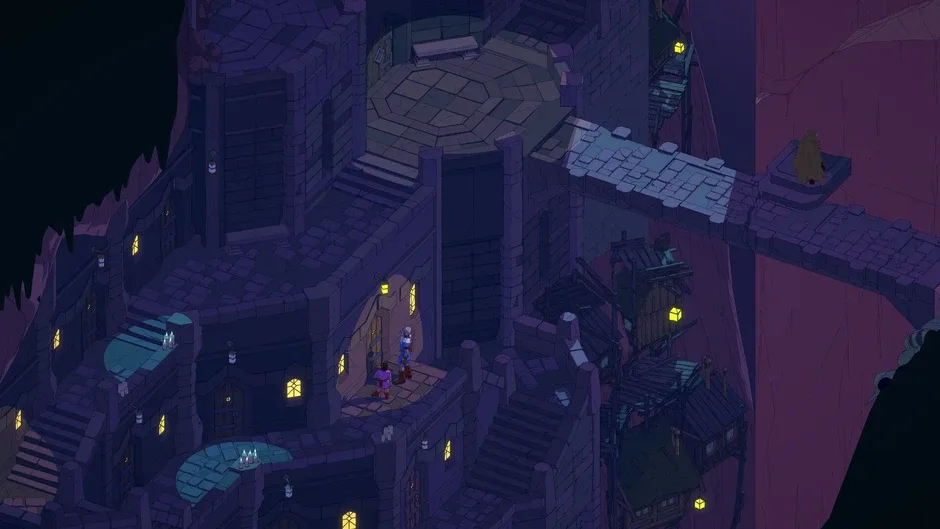
The game calls its world post-Arcanepunk fantasy, and the setting is Norvik, a city where a political conspiracy is the thread that pulls you through the plot. The label suggests a world where the age of arcane technology has come and gone, and the leftovers, both magical and political, are still shaping who holds power. The important thing for a role-playing game is not the label but what it does to the structure. A conspiracy is a social problem. You solve it by learning who wants what, who lies about it, and who can be leaned on.
That is why the faction system matters so much. The game advertises faction juggling, which means your standing with one group is a resource you spend and a liability you carry. Anyone who has played a political role-playing game will recognise the pleasure and the stress in that design. Helping one faction closes some doors and opens others, and the world is not obliged to tell you which is which. When a game builds its central plot around a conspiracy, every conversation becomes an investigation, because information is the currency.
The goblin sidekick deserves a mention as a structural choice rather than a gimmick. A companion in a dialogue-first RPG does two jobs. It gives the player someone to talk to when the world is not, so the tone can shift between political intrigue and something more personal. And it gives the writing a second voice to play against the protagonist's inner ones, which multiplies the number of perspectives in any given scene. A goblin is also a deliberate tonal signal in a fantasy game: it promises humour and mischief alongside the conspiracy.
Dice, encounters and the tension of a bad roll#
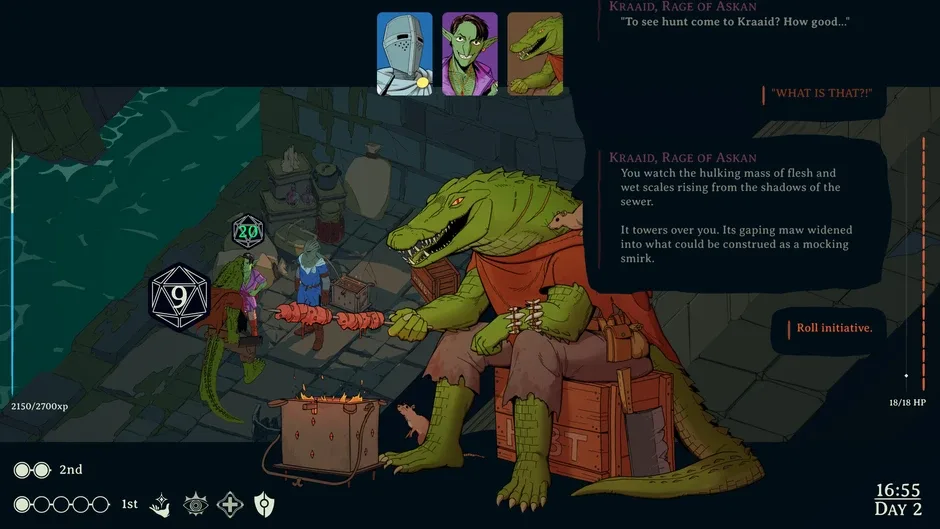
Combat in a role-playing game is usually the part that separates the genres, and here it is intentionally turn-based and dice-driven. The description talks about rolling dice in tense encounters, and the phrasing is worth reading closely. These are not constant fights punctuated by conversation. They are tense moments, points where the plot needs a decision that cannot be reached by talking alone, and the game hands the outcome to a roll.
There are three consequences to that design. First, encounters are rare enough to feel weighty. A game that has a fight every ten minutes makes each fight cheap, whereas a game built around conversation can make a single tense confrontation feel like an event. Second, the dice reintroduce uncertainty into a genre that often lets a well-built character walk through content. Even a strong character can fail a roll, and the game is built to use that failure. Third, the dice are legible. Tabletop-style systems show the target and the modifiers, which means you can see how your build affects your odds and decide whether to gamble.
The downside is the one every dice-based game shares. Randomness feels great when it produces a heroic success and terrible when it derails a carefully prepared plan. Players who want to feel in total control of outcomes will find that friction irritating, and no amount of design cleverness makes a failed roll pleasant in the moment. What Esoteric Ebb offers in exchange is the tabletop promise that failure keeps the story moving. Whether that trade is worth it is a matter of temperament, and it is the main reason the game is a specialist pleasure and not a universal one.
Inner voices: the character sheet as an ensemble cast#
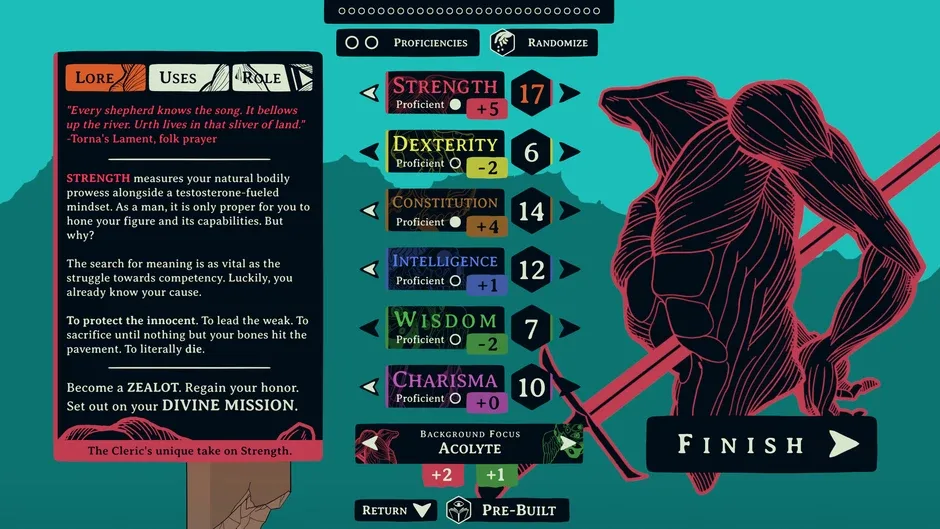
The stat system deserves its own section because it is the feature that most clearly separates Esoteric Ebb from a standard CRPG. In a conventional game, a skill check is a hidden calculation. You click an option, a number is compared to a threshold, and you find out what happened. In this game, abilities are characters. They debate, they interrupt, and they colour how a scene reads. That gives the player two layers of reading to do at once: what the people in the world are saying, and what the voices in the protagonist's head are saying about it.
Games that use this approach live or die by writing quality, because a voice with nothing interesting to say is just a pop-up. The design is ambitious because it asks the writing to deliver a distinct personality for each ability and then keep delivering it across a long game. When it works, the effect is that a build is a personality, and two players with different builds experience the same conversation as two different scenes. That is a form of replayability that does not depend on combat variety. It depends on how many different ways there are to be interrupted.
There is a practical benefit too. A character sheet that talks is easier to understand than one that is a grid of numbers. Instead of learning that a skill does something abstract, you hear it argue, and its personality tells you what it is good for. That lowers the barrier to a genre that is famously heavy on systems, and it turns the act of levelling up into something closer to casting the cast.
The cost is intrusiveness. A game in which your own abilities second-guess you will not suit anyone who finds that noisy. Some decisions feel obvious, and being interrupted while making them can read as friction rather than depth. That is a deliberate design choice rather than a flaw, but it is a choice that divides players, and it is why the interruption mechanic appears as one of the tradeoff cards.
The Questing Tree: a quest log that thinks#
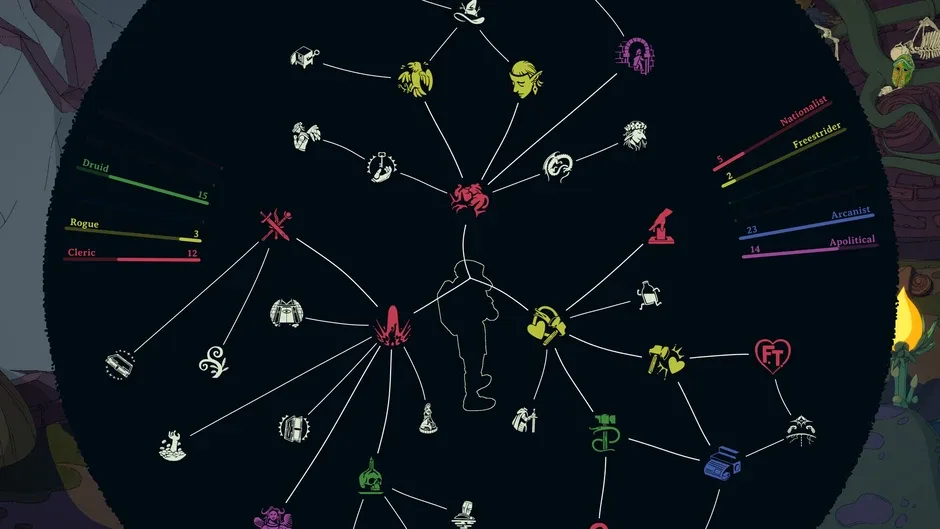
One of the more distinctive interface ideas in the game is the Questing Tree, which combines a quest log, a skill tree and a mind map. Anyone who has lost track of a long RPG will see the appeal. The usual failure of a quest log is that it lists tasks without explaining how they connect, and the usual failure of a skill tree is that it lists upgrades without explaining what they are for. Combining them with a mind map suggests a tool that shows relationships: this clue leads to that person, this ability opens that approach, this faction cares about that outcome.
In a game whose whole purpose is untangling a conspiracy, that is the right kind of interface. A conspiracy is a network, and a mind map is a visual way to hold a network in your head. The fact that the tree also carries the character's progression is a smart bit of design economy. It means growth and investigation live in the same place, so improving your character and understanding the plot are the same activity rather than parallel chores.
The risk with any such tool is complexity. A single screen doing three jobs can be either elegant or overwhelming, and its usefulness depends on how clearly it is laid out. What the design intent gets right is the principle: in a game about information, the interface should be an instrument for thinking. That principle is worth more than any single layout decision.
Open-ended quests and the freedom to break things#
The game describes open-ended quest design, and it pairs that with the option to wreck the campaign. Those two ideas belong together. Open-ended quests are ones that do not funnel you to a single correct resolution. That gives the player agency, and it gives the game a burden: every branch has to be written, and every branch has to matter.
The tabletop comparison is useful here. A good game master does not have a single plot in mind. They have a situation, a set of characters with motives, and a willingness to follow the players wherever they go. A video game cannot improvise in real time, so it has to approximate that flexibility through branching structures and reactive writing. The more open the quests are, the more the game has to anticipate. That is expensive, and it is the reason few studios attempt it at this level.
For the player, the deal is straightforward. You get to shape the story, including by making choices that a more protective game would forbid. The price is uncertainty. When quests are open-ended, you do not always know whether you have found the intended solution, a valid alternative or a dead end. Some players find that thrilling, and others find it stressful, especially in a game that rewards paying attention. The honest advice is to go in expecting to miss things and to treat that as part of the design.
Reality-shaping magic and what it does to a dialogue game#
Magic in most RPGs is a combat tool: a fireball, a heal, a buff. In Esoteric Ebb, the description frames it as reality-shaping, and links it to narrative options. That is a significant shift. Instead of asking what magic does to enemies, the design asks what magic does to the situation. A spell that changes what is true in a scene is a way of solving a problem sideways, and that fits a game where the most interesting solutions are rarely violent.
This is also where the game leans hardest into its tabletop heritage. Tabletop magic users are famous for solving problems in ways the designer did not plan, and the joy of playing one is the improvisation. A video game that supports that kind of thinking has to be built with a lot of flexibility in its writing and scripting, because the player might try something no one anticipated. The fact that the game promotes this as a headline feature says something about its ambitions.
The practical upshot for a player is that a build is not just a set of numbers but a philosophy of problem solving. A character who talks their way out of trouble, one who bends reality, and one who juggles factions are three different games running on the same map. That variety is the main reason to consider a second run, and it is the strongest argument for the score.
Isometric view, controller support and access#
The game uses an isometric perspective, the classic viewpoint of the computer role-playing tradition. It frames the world from above and at an angle, which suits a game about places and conversations. It also signals lineage: this is the camera of the genre's golden age, chosen because it lets a small team build detailed scenes without the cost of a fully free camera.
On the practical side, the Steam listing shows full controller support, along with accessibility options that include adjustable text, subtitle options and colour alternatives, plus custom controls. For a game this dependent on reading, adjustable text is not a nice extra, it is a core accessibility feature, and its presence is a good sign. It also means the game can be played from a couch as well as at a desk, which is not a given for a genre built around menus and tooltips.
The limits are equally clear. The game is available for Windows PC only, and its supported language is English. For a game made mostly of text, the second point is the bigger one. Players who are not fluent in English will be working harder than the game's design assumes, because nuance, wordplay and tone are exactly the things that suffer when reading in a second language. That is a real barrier, and it belongs in the cons list even though it says nothing about the quality of the writing.
Compared with Disco Elysium and Baldur's Gate 3#
The obvious comparison is Disco Elysium, ZA/UM's 2019 role-playing game, which put a talking skill system at the centre of a detective story. Esoteric Ebb shares the central idea, abilities as voices, and adds a tabletop layer through dice rolls in turn-based encounters and a fantasy setting instead of a detective's district. Where Disco Elysium is about a broken man reconstructing himself, this game frames a conspiracy in a fantasy city, with a goblin companion and a magic system built to break rules. The comparison flatters both games, but it should not be read as a claim of equivalence. Esoteric Ebb is a smaller, more focused project and it makes different choices.
Baldur's Gate 3, Larian's 2023 role-playing game built on Dungeons and Dragons rules, is the other useful reference, mostly by contrast. Larian's game is enormous, cinematic and combat-heavy, with a large cast and a wide range of systems. Esoteric Ebb takes the tabletop inheritance and pares it back to the conversation, the roll and the improvisation. If Baldur's Gate 3 is a full campaign with a production crew, this is a one-shot run by a game master who cares more about the players' choices than about set pieces.
The practical guidance follows from that. If you want the largest possible role-playing experience with combat, exploration and production values on a blockbuster scale, Baldur's Gate 3 is the more obvious choice. If you want the closest match to the dialogue-driven, voice-driven design, Disco Elysium is the natural companion. If you want a game that takes both ideas and puts them into a compact, politically minded fantasy with dice, this is the one.
Price, length and value#
The Steam listing shows a price of 24.99 euros in the European store. That places it in the range of a mid-priced indie release, well below the cost of a large studio role-playing game. No official playing time is cited here, and estimates would be guesswork, so the honest way to frame value is by structure. A game built on open-ended quests, factions and multiple approaches offers replay value through different builds and different choices, and the size of that value depends on how much you enjoy reading and experimenting.
The best platform is the only platform: Windows PC. Full controller support means a living-room setup is workable for anyone who connects a PC to a television, and the accessibility options make long reading sessions more comfortable. There is no console version to compare against, so the decision is simply whether PC is where you want to play.
Language matters for the value calculation. The supported language is English, so anyone who would need Swedish, German or another language for the text will find no localisation in the store listing. For a game this text-heavy, that changes what the price buys, and it is worth deciding honestly before purchase whether your English is comfortable enough for long, nuanced reading.
As for timing, a price like this is easy to justify at full cost if the premise appeals. Waiting for a sale makes sense if you are on the fence, because the game is not time-sensitive: it has no multiplayer community to keep up with and no live service to fall behind on.

New to dialogue-first RPGs? Start here#
For anyone coming from action games or from combat-driven role-playing games, a few habits make the start smoother.
- Read everything before choosing. In a game where abilities interrupt and argue, the voice that speaks up is often a hint about what your build is good at.
- Treat failed rolls as story, not punishment. The tabletop premise is that a failure changes the situation, so a bad result is a reason to look for a new angle.
- Use the Questing Tree as a thinking tool. Because it combines quest log, skill tree and mind map, it is the fastest way to reorient after a break.
- Expect to miss things. Open-ended quest design means some content is not on the main path, and that is by design.
Worth the money?#
At 24.99 euros, this is a fair price for a game whose value comes from writing and structure rather than from production scale. The question is not whether the price is reasonable but whether the game is aimed at you. A person who enjoys reading, likes tabletop role-playing and wants a fantasy conspiracy to untangle will find a great deal of game for the money. A person who wants action will find a mismatch, whatever the price.
Best platform: Windows PC, the only supported platform, with full controller support if you prefer to play from a sofa. Language: text is in English only, with no Swedish, German or other localisation listed. That is the single most important thing to check before buying.

Play this instead if…#
Shorter: Any compact, narrative-driven role-playing game with a tight scope is a better fit if a long, reading-heavy commitment is the concern, since Esoteric Ebb is built on depth of dialogue and choice rather than brevity.
Easier: Baldur's Gate 3 offers a friendlier on-ramp for players who want guidance, cinematic scenes and combat that can carry a session, even though it is a much larger game to commit to.
Cheaper or co-op: Disco Elysium is the closest cousin in design if you want the talking-skills idea, and it is often discounted. Baldur's Gate 3 is the co-op option, since it supports playing a campaign together, which Esoteric Ebb, a single-player game, does not.
Frequently asked questions#
How long is Esoteric Ebb? No official length is cited here, so any number would be a guess. The structure, with open-ended quests, factions and different builds, suggests that length depends heavily on how much you read and how many alternatives you explore.
Is it an open world? No. It is an isometric role-playing game set in a city and built around quests and conversations, not a large open map to roam.
Does it have co-op? No. Esoteric Ebb is a single-player game.
Is there a difficulty setting? The game is built on dice rolls in turn-based encounters, and its listed accessibility options cover text size, subtitles, colour alternatives and custom controls. The store listing shown for this review does not mention a separate difficulty selector.
Do you need to know Dungeons and Dragons first? No. The game takes inspiration from tabletop adventures, but familiarity with dice-based role-playing is a bonus rather than a requirement. Anyone who has seen a dice roll decide an outcome will understand the premise quickly.
Is there Swedish or German text? No. The supported language listed on Steam is English.
The Game Avant verdict#
Esoteric Ebb is not a game for everyone, and it does not try to be. Its reliance on English-only text is a genuine limitation, its reading load will be too much for some, and open-ended quests can leave a player unsure whether they are on track. Those are real costs, and they are the reason the score is not a 10. What the game gets right is more important than what it gives up. It puts the conversation at the centre and builds systems around it: abilities that argue, dice that complicate, magic that rewrites the situation, and a quest tool that maps a conspiracy. That coherence is rare, and it is the reason a compact independent project stands comfortably beside much larger role-playing games. The unpopular opinion is that its lack of spectacle is a strength. A game that trusts you to read, argue and break its story on purpose respects your intelligence in a way that most blockbuster RPGs no longer do.
9 out of 10 – a confident, text-first CRPG that makes talking feel like the most dangerous thing you can do.