
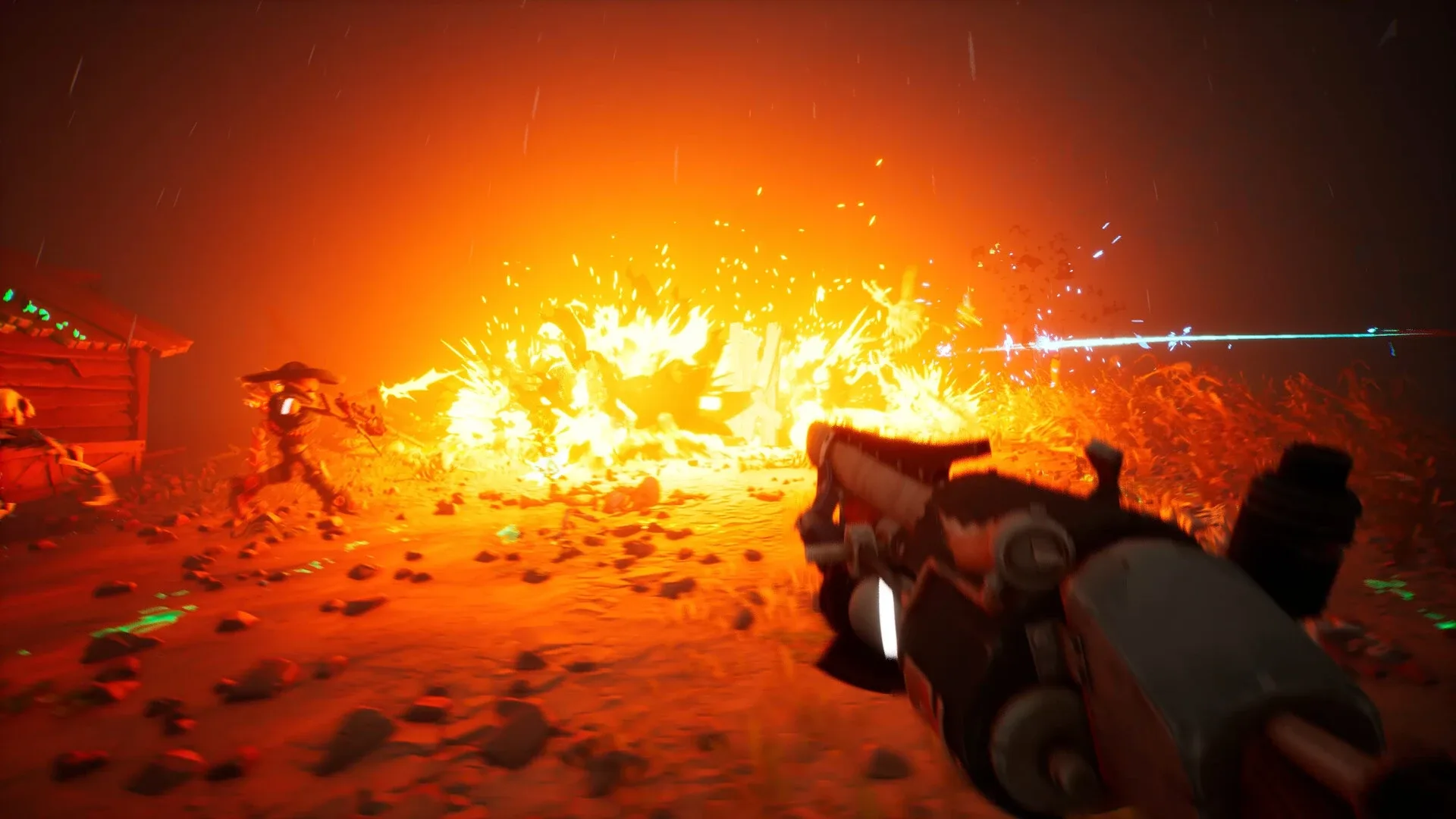
An Early Access bounty hunt that already knows what it wants to be#
Far Far West is not trying to be everything at once, and that restraint is the most reassuring thing about it. It is a first-person, online co-op PvE extraction shooter set in a Western world with a supernatural edge, built by Evil Raptor, a French independent studio founded in 2020 and made up of only eight people, and published by Fireshine Games. It entered Steam Early Access on April 28, 2026, for PC, and in the months since it has picked up more than 3,000 positive Steam reviews and an "Overwhelmingly Positive" rating. None of that makes it a finished game, and it should not be reviewed as one. What it is, right now, is a small studio's confident first pass at a genre that is usually the domain of much bigger teams, and it is worth knowing about before it grows into whatever it becomes at 1.0.
The premise is straightforward and stated plainly by the people making it: teams of up to four players take on jobs to track down dangerous targets, take them out, and bring the bounty home. That is the whole loop, described in the game's own pitch, and it is a good one to build an Early Access game around, because it is simple enough to be understood in a sentence and open enough to be expanded for years without needing to be reinvented.
What makes Far Far West different#
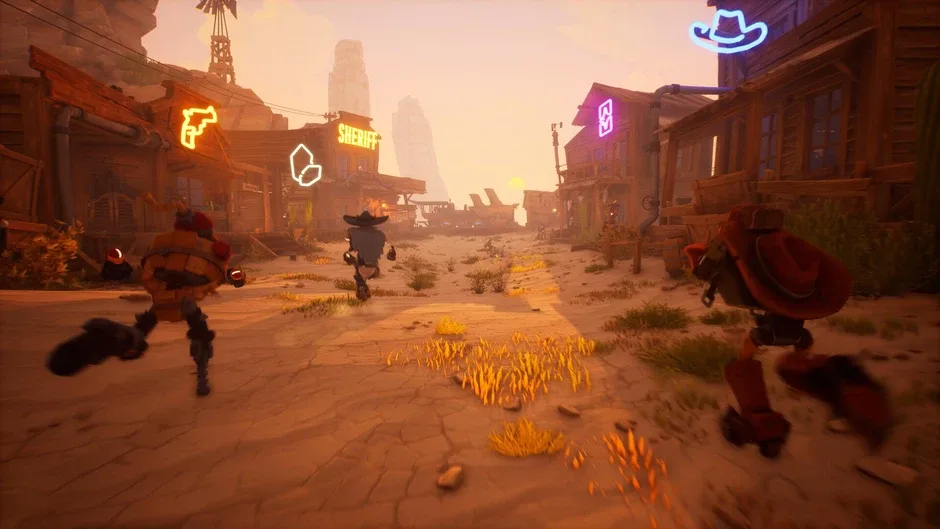
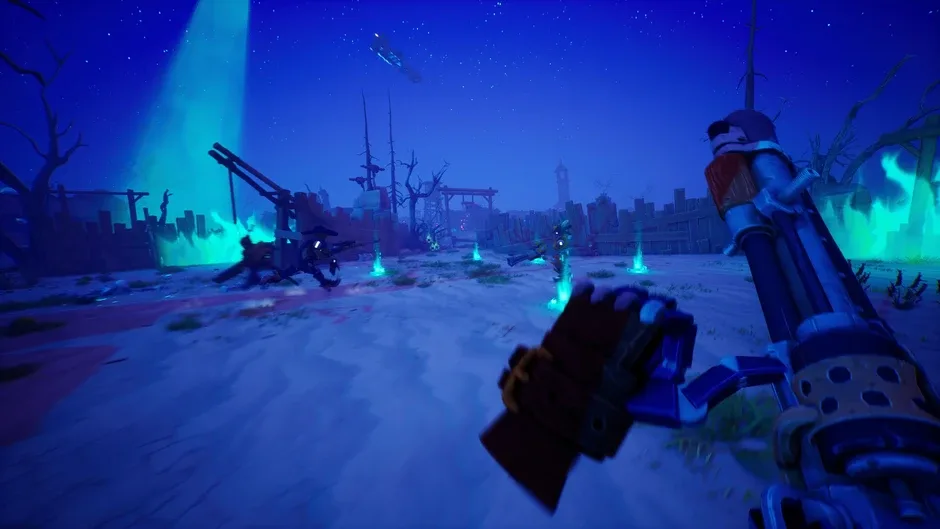
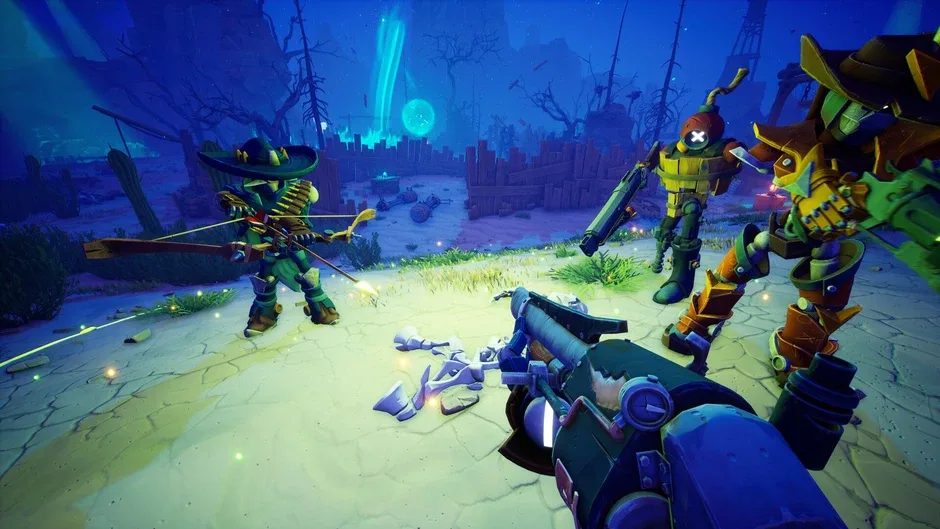
The one idea Far Far West leans on is the collision between two moods that don't usually share a game. The Western half is familiar: bounty hunters, dangerous targets, a frontier that does not care whether you live. The "spooky twist" that press coverage around the game has consistently pointed to is the part that changes the equation, folding supernatural and horror elements into that frontier so that a bounty hunt stops being a purely human problem. Extraction shooters usually earn their tension from other players or from a ticking clock. Far Far West gets an extra source of dread from the setting itself, because a Western frontier that might not be entirely populated by the living is a different kind of hostile than one that is just full of outlaws.
That combination is also why the game reads as more than a skin swap. A lot of co-op shooters pick an aesthetic and then build a fairly generic extraction loop underneath it. Far Far West's premise only works because the two halves feed each other: the Western setting supplies the job (hunt the target, collect the bounty, get out alive) and the horror layer supplies the reason that job is never quite as simple as it sounds on the job board. It is a small idea, executed by a small team, but it is a coherent one, and coherence is worth more at this stage than a long feature list would be.
The bounty loop: hunting a target as a team#
Every run in Far Far West starts from the same place: a target worth tracking down, a squad assembled to do it, and a bounty waiting on the other end if the job goes right. That structure puts it squarely in the extraction shooter tradition, where the tension comes from committing to a run, not from a level select screen. What separates Far Far West's version from a generic loot run is that the objective is a who, not a where. You are not just clearing an area and grabbing whatever is inside it; the job is built around a specific dangerous target, and the run is judged by whether that target goes down and the bounty comes home, not by how much loose loot ends up in a bag.
Because the studio has confirmed the core loop in exactly those terms, tracking, taking out, and bringing home, it is fair to say the structure is deliberately simple. That is the right choice for an eight-person team in Early Access. A small studio that tries to ship a deep progression system, a full map roster and a live economy on day one of Early Access usually ends up shipping a shallow version of all three. Evil Raptor instead appears to have picked the one loop it can make feel good, the hunt itself, and built the game's identity around getting that loop right before adding everything around it.
Co-op for one to four: the same job, a different kind of pressure#
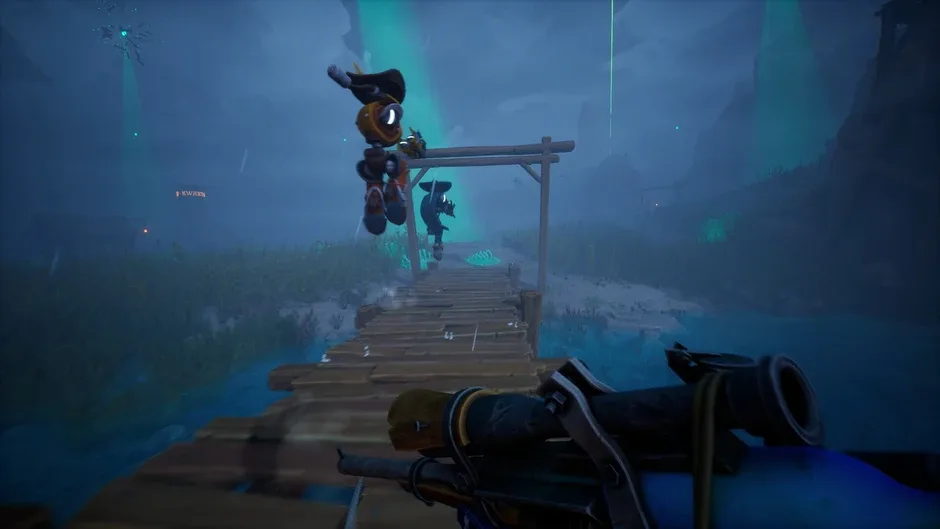
Far Far West supports one to four players online, and that range matters more than it might look on a feature list. A solo run through a bounty hunt against a target with a supernatural edge is a tense, exposed thing: no one to watch your back, no one to split attention with when something in the frontier turns out not to be what it looked like. A full four-player squad changes the equation completely, letting a team split up to cover ground, cover each other during the actual takedown, and share the risk of hauling a bounty out once the target is down.
That scaling is also the part of the design that most rewards patience during Early Access. A co-op game that only works well at full squad size is a much harder sell than one that also holds up solo, because Early Access populations are smaller and less predictable than a launched game's. Far Far West being built to flex between one and four players, rather than requiring a fixed squad, is a sensible bet for a small studio that cannot guarantee a full lobby every night, and it is also simply the more honest design: a bounty hunt should feel different with a partner than it does alone, and giving both options a reason to exist is harder than it sounds.
Early Access, honestly: what that label should tell you#
The single most important fact about Far Far West is the one easiest to skim past: it is in Steam Early Access, not a 1.0 release. That is not a knock against it, but it does change how it should be judged and how it should be bought. An Early Access label from an eight-person studio means the game available today is a working foundation that the team is actively building on, not a finished product with a content roadmap already banked. Reviews of Early Access games that pretend otherwise, praising or criticising features as if they were permanent, do readers a disservice, so the honest version of this review has to say plainly: what is confirmed right now is the core premise, the co-op structure, and the Western-with-a-supernatural-twist setting, and beyond that, how much content, how many targets, how the game evolves before a full release, is Evil Raptor's to decide and not yet public record.
What can be said with confidence is that the reception so far has been unusually strong for a small studio's Early Access debut. More than 3,000 positive Steam reviews and an "Overwhelmingly Positive" aggregate rating are not numbers a co-op shooter earns by accident, and they suggest that whatever is in the current build, the core hunt-and-extract loop is landing with the people actually playing it. That is meaningful evidence for anyone deciding whether to buy in during Early Access rather than wait, even without a single feature list to point to.
It is also worth understanding, in general terms, how an "Overwhelmingly Positive" rating tends to behave over time, because that context matters for reading the number correctly rather than treating it as a permanent verdict. Steam's aggregate ratings are a rolling snapshot, not a fixed score: they are recalculated as new reviews come in, and a rating earned from an initial wave of enthusiastic early adopters, the players most excited to jump into a new Early Access game on day one, does not automatically hold once a wider, more varied audience arrives later, or once the honeymoon period of discovering a new loop wears off. A strong Early Access rating is a genuine signal that the core idea works for the people who have tried it so far; it is not a guarantee that the same rating survives contact with a bigger, more demanding crowd, especially if content additions do not keep pace with how quickly a dedicated playerbase can exhaust a single core loop. None of that is a knock specific to Far Far West. It is simply the honest context any Early Access rating this strong deserves, and it is a reason to check the current rating and review volume again before buying, rather than treating the number in this review as fixed months after publication.
Buying into any Early Access game, this one included, also means weighing a price-to-content trade that looks different from a finished release. A 1.0 game is priced against a known, fixed amount of content; an Early Access game is priced against a promise that the content will grow, and how fair that trade feels depends entirely on how quickly a small team can deliver on it. An eight-person studio is not going to ship content at the cadence of a hundred-person live-service team, and buyers going in should size their expectations to that reality rather than to how other, much larger extraction shooters have been supported after their own launches. The right question before buying is not "how much is here today", but "am I comfortable paying for a foundation and watching it grow at a small studio's pace", because that is the actual transaction Early Access represents.
A small studio's bet on a genre built for big teams#
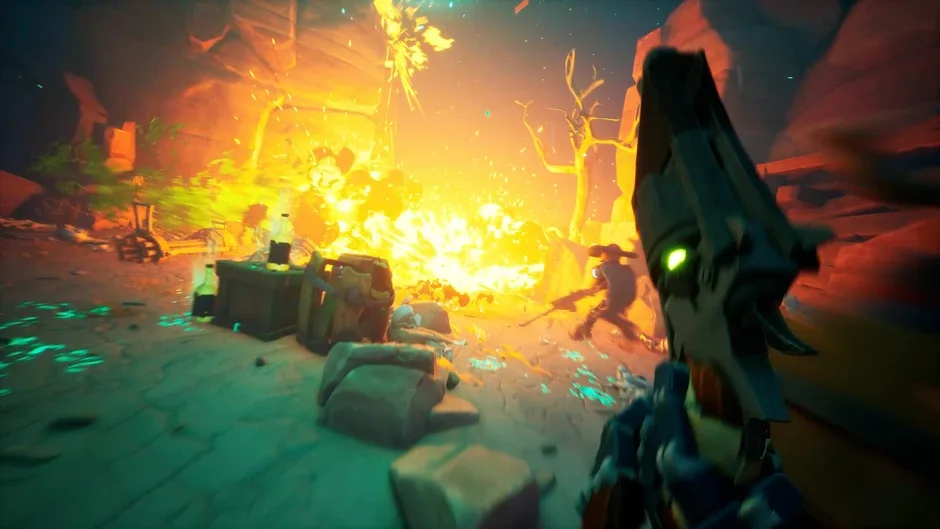
Extraction shooters and co-op PvE games have, in the last several years, mostly been the territory of teams with dozens or hundreds of people, building large weapon rosters, seasonal content pipelines and persistent economies. Evil Raptor is eight people. That gap is worth naming directly rather than glossing over, because it explains both the shape of Far Far West and the shape of what to expect from it going forward. A studio that size cannot compete on raw content volume with a live-service giant, and it should not be judged as though it were trying to. What it can do, and appears to be doing, is find one idea, the Western bounty hunt with a horror current running underneath it, and build a tight version of it that earns trust before it earns scale.
The difference between an eight-person studio's extraction shooter and a AAA studio's version of the same idea is mostly a difference in what gets prioritised first, and it is worth spelling out because it explains where a buyer's patience should go. A team with hundreds of developers typically builds breadth early: multiple maps or biomes in parallel, large weapon and cosmetic rosters, a live-service backend for events and seasons, all developed by specialised sub-teams working at once. A team of eight cannot parallelise that way; there are not enough people to staff separate map, weapon, narrative and backend teams simultaneously, so the work has to happen in a much more linear order. That usually means the loop itself, the actual moment-to-moment feel of hunting a target and getting out with the bounty, gets the concentrated attention a bigger studio would split across dozens of systems at once. The trade-off is real: a small studio's Early Access build will almost always look thinner on paper, fewer confirmed features, less marketing material, than a AAA competitor's launch. What it can offer instead, if the core idea is good, is a loop that feels more considered because it did not have to compete for attention with twenty other systems being built in parallel. Far Far West's Steam reception so far is at least consistent with that trade paying off for the people trying it.
That is also why Fireshine Games' involvement as publisher matters more here than it would for a bigger studio's game. A publisher backing a small team's first major co-op shooter is often the difference between an ambitious idea reaching Steam's Early Access page at all and it staying a pitch deck. It does not guarantee the game's eventual scope, but it is a concrete, verifiable fact about the game's footing going into Early Access, and it is a reasonable factor in deciding whether to trust that the studio can keep supporting the game.
New to extraction shooters? Here is what the genre asks of you#
If Far Far West is your first extraction shooter rather than your first co-op game, it is worth knowing what the genre expects before jumping into a squad with strangers. The defining trait of the genre, and the one Far Far West clearly leans on with its "take out the target and bring home the bounty" pitch, is that a run only pays off if you survive to the end of it. That is a different rhythm from most shooters, where dying mostly costs you a respawn timer. In an extraction game, committing to a job is committing to the risk that the run ends with nothing to show for it, and that risk is exactly what makes a successful extraction feel earned rather than routine.
The practical advice that carries over from every extraction shooter applies here too: communication matters more than aim. A four-player squad that talks through what it sees and what it plans to do beats a squad of four people independently good at shooting, because the tension in this kind of game usually comes from a situation turning bad faster than one person can read alone. Starting with a smaller squad, one or two players, is also a reasonable way to learn the loop's rhythm before committing to the coordination a full four-player job demands, especially while the game is still filling in around that core loop during Early Access.
Compared with Hunt: Showdown and Deep Rock Galactic#
Far Far West sits closest, in spirit, to Hunt: Showdown, which also mixes a period setting with supernatural horror and builds its tension around hunting something dangerous and getting out alive. The difference is the social contract, and it changes where the tension actually comes from. Hunt: Showdown is built around PvP as much as PvE, so its extraction tension has two separate sources stacked on top of each other: the supernatural target itself, and the knowledge that any other team on the map might be hunting the same bounty and would rather take it, and your gear, off your corpse than share it. That second layer is what gives Hunt: Showdown its particular, paranoid tension, the sense that the loudest threat on the map might not be the monster at all. Far Far West's confirmed structure removes that layer entirely: it is PvE co-op, up to four players working together against the target rather than against each other or against rival teams, so whatever tension it generates has to come purely from the target, the setting and the extraction itself, without another squad of human players adding a second axis of threat. That is a meaningfully gentler, more cooperative version of a similar mood, and it changes who the game is for. If what appeals about Hunt: Showdown is the horror-Western atmosphere without the added stress of human hunters stalking you, Far Far West's PvE-only structure is the more inviting entry point; if the cross-team paranoia is the actual draw, its absence here is a real difference, not a small one.
The two games also likely differ in how a team divides labour inside a run, based on what each genre shape rewards. A PvP-inclusive extraction shooter like Hunt: Showdown rewards a team that can both hunt its target and stay alert to being hunted itself, splitting attention between the objective and the rest of the map at all times. A PvE-only co-op structure like Far Far West's confirmed design instead lets a team divide roles purely around the job itself, tracking, engaging and extracting, without needing to hold part of its attention in reserve for other players. That usually makes coordination easier to learn, because there is one direction of threat to plan around instead of two, which matters for a game whose squads can be as small as two people rather than a full four.
Deep Rock Galactic is the better comparison for the co-op shape rather than the setting: a small team, a mission with a clear objective, and a return trip that only counts if you make it out with what you came for. It is also a useful comparison for pacing and session length, in general terms. Deep Rock Galactic's missions are built to be finished, successfully or not, inside a single sitting, short enough to queue up a second run right after the first without a big time commitment. An extraction-shooter structure built around hunting a specific target, as Far Far West's confirmed loop is, tends to invite a similar shape of session: a defined job with a clear end state, rather than an open-ended session with no natural stopping point. That kind of self-contained pacing is generally a good fit for a co-op game trying to hold a squad's attention across a single evening, because everyone can agree in advance roughly how long the next run will take. Far Far West trades Deep Rock Galactic's dwarves-in-space theme for bounty hunters on a haunted frontier, but the underlying promise, that a mission with friends is only a win once everyone and the prize are both back safely, is the same shape of satisfaction. Anyone who already knows they like that shape of co-op game has a good reason to look at Far Far West even without every mechanical detail nailed down yet.
Worth the money right now?#
This is the honest, harder question for an Early Access game, and it deserves an honest answer rather than a confident one: Far Far West's price, exact content volume, and roadmap toward a full release are not confirmed facts to build a verdict on here, so any specific number would be a guess dressed up as reporting. What is fair to say is this: buying into Early Access is a different transaction than buying a finished game. You are paying for the current build and for a stake in how it grows, not for a guaranteed amount of content. Given the studio's size, patience is the right expectation to bring, not a demand for a launch-scale roster of targets and features on day one.
What is confirmed, and does support a buy-in now rather than a wait, is the reception: an Overwhelmingly Positive rating built on more than 3,000 reviews is a genuinely strong signal this early in a small studio's Early Access life, and it means the core hunt is already working for the people who have tried it. PC is currently the only confirmed platform, so anyone waiting for a console version has no confirmed timeline to watch for yet.
Play this instead if…#
Shorter or less committal: Hunt: Showdown offers a similar Western-horror bounty-hunting atmosphere in shorter, punchier rounds, if you want that mood without buying into an Early Access game's ongoing development.
A gentler co-op loop: Deep Rock Galactic delivers the same "go in with a team, complete the job, get out together" satisfaction in a setting that has been fully built out for years, if what you actually want is the co-op shape rather than the Western dressing.
Fully finished right now: any 1.0-released co-op shooter in a similar vein is the safer pick if the idea of a game still being built in Early Access, with its unfinished edges and unknown roadmap, is a dealbreaker rather than part of the appeal.
Frequently asked questions#
Is Far Far West finished? No. It entered Steam Early Access on April 28, 2026, and is still being actively developed by Evil Raptor; it should be treated as a work in progress rather than a complete release.
How many players does it support? Online co-op for one to four players, so it can be played solo or with a full squad.
What platforms is it on? PC, via Steam. No other confirmed platforms at this time.
Who made it? Evil Raptor, a French independent studio founded in 2020 with only eight people, developed the game; Fireshine Games published it.
Is it PvP or PvE? PvE. Squads work together to hunt and take down targets rather than competing against other players.
Is it well received so far? Yes. It has more than 3,000 positive Steam reviews and holds an "Overwhelmingly Positive" rating during Early Access.
Does it have a single-player mode? The confirmed structure is online co-op for one to four players, which allows a solo run through the same job rather than a separate offline single-player mode.
Is there a story beyond the bounty hunts? The confirmed premise is the bounty-hunting loop itself, set in a Western world with supernatural elements; how much narrative framing sits around individual jobs is not detailed in what has been confirmed so far.
The Game Avant verdict#
Judge Far Far West as what it says it is, an Early Access co-op shooter from an eight-person studio, and it is easy to respect: a simple, coherent premise, a co-op structure that scales sensibly from one to four players, and a Western-horror atmosphere that gives an extraction loop a source of dread most of the genre does not have. Judge it as a finished game, and it obviously falls short, because it is not one yet, and nobody involved in making it claims otherwise. The fair verdict sits between those two readings: this is a small team's promising, well-liked foundation, not yet the whole house, and the more than 3,000 positive Steam reviews behind its Overwhelmingly Positive rating say the foundation is solid enough to build real trust on. Buy in expecting a game still under construction, not a finished product, and that is exactly what you will get, delivered with more confidence than eight people usually manage this early.
7 out of 10 – a small studio's Early Access bounty hunt with a genuinely good idea at its core, worth joining now if you go in knowing it is not finished yet.