
A kingdom that owes you nothing#
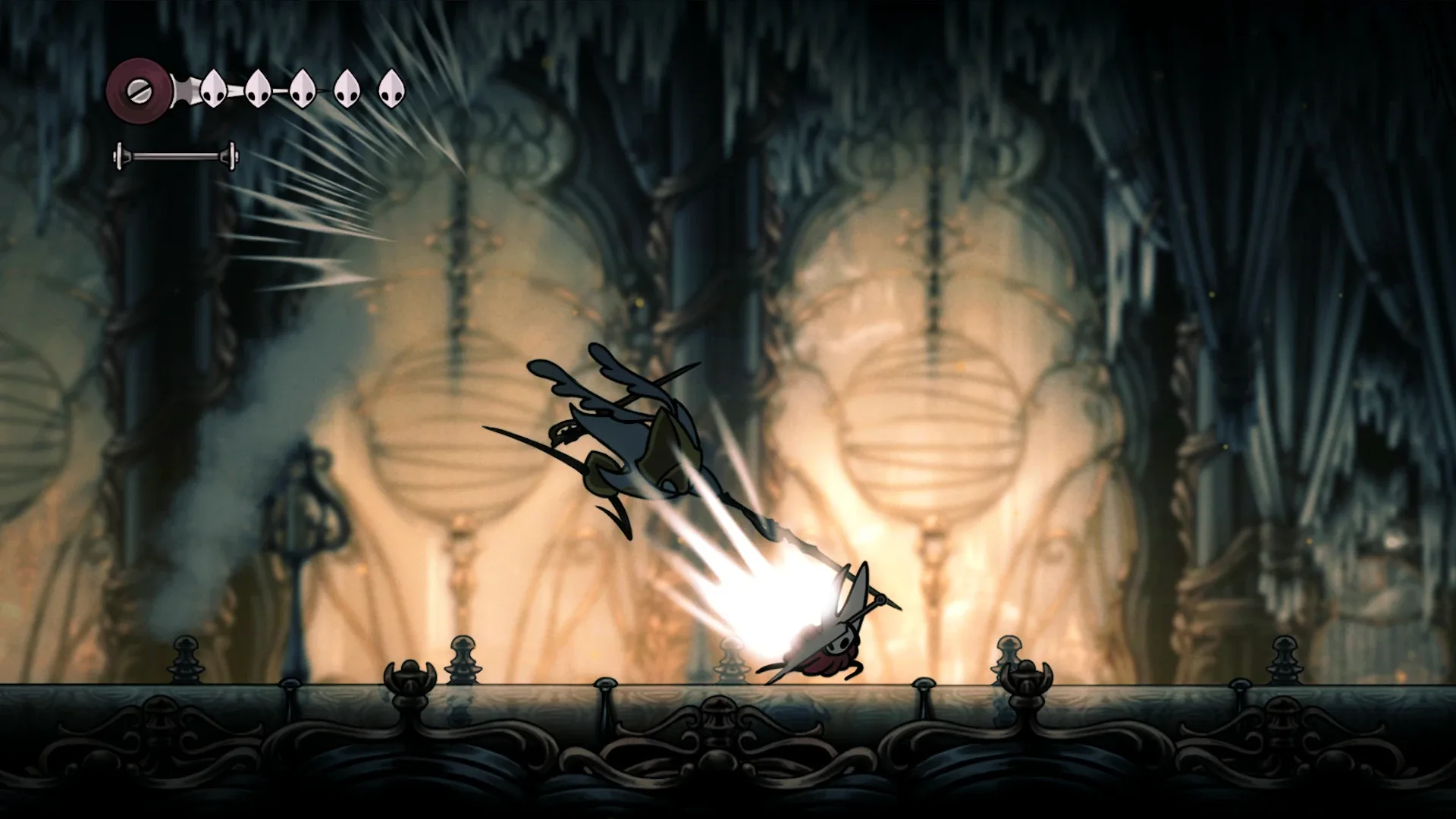
Hollow Knight: Silksong spent roughly six years between its 2019 announcement and its 4 September 2025 release, and almost none of that wait shows up as caution on screen. Team Cherry, the small Australian studio behind the original Hollow Knight, has built a sequel that trades the first game's patient, exploratory pace for something sharper and considerably less forgiving. It swaps the mute, wandering Knight for Hornet, a character with a name, a voice and a needle she is clearly furious about having to use again. The result is one of the densest, best-fought metroidvanias in years, and also one that will actively test whether that description sounds appealing or exhausting.
The premise is simple enough to survive a single sentence. Hornet, once Hallownest's princess-protector, is captured by cultist insects called Choirbugs and dragged to Pharloom, a kingdom she has never seen, to be delivered to something called Grand Mother Silk at the top of a distant Citadel. She escapes the cage before she arrives, and the rest of the game is the climb back up, on her own terms, to find out why she was taken and what waits for her at the summit. Team Cherry does not dress that premise up with a tutorial or a quest log. It hands Hornet a needle, drops her at the bottom of Pharloom, and lets the kingdom's geography do the rest of the talking.
What makes Silksong different#
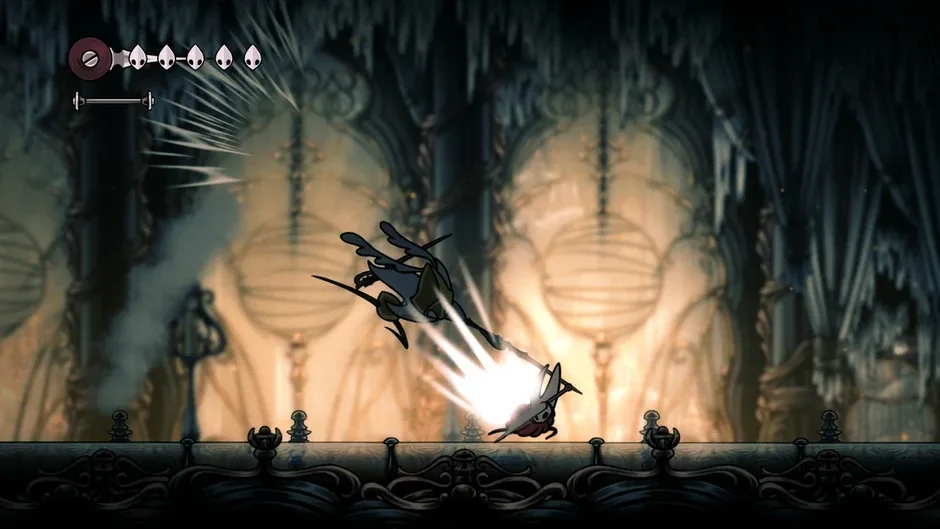
The one idea that reshapes everything else in Silksong is that Hornet is built to be aggressive, and the game is built around punishing anyone who forgets it. Where the original Knight absorbed hits, healed slowly and could afford to be patient, Hornet moves like someone who has already decided patience is a losing strategy. She dashes further, pogos off enemies and hazards with more control, and her needle strikes come out faster than the Knight's nail ever did. Her healing move, Bind, is the clearest expression of the design: it costs her entire pool of Silk in one use rather than a fraction of it, so healing mid-fight is not a safe fallback but a genuine gamble on whether the next few seconds go well. Silk itself only builds up by landing hits, which means retreating to turtle up and heal is rarely an option Silksong wants you to take. Everything about the moveset argues that the correct response to a hard fight is to get better at it, not to slow it down.
Hornet's needle and the silk economy#
Combat is built on two currencies that constantly pull against each other. Silk fuels both healing and a set of Silk Skills, more aggressive special moves equipped through Hornet's Crest, and it only fills up through successful attacks, so every decision about whether to spend it on offense or save it for a heal is made under pressure rather than at leisure. The needle itself upgrades over the course of the game at smiths hidden through Pharloom, raising both its base damage and the ceiling on what Silk Skills can do with it. The result is a combat loop that rewards reading an enemy's windup and punishing it immediately, rather than the more cautious poke-and-retreat rhythm the original Hollow Knight allowed. Enemies clearly designed around this philosophy, quick, aggressive insects that close distance fast and threaten multiple hits before Hornet can reset, are common from the first hour onward, and they make it clear early that Silksong expects a different kind of player than its predecessor did.
Crests and tools replace charms#
The charm system from the first game is gone, replaced by two interlocking systems: Crests and Tools. A Crest is effectively a loadout, changing Hornet's basic moveset, the number of Tool slots available and which Silk Skills she can use, and swapping between Crests such as the starting Hunter's Crest and later options changes how the same fight has to be approached. Tools sit on top of that framework and are color-coded by function: red tools are limited-use active items like thrown weapons and traps, replenished with Shell Shards at rest benches; blue tools are passive defensive upgrades; yellow tools boost offense or exploration; and white tools are the Silk Skills tied to a given Crest. Crafting new tools and expanding how many can be carried happens at benches scattered through Pharloom, which turns downtime between fights into genuine build planning rather than a menu chore. It is a more flexible system than charms ever were, though it also means a badly chosen loadout going into a boss fight is a mistake the player made, not the game.
Pharloom: a world built to be climbed#
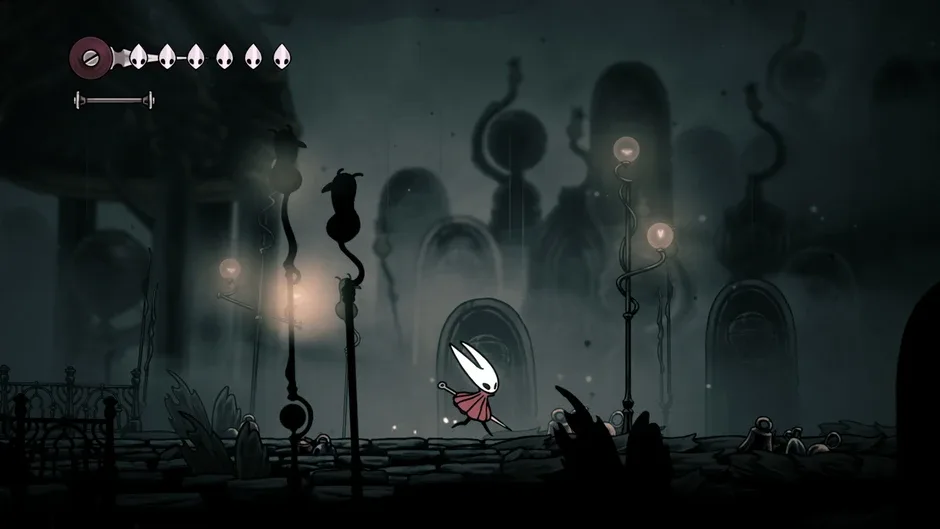
Where Hallownest sprawled mostly downward and outward, Pharloom is explicitly vertical: the whole story is a climb from the depths toward the Citadel at the kingdom's peak, and the map reflects that with towns, tunnels and hazard-filled shortcuts stacked on top of each other rather than spread flat. As in the original game, the map for each area has to be bought or found before it becomes legible, and until then Pharloom is deliberately confusing on purpose, forcing genuine navigation rather than icon-chasing. Bell-towns act as hubs and safe points between stretches of hostile terrain, and the game rewards backtracking through them once new movement tools open up shortcuts that used to be one-way drops. Secrets are hidden behind false walls, silk-thread bridges that only appear from certain angles, and side paths that lead to entirely optional bosses rather than simple treasure rooms, which keeps exploration feeling worthwhile well past the point most metroidvanias start recycling their ideas.
Bosses that don't apologize#
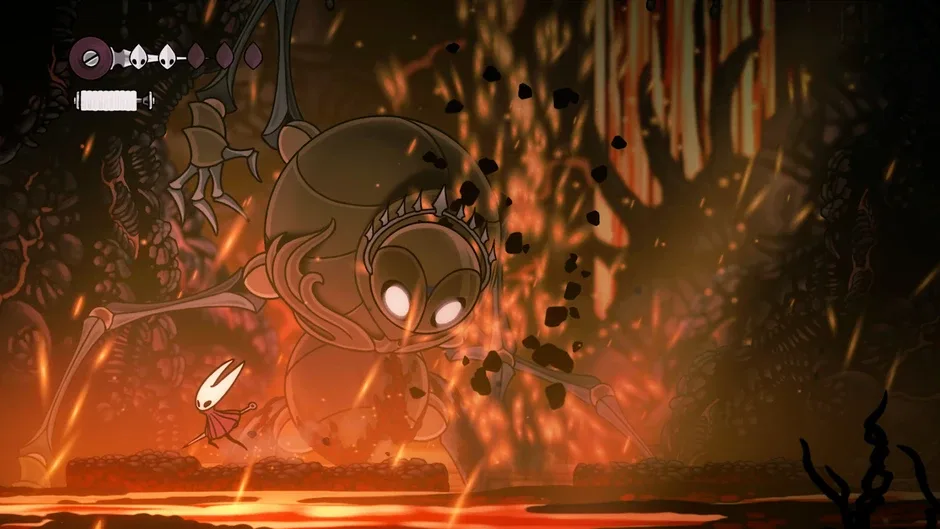
Silksong's boss roster is where the game's ambitions and its punishing streak are most visible at once. Moorwing, one of the earlier real walls in the game, is an erratic flier whose swooping attacks demand a completely different read than the grounded fights that precede it, and it is often the first moment new players realize the game has changed pace. Trobbio returns across the story in an escalating form, faster and harsher each time he reappears, which turns a single named enemy into a running measure of how much the player has improved. Lace, first encountered relatively early, is fast, punishes button-mashing outright, and returns later in a three-phase form with an expanded moveset that is significantly more aggressive than the first meeting, culminating eventually in Lost Lace, a corrupted version of the same character who serves as the game's true final confrontation. What ties these fights together is that almost none of them feel unfair on repeat attempts: the patterns are readable, the openings are real, and losing to them twenty times in a row generally means the player has not yet found the right rhythm rather than that the fight is broken.
A story Pharloom keeps at arm's length#
Silksong tells its story the same way the original game did: sparingly, and mostly through the world rather than through cutscenes. Hornet is voiced with short, dry lines this time, which gives the adventure a clearer point of view than the mute Knight ever offered, but the plot itself still has to be pieced together from NPC dialogue, item descriptions and the layout of Pharloom's ruins. The Weavers, spider-like insects who once served a being called Grand Mother Silk, sit at the center of why Hornet was taken in the first place, and the Citadel at the top of the kingdom turns out to be less a holy site than a trap built specifically around what her body can produce. None of this is delivered as exposition. It surfaces gradually, through characters met along the climb and the visible decay of the Citadel's pilgrim-worshipping culture the closer Hornet gets to it, which keeps the writing consistent with the atmosphere rather than interrupting it.
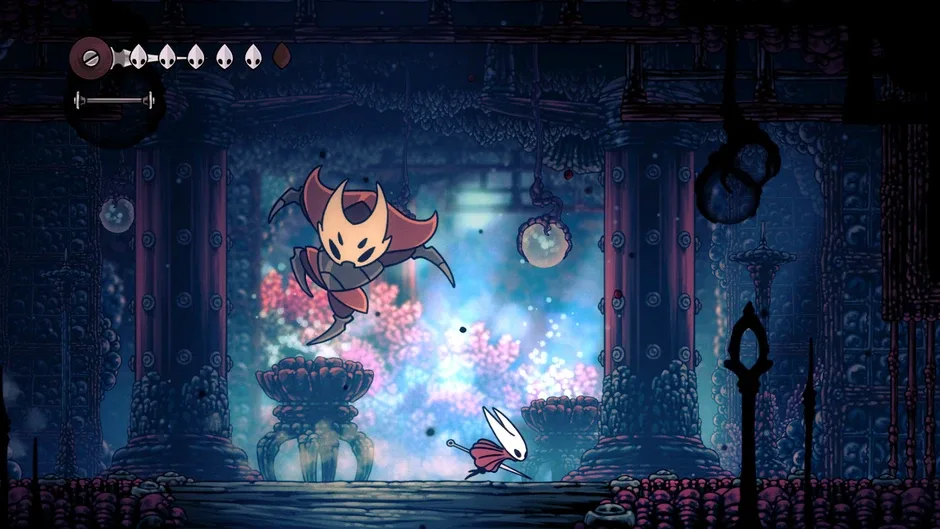
A world built from more than one silhouette#
Pharloom's regions vary enough in tone that no single hour of the game looks like another. Early bell-towns feel almost pastoral against the surrounding hostility, their bells literally used as landmarks and, later, as tools for solving environmental puzzles tied to Hornet's silk abilities. Deeper regions swap that warmth for collapsing infrastructure, flooded tunnels and the kind of vertical drop-shafts that make the map's climb feel physical rather than abstract. What ties the whole kingdom together visually is Team Cherry's hand-drawn art, which remains some of the most detailed pixel and ink-style work in the genre, and Christopher Larkin's score, which shifts from quiet, string-driven themes in the bell-towns to dissonant, percussive pieces the moment a boss arena opens up. The audiovisual craft rarely gets mentioned as a headline feature because the difficulty conversation tends to swallow it, but it is doing as much work as the combat to make Pharloom feel like a real, lived-in place rather than a series of arenas connected by corridors.
A difficulty curve with no mercy#
Silksong's difficulty has been the single most argued-over part of the game since launch, and the argument is a fair one. The game's baseline is set roughly where Hollow Knight's endgame sat, except Hornet begins with none of the accumulated charms, health and upgrades a Knight player would have by that point, so early enemies that deal proportionally heavy damage land far harder on a fresh save than the difficulty curve of the first game ever did. Rosaries, the currency spent on tools, map pins and services, stay scarce enough throughout the early hours that some upgrades feel gated behind luck as much as skill, and several boss arenas sit at the end of long, hazard-filled runbacks that punish death almost as much as the boss itself does. Team Cherry's own first major patch after launch softened a handful of the sharpest early encounters and nudged some of that balance, which suggests the studio agreed the initial curve ran hotter than intended, even if the game's overall difficulty remains high by design rather than by accident. None of this makes Silksong unfair so much as uncompromising: it is a game that assumes commitment to failing repeatedly as part of the deal, and it never really apologizes for that assumption.
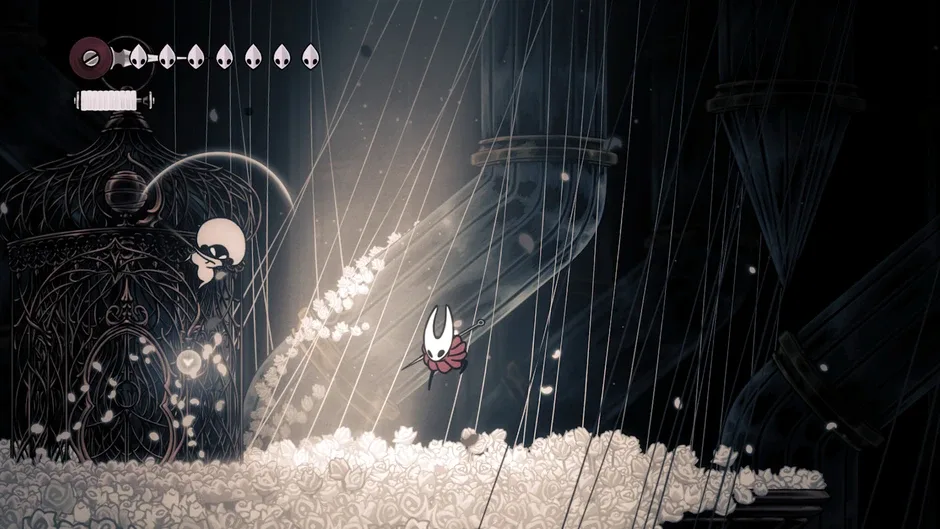
New to the genre? Start here#
Silksong is not the easiest entry point into metroidvanias, but a few habits make the opening hours far more survivable. Prioritize the Silk Heart and Silk Spool upgrades that increase healing capacity before chasing offensive tools, since survivability solves more early problems than raw damage does. Buy every map for a new area from its cartographer as soon as it becomes available rather than exploring blind, because Pharloom's layout punishes guesswork more than the original Hallownest did. Rest at benches often to refill Shell Shards into usable tools, since running into a boss with an empty red-tool slot removes options the fight was designed around. And treat an early wall like Moorwing as a checkpoint to farm nearby Rosaries and upgrade the needle rather than a signal to push forward underleveled, since Silksong is generally more willing to let a patient player catch up than to let a rushed one skip ahead.
Compared with Hollow Knight and Metroid Dread#
Hollow Knight is the inevitable comparison, and Silksong is both clearly its sequel and clearly a harder, faster game built on the same bones. Hallownest's melancholy, slower rhythm gave players room to learn at their own pace; Pharloom assumes a player already fluent in the genre's grammar and pitches its early fights accordingly. Anyone who found the first game's optional content, Path of Pain, the Radiance, the true ending's platforming gauntlets, to be the highlight rather than an endurance test will feel at home almost immediately in Silksong. Anyone who enjoyed Hallownest mainly for its slower, sadder atmosphere may find Pharloom's constant pressure less comfortable, even though the artistry underneath it is just as strong.
Metroid Dread is the fairer external comparison, since both games build combat around fast, punishing engagements rather than the slower attrition older metroidvanias favored. Dread's EMMI sections isolate its tension into scripted stealth chases with a hard reset on failure; Silksong spreads that same pressure across nearly every encounter, since regular enemies routinely threaten multiple hits in a way Dread's rank-and-file mobs rarely do. Dread is the tighter, more controlled experience as a result, with a runtime under half of Silksong's; Silksong is the larger, messier, more generous one, trading some of that precision for a kingdom big enough to get properly lost in.
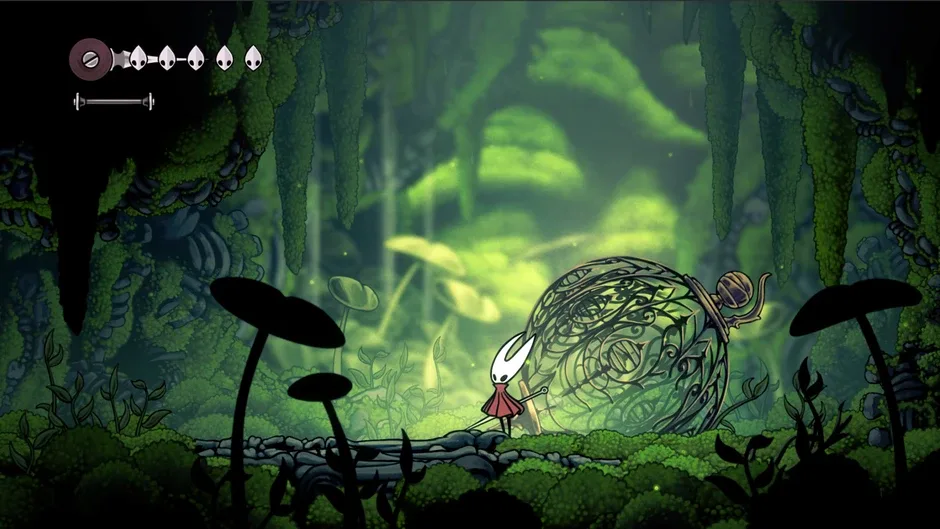
Worth the money?#
At $19.99, Silksong is priced closer to an indie release than the 40-to-60-hour game it actually is, and that gap is the single strongest argument for buying it without waiting for a sale. A focused run to the credits sits in the neighborhood of 20 to 30 hours depending on how much optional content gets skipped, a full story playthrough that engages with side content runs closer to 40 to 45 hours, and a genuine 100% completion file, all bosses, all tools, all areas, stretches past 60 hours for most players. Very few games in any genre offer that much content at that price, and the demand at launch, which briefly overloaded storefronts on PC, Xbox and PlayStation as well as the Nintendo eShop, reflected just how aware players already were of that value.
Silksong is available on PC, Mac and Linux, PlayStation 4 and 5, Xbox One and Xbox Series X|S, and Nintendo Switch and Switch 2. On PC, it runs comfortably even on modest hardware and plays well on Steam Deck, since the game's 2D, hand-drawn art never leans on the kind of shader-heavy rendering that causes stutter in bigger 3D releases. The game was also available through Xbox Game Pass from its first day, which is worth factoring in for anyone with an existing subscription before paying full price elsewhere.
Play this instead if …#
Shorter: Blasphemous 2 delivers a tighter, roughly 15-hour metroidvania with similarly punishing combat and a much smaller map to master.
Easier: Ori and the Will of the Wisps keeps the genre's exploration and platforming focus while leaning far more on spectacle and forgiveness than on punishing combat.
Cheaper or more casual: the original Hollow Knight is regularly discounted well below Silksong's price and remains the gentler on-ramp into the same world and rules.
Frequently asked questions#
How long is Hollow Knight: Silksong? Around 20 to 30 hours for a focused run to the credits, 40 to 45 hours for a full playthrough that explores side content, and 60-plus hours for a complete file with every boss, tool and area found.
Is it harder than the original Hollow Knight? Yes, noticeably so in its opening hours, since Hornet starts with none of a veteran Knight's accumulated upgrades and several early bosses deal damage tuned closer to the first game's late stretches.
Does it have co-op? No. Silksong is a single-player experience from start to finish, with no cooperative or competitive modes.
Is there a difficulty option? No adjustable difficulty setting exists; tool loadouts, Crest choice and grinding for upgrades are the only ways to make individual fights more manageable.
Do you need to have played Hollow Knight first? No, the story stands on its own with a new protagonist and setting, though returning players will recognize Hallownest characters and lore threads woven into Pharloom's background.
Is it on Steam Deck? Yes, the hand-drawn 2D visuals run smoothly on Steam Deck without the shader-compilation issues that affect many modern 3D releases.
Was the launch itself smooth? Demand outpaced the storefronts rather than the game: Steam, Xbox and PlayStation store pages, along with the Nintendo eShop, briefly buckled under traffic in the minutes after release, though the game itself was playable once purchased and the storefronts recovered quickly.
The Game Avant verdict#
Hollow Knight: Silksong is not a gentler, more polished version of its predecessor built to win over people the first game lost. It is a harder, faster, more demanding sequel that assumes anyone picking it up already wants exactly that, and it delivers on that assumption with some of the best boss design and world layout the genre has produced in years. The rough edges are real: the opening hours ask more of a fresh save than they arguably should, Rosaries stay tight longer than feels necessary, and a few runbacks punish death more than the fights that caused it. None of that changes what Pharloom actually is once its systems click into place, which is a kingdom built with total confidence that struggling through it is the entire point, not a flaw to be patched away.
9 out of 10 – a huge, unforgiving metroidvania that earns its difficulty more often than it abuses it.