
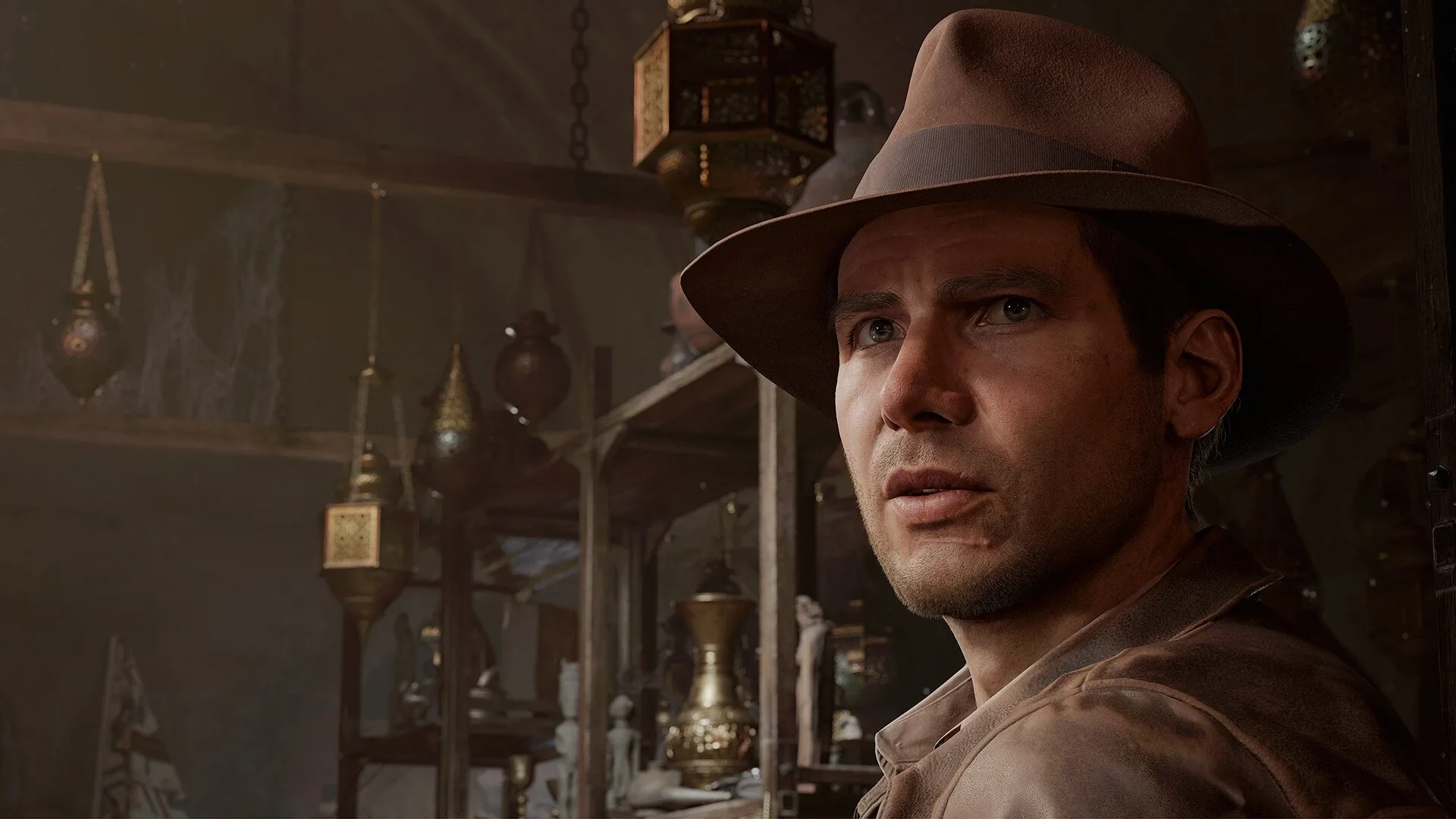
Indy was never supposed to be good at fighting, and this game finally agrees#
Indiana Jones and the Great Circle is the first game to treat its hero the way the 1981 film actually wrote him: a professor who improvises his way out of trouble with whatever is nearby, not a one-man army. Developed by MachineGames and published by Bethesda Softworks under the Lucasfilm Games banner, it released on 9 December 2024 for Xbox Series X|S and PC, arrived on PlayStation 5 on 17 April 2025, and reached Nintendo Switch 2 in May 2026. It sets its own original story in 1937, between Raiders of the Lost Ark and The Last Crusade, and never leans on footage, likenesses or plot points from the films to justify itself. The result is a first-person adventure game that gets more of Indiana Jones right than any licensed game has managed in over two decades, precisely because it lets him lose fights, drop his hat and get outsmarted before he outsmarts everyone else.
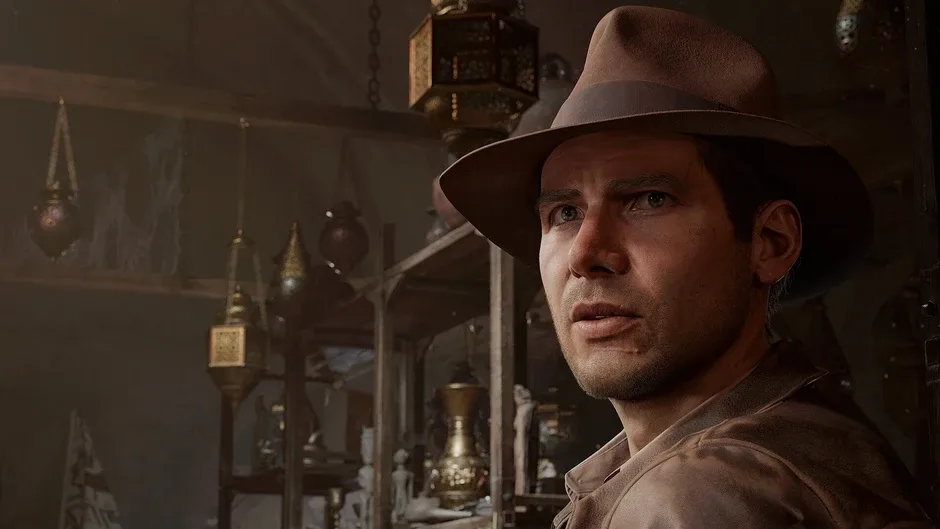
What makes The Great Circle different#
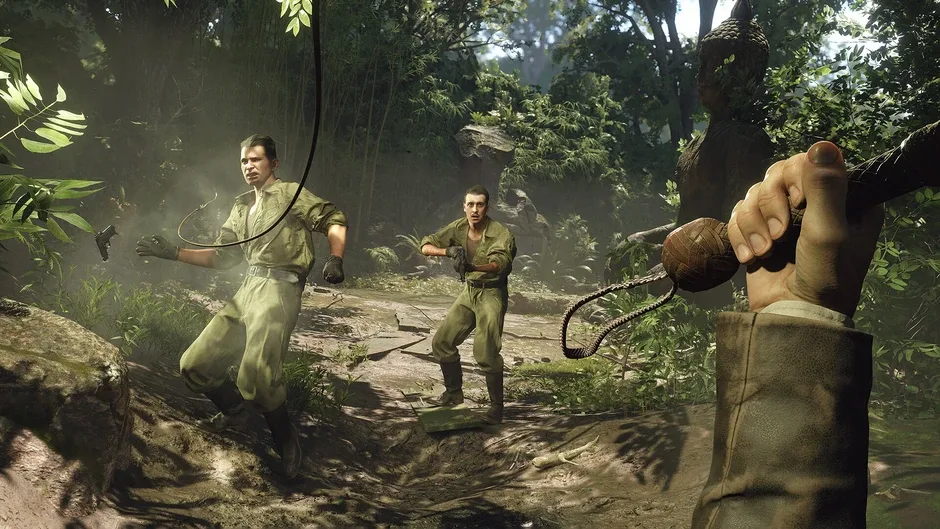
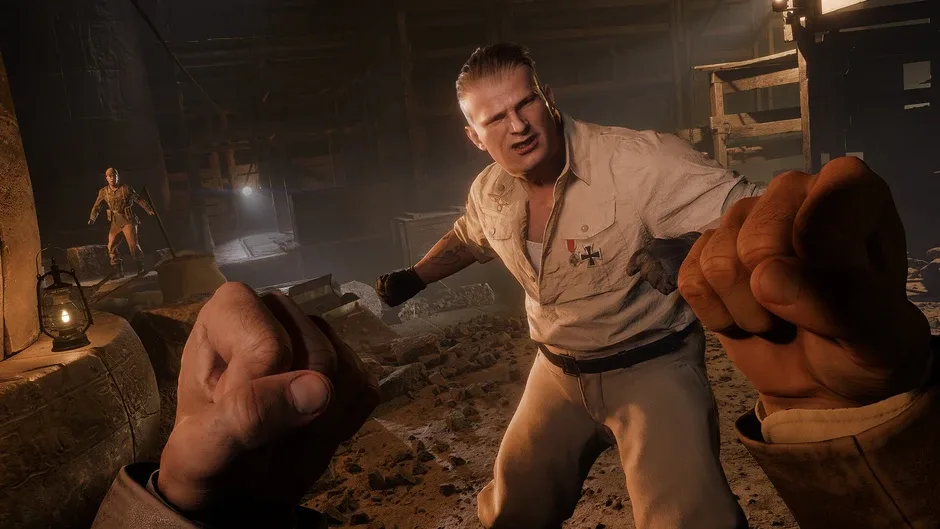
The one decision that carries the entire game is that combat is meant to be bad. Not broken, bad on purpose. MachineGames' own design team has said in interviews that guns were the studio's biggest worry going in, because a gun in a first-person game is naturally more powerful and more satisfying to use than a fist, and that would have turned Indiana Jones into someone he has never been. So the team built melee around chaos instead of competence: a swing with a wrench or a chair connects late, staggers unpredictably, and rarely ends a fight in one clean hit, while pulling out a pistol does not make Indy stronger so much as it escalates the entire situation, drawing every guard within earshot into a fight he almost never wins outright. The whip, similarly, is a traversal and utility tool first and a weapon of absolute last resort, useful for disarming a single guard in a pinch but never the answer to a room full of them. The game is at its best, and clearly wants you to notice, in the long stretches where you never draw either.
That single choice reshapes everything else. Because winning a stand-up fight is neither fun nor reliable, the game pushes you constantly toward the things Indiana Jones is actually good at: reading a room, finding the unguarded route, picking a lock, and talking or sneaking his way past a problem instead of punching through it. A guard patrol in the Vatican's archive wing is not an obstacle to clear; it is a puzzle about timing, cover and disguise. The frustration some players feel toward the combat is real and earned, but it is also the clearest sign the design is working as intended: you stop reaching for your fists because reaching for your fists rarely helps.
Giza and the Vatican: exploration as the main event#
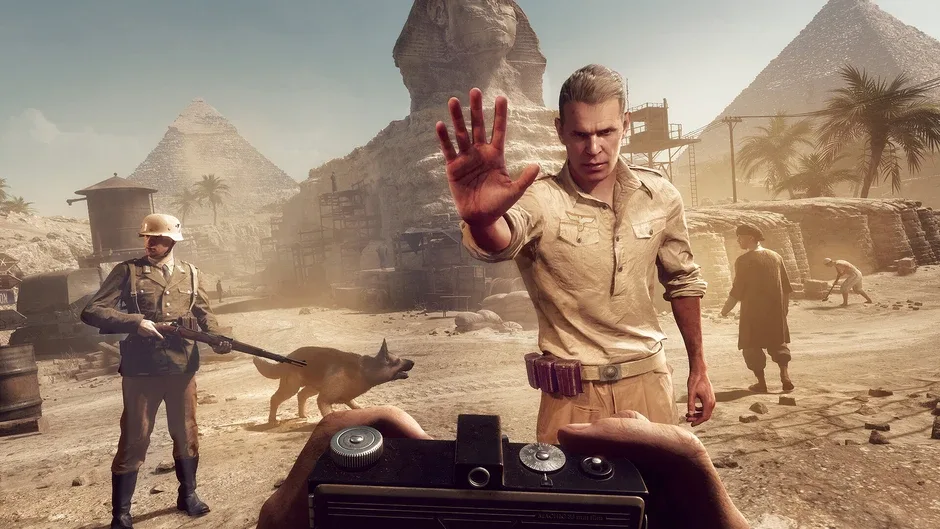
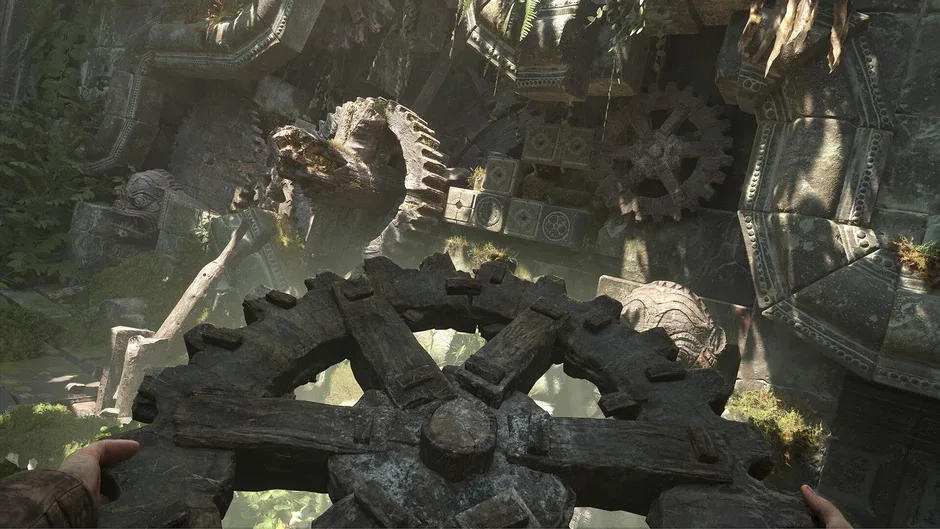
The Vatican, reached early in the story after Indy and archaeologist Gina Lombardi trail a Nazi expedition into its restricted archives, and Giza, reached shortly after by airship, are the two hubs where the design is at its most confident. Both are built as dense, vertical playgrounds rather than open fields: rooftops, courtyards, half-collapsed excavation sites and locked chambers stacked on top of each other, all connected by climbable ledges, hidden passages and the kind of environmental storytelling that rewards actually stopping to read an inscription rather than sprinting past it. Giza in particular treats the pyramids and their surrounding dig sites as one interconnected structure, with a genuine sense of scale that comes from the way sightlines open up as you climb rather than from raw map size. Both hubs hide dozens of side puzzles, hidden tombs and optional relics that have nothing to do with the main story and everything to do with rewarding curiosity, and both are built around two-tier disguise systems: an obvious costume that gets you past casual guards and into most public areas, and a rarer, hidden outfit that opens restricted zones entirely, found only by players willing to dig through a hub's side content.
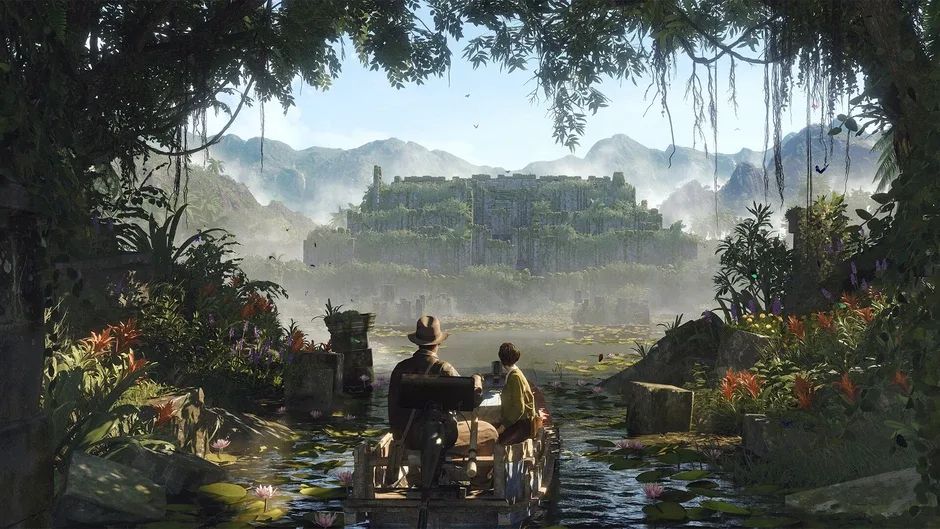
Shanghai and the game's Thailand chapter, reached later, lean harder into narrower, mission-driven spaces and a more linear rhythm, which works well for Shanghai's rooftop chases and back-alley intrigue but leaves the Thailand stretch feeling like a comparative lull between two much stronger acts. It is not a bad section of the game, but after the density of Giza and the Vatican, a chapter that spends more time moving you from set piece to set piece than letting you get lost on your own terms is a noticeable step down, and it is the clearest place where the game's ambitions slightly outrun its pacing.
Adventure Books reinforce all of this without turning exploration into busywork. Dozens of them are hidden across the four hubs, some handed over during the story and most tucked behind an environmental puzzle, a locked safe, or a specific vendor who only sells to a player who has bothered to track them down, and each one grants a small, permanent perk once read: faster climbing, quieter footsteps, sharper hearing near guards, a longer window for a stealth takedown. None of the individual perks are transformative on their own, but the act of hunting for them gives every side room and locked door in Giza and the Vatican a second reason to exist beyond a relic or a photograph, and the fact that the books are found rather than bought or unlocked on a skill tree keeps the whole system feeling like part of the world instead of a menu bolted on top of it.
The camera as a puzzle tool, not a collectible counter#
The single mechanic most likely to change how you think about adventure-game puzzles is Indy's camera. Photographing an object of interest earns Adventure Points, which unlock passive perks through dozens of Adventure Books scattered across every hub, but the camera's more important job is as a built-in hint system. Point it at a cipher, a locked mechanism or a relic you cannot place, snap a photo, and Indy will offer a short, in-character observation about what he is looking at. Photograph the same puzzle again and the hint sharpens; keep at it and he will eventually spell out the answer outright, all without leaving the game world or opening a menu. It respects the player's intelligence in a way most modern puzzle design does not, because the hint is opt-in and diegetic rather than a waypoint quietly guiding your eyes. The one real flaw is that a handful of the game's later puzzles hide the detail you need to photograph well outside the frame a player would naturally point the camera at, which can turn an otherwise elegant system into a frustrating game of guessing where to look, rather than what to look at.
Troy Baker's Indy and a story that earns its own name#
Troy Baker plays Indiana Jones through full performance capture, and the choice to hire an actor rather than lean on archived dialogue or a digital likeness pays off across the entire runtime. His performance carries the weary sarcasm and genuine academic curiosity the character needs without ever slipping into impression. The plot, an original story about a Nazi archaeologist named Emmerich Voss hunting relics tied to the Great Circle, a set of ancient sites that align across the globe, gives Indiana Jones a mystery worth chasing rather than a checklist of film cameos. Gina Lombardi, an Italian journalist who becomes Indy's reluctant partner through the Vatican and Giza chapters, is the strongest supporting character the series has had outside the films, and the writing trusts her with real stakes in the plot rather than reducing her to comic relief. The story does lean on familiar Indiana Jones beats, a secretive religious order, a race against a fascist regime, an ancient power nobody fully understands, but it earns them by never pretending to be an adaptation of something else.
Difficulty and accessibility: four settings that actually change the feel#
The game splits its difficulty into two separate sliders, one for combat and stealth and one for puzzles, which is a smarter approach than a single overall number. Combat and stealth run from Light through Moderate, Hard and Very Hard, changing how much damage enemies deal and how many of them engage at once, while the puzzle slider adjusts how readily the camera's hint system offers help. Between those two axes and a genuinely thorough accessibility menu covering aim assist strength, interactable highlighting, subtitle sizing, colour-blind modes and high-contrast outlines, the game is unusually good at letting a player who wants the story and puzzles without a stealth-action challenge, or the reverse, tune the experience to match. It is one of the more thoughtful accessibility packages a big-budget adventure game has shipped with, and it deserves more attention than it has received.
Stealth and disguises: the game's real combat system#
If melee is deliberately weak, stealth is where the design puts its actual effort, and it shows. Disguises are the backbone of every hub: put on a Vatican clergyman's robes or a Nazi officer's uniform and most guards will leave you alone entirely, so long as you do not linger somewhere you obviously should not be, get spotted doing something suspicious, or run into an officer sharp enough to see through the costume. That last wrinkle keeps disguised sections tense rather than trivial, since a guard who is not fooled will call the alarm the moment they notice, and a blown disguise in a crowded courtyard escalates fast. Improvised takedowns, knocking a guard out with a well-timed grab from a hiding spot, dragging a body out of sight, distracting a patrol with a thrown object, are all context-sensitive rather than tied to a combo system, which keeps them feeling like Indy solving a small tactical problem rather than performing a rehearsed animation. The best sequences in the game, particularly through the Vatican's restricted wings, are built entirely around this loop, and it is a stronger, more distinctly Indiana Jones combat system than the actual fistfights ever manage to be.
Compared with Uncharted and Tomb Raider#
Uncharted is the inevitable comparison, and the difference is instructive. Nathan Drake's games are third-person action-adventures where the shooting is polished and the climbing is a scenic backdrop between set pieces; the fantasy is being extremely good at violence while looking effortless doing it. The Great Circle inverts that completely. Its climbing and puzzle-solving are the main event, its shooting is deliberately clumsy, and the fantasy on offer is being resourceful rather than powerful. If you want the adrenaline of a blockbuster action sequence executed flawlessly, Uncharted still does that better. If you want to feel like the smartest person in the room rather than the deadliest, this is the stronger game.
The 2013 Tomb Raider reboot and its sequels are the closer structural cousin, with hub-based exploration, optional tombs, and a camera-and-notebook approach to environmental puzzles that clearly informed some of what MachineGames built here. The difference is emphasis: Lara Croft's games gradually turn her into a highly capable survivalist with genuinely strong combat by the midpoint of each game, while Indiana Jones never gets meaningfully better at punching, because the game does not want him to. Anyone who found Tomb Raider's late-game armoury satisfying will likely find The Great Circle's insistence on staying weak an odd, occasionally frustrating choice. Anyone who found that same armoury a betrayal of who Lara was supposed to be will recognise exactly what MachineGames was trying to protect here.
Both comparisons point at the same underlying question: what is an adventure game actually for? Uncharted and the modern Tomb Raider answer it with escalation, more guns, more traversal tools, bigger set pieces as the credits approach. The Great Circle answers it with restraint. Indy has the same whip, the same weak fists and the same reluctance to use a gun in the final hours that he had in the first, and the game's climactic sequences are built to be solved and outmanoeuvred rather than shot through. It is a smaller, quieter kind of escalation, built around how much of the world you have learned to read rather than how much firepower you have accumulated, and it is a legitimately different pitch from either of its closest genre neighbours rather than a watered-down version of them.
Worth the money?#
At $69.99 for the standard edition, the base game alone is a reasonable buy for anyone who finishes it with even moderate side-content engagement: the main story runs somewhere in the range of 14 to 20 hours depending on how much optional exploration you do along the way, a normal playthrough that samples the side puzzles and Adventure Books comfortably reaches 20 to 30 hours, and chasing every relic, book and hidden disguise across all four hubs pushes a completionist run toward 50 hours. That is a strong hours-to-price ratio for a story-driven adventure game rather than an open-world time sink. The Order of Giants expansion, released 4 September 2025 as a standalone purchase or bundled into the Digital Premium Upgrade, adds a further chapter and is worth considering only after finishing the base story, not as a reason to buy in on its own.
Best platform is close to a toss-up between Xbox Series X and PC for anyone chasing the sharpest visuals, since the game was built first for those two platforms and it shows in how comfortably it runs there; PlayStation 5 arrived four months later with PS5 Pro enhancements and is every bit as solid a way to play if that is your platform of choice. The Nintendo Switch 2 version, releasing well over a year after the others, is the one to pick only if portability genuinely matters more to you than visual fidelity. Text and voice are English-only for voice acting, with subtitles and interface text available in a wide range of languages.
Play this instead if …#
Shorter: Uncharted: The Lost Legacy trims a similar action-adventure formula down to roughly 8 to 10 hours with tighter, more consistently paced set pieces.
Easier: The 2013 Tomb Raider reboot offers a comparable hub-and-puzzle structure with combat that actually rewards getting good at it, rather than staying deliberately clumsy throughout.
Cheaper: A Plague Tale: Innocence delivers a similar first-person-adjacent stealth loop built around avoidance over confrontation, usually available well below full price.
Frequently asked questions#
How long is Indiana Jones and the Great Circle? Roughly 14 to 20 hours for the main story alone, 20 to 30 hours for a normal playthrough with side content, and up to 50 hours to find everything across all four hubs.
Is it an open world? No. The game is built around four large, densely designed hubs, the Vatican, Giza, Shanghai and Thailand, connected by a linear story rather than one continuous open map.
Does it have co-op or multiplayer? No. It is a single-player game from start to finish with no multiplayer modes.
Is there an easy mode? Yes, through separate combat/stealth and puzzle difficulty sliders, plus a detailed accessibility menu covering aim assist, interactable highlighting and more.
Do you need to know the Indiana Jones films to follow the story? No. The plot is an original 1937 adventure that assumes no prior knowledge of the films and does not depend on them for its stakes.
Is the melee combat actually bad, or just different? It is intentionally weak and unpolished by design, meant to push you toward stealth and improvisation rather than toward standing and fighting, and it is worth knowing that going in.
The Game Avant verdict#
Indiana Jones and the Great Circle succeeds by refusing to give its hero the thing almost every action-adventure game hands out for free: competence in a fight. That refusal is also its biggest liability, since a handful of forced combat encounters ask you to engage with a system the game itself does not respect, and the Thailand chapter never quite matches the density of the Vatican and Giza hubs that precede it. None of that undoes what the rest of the game gets so thoroughly right. The camera-based puzzle hints, the two-tier disguise systems, and a story that never once needs to borrow a scene from the films to justify Indiana Jones being on screen add up to the most faithful translation of the character this medium has produced. It is a game that trusts you to be curious rather than powerful, and that trust is rare enough to forgive the moments where the fists let you down.
9 out of 10 – an adventure game brave enough to make its hero a bad fighter, and better for every minute of it.