

A deckbuilder that makes you defend a building, not a lane#
Monster Train is the game that looked at Slay the Spire's turn-based card combat and asked what would happen if a single battlefield became three of them, stacked on top of each other, all defended by the same deck at the same time. Developed by Shiny Shoe and published by Good Shepherd Entertainment, it released on 21 May 2020 for Windows, reached Xbox One that December, arrived on Nintendo Switch as the Monster Train: First Class complete edition in August 2021, came to iOS in October 2022 and finally to PlayStation 5 in July 2024. Five years after its original launch, to the exact date, a sequel arrived in May 2025. None of that history is the reason to care about the original now. The reason is that Monster Train solved a structural problem the genre still mostly hasn't: how do you make a deckbuilder feel like you're managing a war instead of a duel? Its answer is to give you a train with three floors of combat and a fourth floor with something worth dying for, and to never let you forget that all three floors are burning down at the same time.
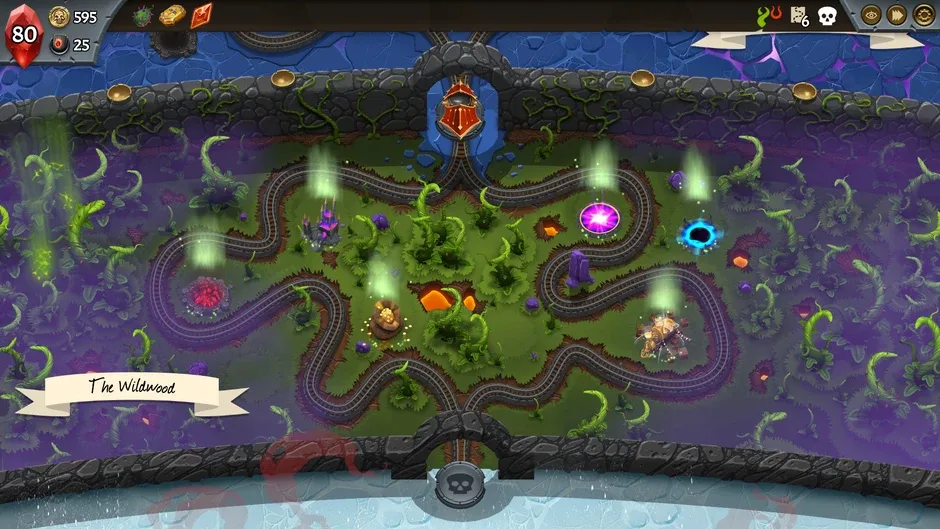
The premise is simple enough to survive a two-sentence pitch. Hell has frozen over, its last ember is loaded onto a train called the Pyre, and you are one of hell's monstrous clans escorting it back down to reignite the underworld while waves of angelic Zealots try to snuff it out along the way. Every run is a straight climb: pick a starting clan, pick a champion, draft cards and artifacts between stops, fight at every stop, and eventually face the Seraph at the bottom of the line. There is no branching map to memorise and no long story to sit through between fights. The entire game is the climb, repeated, each time with a different hand of tools.
What makes Monster Train different#
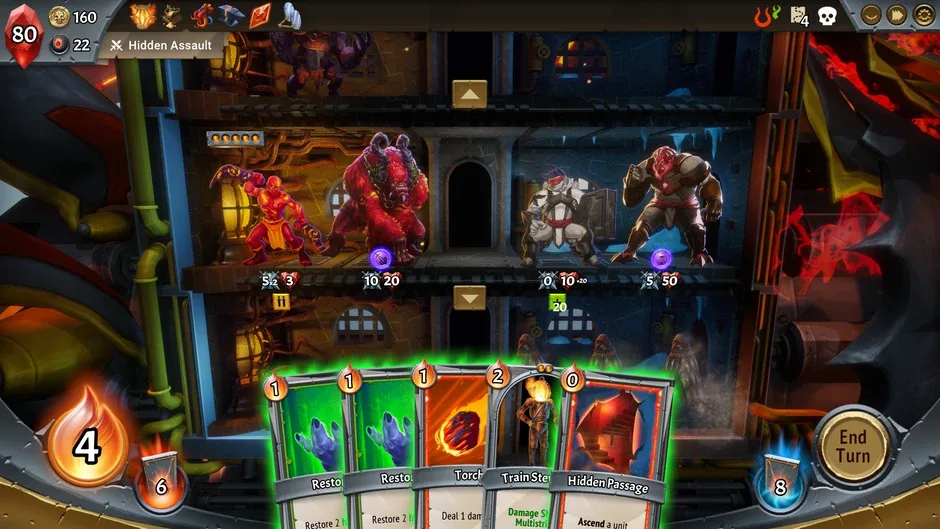
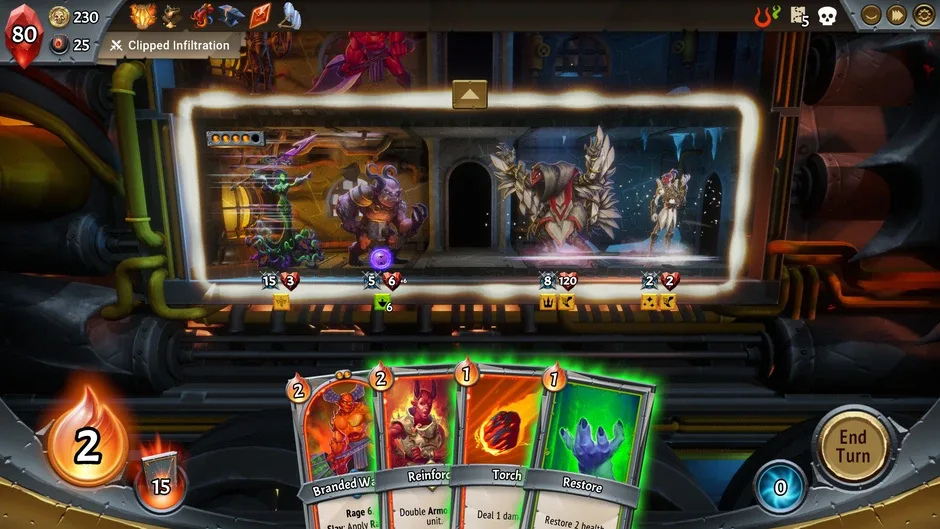
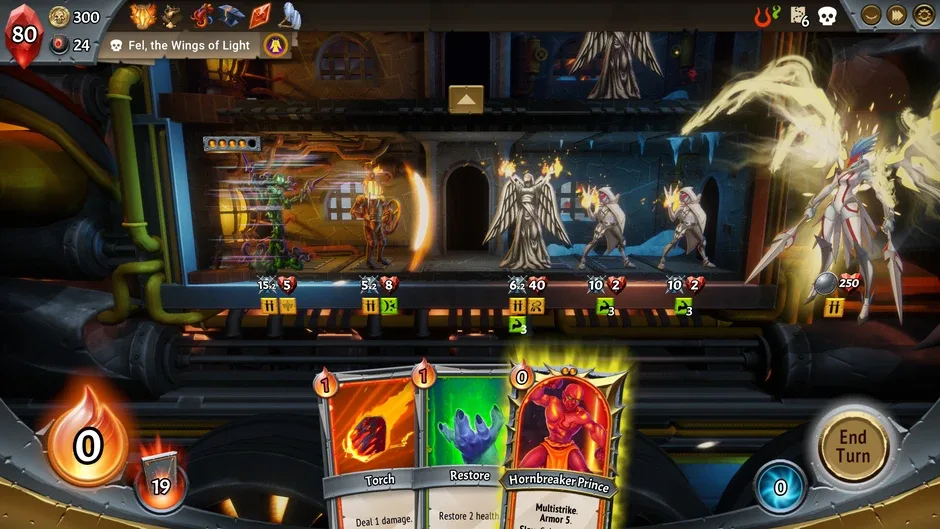
The one idea that separates Monster Train from every deckbuilder that came before or after it is vertical defense. The train has four levels stacked on top of each other: three floors where your units can stand and fight, and a top floor that holds the Pyre itself, the ember your whole clan is trying to protect. Enemies always start on the bottom floor and climb upward, breaking through whatever you've placed on each level as they go. If a Zealot survives the bottom floor, it doesn't disappear or reset. It walks up the stairs and immediately starts attacking the floor above, and if it survives that floor too, it keeps climbing until it reaches the Pyre and starts chipping away at the health bar that persists across every fight in the run.
That single mechanical decision changes what deckbuilding means here. In a normal genre entry you build one line of defenders and one line of attackers and hope the math works out. In Monster Train, you are running three separate skirmishes simultaneously, and a card that would be excellent on the bottom floor, where you want tanky units that can eat hits from a whole wave, can be actively wrong on the top floor, where a single fragile unit is often better than a wall because there's nothing left to protect behind it. Spending your whole hand reinforcing the bottom floor because that's where the fight looks scariest is a classic beginner mistake, and the game punishes it specifically: a bottom floor that holds forever but a middle floor that quietly collapses is exactly how a Pyre dies at full health while every unit you own is still alive one level down.
Two clans, one deck: the dual-pool draft#
Every run begins with a decision the genre rarely makes this explicit: pick a primary clan and a secondary clan, and your deck for the entire run is drawn from both pools. At launch there were five clans, later six with an expansion, and each one plays with a distinct identity. The Hellhorned lean on aggressive imps that trade their own lives for burst damage. The Awoken grow massive, slow plant units that start weak and become nearly unkillable walls by turn five. The Stygian Guard build around spellcasting and card draw rather than raw stats. The Umbra thin their own deck and buff a single monstrous unit that eats the others. The Melting Remnant field short-lived, disposable units that reward keeping something, anything, alive at the end of a fight.
None of those identities is the point on its own. The point is what happens when you pair two of them, because the game's card pool is built so that a Hellhorned-Umbra deck plays almost nothing like a Hellhorned-Awoken deck, even though half the cards on offer are identical between the two runs. Sacrificing a wave of cheap Hellhorned imps to buff a single hungry Umbra unit is a completely different plan from stacking Hellhorned aggression under a wall of Awoken plant units that buy time for the burn damage to add up. With ten possible clan pairings at launch and fifteen after the sixth clan arrived, the game does the unglamorous but crucial job of making sure a run in October rarely resembles a run from August, without needing a single new card to do it.
Champions, ember and the economy that decides a run#
Every clan has two champions, one available from the start and a second unlocked through play, and picking a champion at the start of a run is closer to picking a build than picking a character. The Hellhorned's Hornbreaker Prince rewards a deck built to trigger his growing rage the more units die around him, which pushes the whole run toward sacrifice effects. The Umbra's Penumbra, by contrast, grows only when it consumes other units outright, which turns a deck into a single-unit scaling project rather than a wide board. Because champions can be upgraded with the same card-improvement currency as everything else, and because they sit permanently on whichever floor you place them, choosing where to put your champion is itself a strategic decision: keep it on the bottom floor as an anchor, or move it up to protect a weaker line that would otherwise fold.
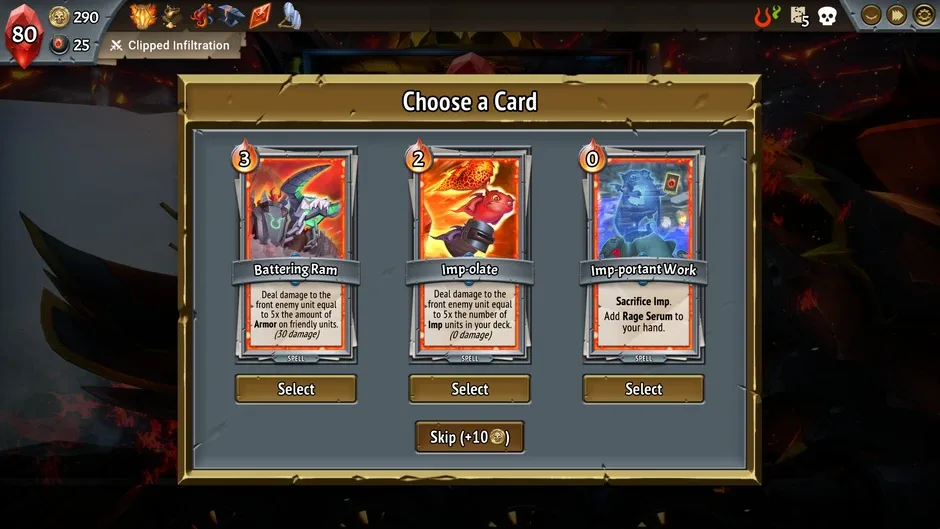
Underneath the clan and champion choices sits Ember, the resource spent to play cards each turn, and a card-upgrade system that lets you spend gold between fights to permanently improve a card in your deck rather than only adding new ones. That upgrade path matters more here than in most of the genre, because a fifteen-card deck with three heavily upgraded staples usually beats a thirty-card deck of decent options; thinning and improving what you already have is frequently the correct answer to "what do I draft next," which is a more interesting question than the genre usually asks.
Eight fights, two bosses, and a roster that grew for free#
A run is built from eight battles in total. Regular waves fill most of the climb, but the third and sixth stops always throw a named minor boss at you, drawn from a pool that includes fights like Daedalus and Fel, before the run ends at the eighth stop against the Seraph itself. That structure means a run has a rhythm you can plan around: two checkpoints to prepare a deck for before the final exam, rather than a flat string of identical fights. Shiny Shoe kept adding to that pool for free well after launch. The September 2020 Friends & Foes update, released at no extra cost, doubled the champion roster by giving every one of the five original clans a second, alternate champion, Shardtail Queen for the Hellhorned, Wyldenten for the Awoken, Solgard the Martyr for the Stygian Guard, Primordium for the Umbra and Little Fade for the Melting Remnant, each arriving with its own starter card and a matching artifact. The same update added two new minor bosses, Talos and Archus, each with three variants, to keep the third and sixth stops from feeling like the same two fights on repeat, plus a tougher Seraph variant called Seraph the Patient for players who had already beaten the standard version. None of it needed to be bought separately, and all of it is still there in the base game five years later.
The climb: Covenant difficulty and why runs stay short#
A single successful run, from the first stop to the Seraph fight at the bottom of the line, rarely takes more than 45 minutes to an hour, and that brevity is deliberate. Monster Train wants you to lose, learn something specific about why, and start again immediately, and the escalating Covenant difficulty system is what keeps that loop from going stale. Clearing a run at the base difficulty unlocks a harder Covenant rank for that clan pairing, adding new twists such as tougher starting conditions or meaner enemy waves, and climbing through those ranks is where the game's real skill ceiling lives. The first handful of runs with any given clan combination can feel almost too forgiving; the higher Covenant tiers are where a single misplaced card on the wrong floor turns into a lost Pyre.
That structure means the first ten or so hours of Monster Train undersell it slightly. Anyone bouncing off an early run because the base difficulty felt easy is judging the game by its tutorial. The Seraph itself, the recurring final boss, adds a stacking curse to your deck every single turn of the fight that slowly drains your units' attack, which forces every deck, regardless of clan, to answer the same question by the end of a run: can you scale up faster than the fight can grind you down.
The Last Divinity: hell gets a sixth clan#
The Last Divinity, released in March 2021 as the game's expansion, does the thing genre expansions rarely manage: it adds real strategic surface area rather than just more of the same cards. Its headline addition is the Wurmkin, a sixth clan built around Charged Echoes, a resource that spells and units generate and spend to snowball each other's power, led by the Spine Chief and the Echowright as its two champions. Alongside the new clan comes Pact Shards, a currency that inverts the genre's usual risk-reward math: gaining shards helps you immediately, through gold, artifacts or upgrades, but also makes the run's enemies stronger, and banking enough shards across a run unlocks a fight against a new final boss, the Last Divinity itself, in place of the standard Seraph. The expansion also folds in new events, ten additional difficulty mutators and a set of expert challenges, and because all of it is optional, it expands the ceiling without touching what made the base game work in the first place.
Artifacts and the deck you didn't draft#
Cards are only half of what shapes a run. Between stops, alongside the usual card and gold rewards, Monster Train regularly offers artifacts, passive items that sit outside the deck entirely and quietly rewrite how a run plays without needing a single card slot. Some are narrow and clan-specific, like the totems and blades tied to each clan's alternate champion, and some are broad enough to matter in almost any deck, boosting a stat across every unit on a floor or changing how status effects like Frostbite and Regeneration behave for the rest of the run. Because artifacts are drafted rather than guaranteed, two runs with an identical deck list can still play out completely differently depending on which handful of artifacts showed up along the way, which adds a second, quieter layer of randomness on top of the card draft that experienced players learn to read almost as carefully as the cards themselves. Knowing when to skip a mediocre card in favour of banking gold for a card upgrade, or when to pick a build-defining artifact over a safe stat stick, is where a lot of the game's real decision-making lives, well below the surface of "attack the enemy, defend the floor."
Compared with Slay the Spire and Monster Train 2#
Slay the Spire is the game every roguelike deckbuilder gets measured against, including this one, and the comparison is instructive precisely because Monster Train doesn't try to out-Spire Spire. Slay the Spire's branching map, single-character decks and slot-machine relic pool reward careful route planning and reading the run ahead of you. Monster Train removes the map entirely in exchange for the vertical floor system and the two-clan draft, trading Spire's exploration for a tighter, more mechanically dense fight structure where every single combat matters more because there's nowhere to route around a bad matchup. Neither approach is strictly better; Slay the Spire is the pick for players who want to plan a run like a puzzle from the outset, and Monster Train is the pick for players who want every individual fight to carry more weight.
Monster Train 2, released in 2025, is the more direct point of comparison, since it keeps the vertical train structure and the dual-clan draft intact while folding the original's six clans in as unlockable content alongside a fresh roster of its own. It is worth knowing about, but it doesn't make the original obsolete: the first Monster Train is the leaner, cheaper way into exactly the same core idea, and anyone who wants to know whether this specific kind of deckbuilder is for them before committing to a newer, pricier game has every reason to start here first.
Worth the money?#
Monster Train sits at the higher end of what an indie deckbuilder typically charges, listed at $24.99 on Steam, and it is discounted heavily and often, regularly dropping to a fraction of that price during storewide sales. For that money you get a game that is functionally endless if the Covenant climb hooks you: a first clear of any given clan pairing takes an hour at most, but chasing higher Covenant ranks across ten-plus clan combinations, and later six clans' worth of pairings, is the kind of thing that can occupy dozens of hours without repeating itself in any meaningful way. The Last Divinity expansion is worth adding once the base clans start feeling familiar, since it changes the shape of a run rather than just padding the card pool.
Steam is the safest platform for the deepest experience and mod-adjacent community content, and the game runs comfortably on Steam Deck thanks to its low technical demands and turn-based pacing. The Switch version, sold as Monster Train: First Class, bundles the base game with The Last Divinity and is the strongest pick for anyone who wants runs in short, portable sessions rather than at a desk. Text is available in English, French, German, Brazilian Portuguese, Russian and Simplified Chinese, though there is no Swedish localisation.
Play this instead if…#
Shorter: Griftlands trims a run down to a single, tighter deck and a branching narrative negotiation system if the idea of managing three floors at once sounds like more juggling than you want.
Easier: Dicey Dungeons swaps card-based combat for dice-based combat with a gentler learning curve and a much friendlier tone for anyone new to the genre.
Cheaper or more casual: Slay the Spire is frequently available for less than Monster Train and delivers the genre's other essential take on the roguelike deckbuilder, with a single lane instead of three.
Frequently asked questions#
How long is a run of Monster Train? A single climb from the first stop to the Seraph typically takes 30 to 60 minutes, and a full campaign clear across the clan roster and Covenant ranks can run well past 50 hours.
Is there co-op or multiplayer? No. Monster Train is a single-player game with no co-op or competitive modes of any kind.
Do I need The Last Divinity to enjoy the base game? No. The base five clans and the standard Seraph fight are a complete game on their own; the expansion adds a sixth clan and an alternate final boss on top.
Is there a difficulty option for new players? The base Covenant rank for any clan pairing is deliberately forgiving, and difficulty rises gradually as you clear runs and unlock harder Covenant tiers, rather than being set with a single slider.
Do you need to know Slay the Spire first? No. Monster Train explains its own systems from the first run and shares only the broadest genre conventions, drafting cards and fighting turn by turn, with other deckbuilders.
Is there text in Swedish? No. The game supports English, French, German, Brazilian Portuguese, Russian and Simplified Chinese, but not Swedish.
The Game Avant verdict#
Monster Train is not the biggest game in its genre and has no interest in pretending to be. What it has instead is a single structural idea, defending three separate floors of the same train at once, that nobody has fully replicated even after a sequel and five years of imitators trying. The dual-clan draft keeps that idea from ever feeling solved, the champions give every run a build to lean into rather than just a stat stick, and the escalating Covenant system means the difficulty most people bounce off in the first few hours is nowhere close to the game's actual ceiling. It asks for very little of your time per run and a great deal of your attention while you're in one, which is precisely the trade a deckbuilder should be making.
9 out of 10 – the deckbuilder that turned one battlefield into three and still hasn't been matched at it.