
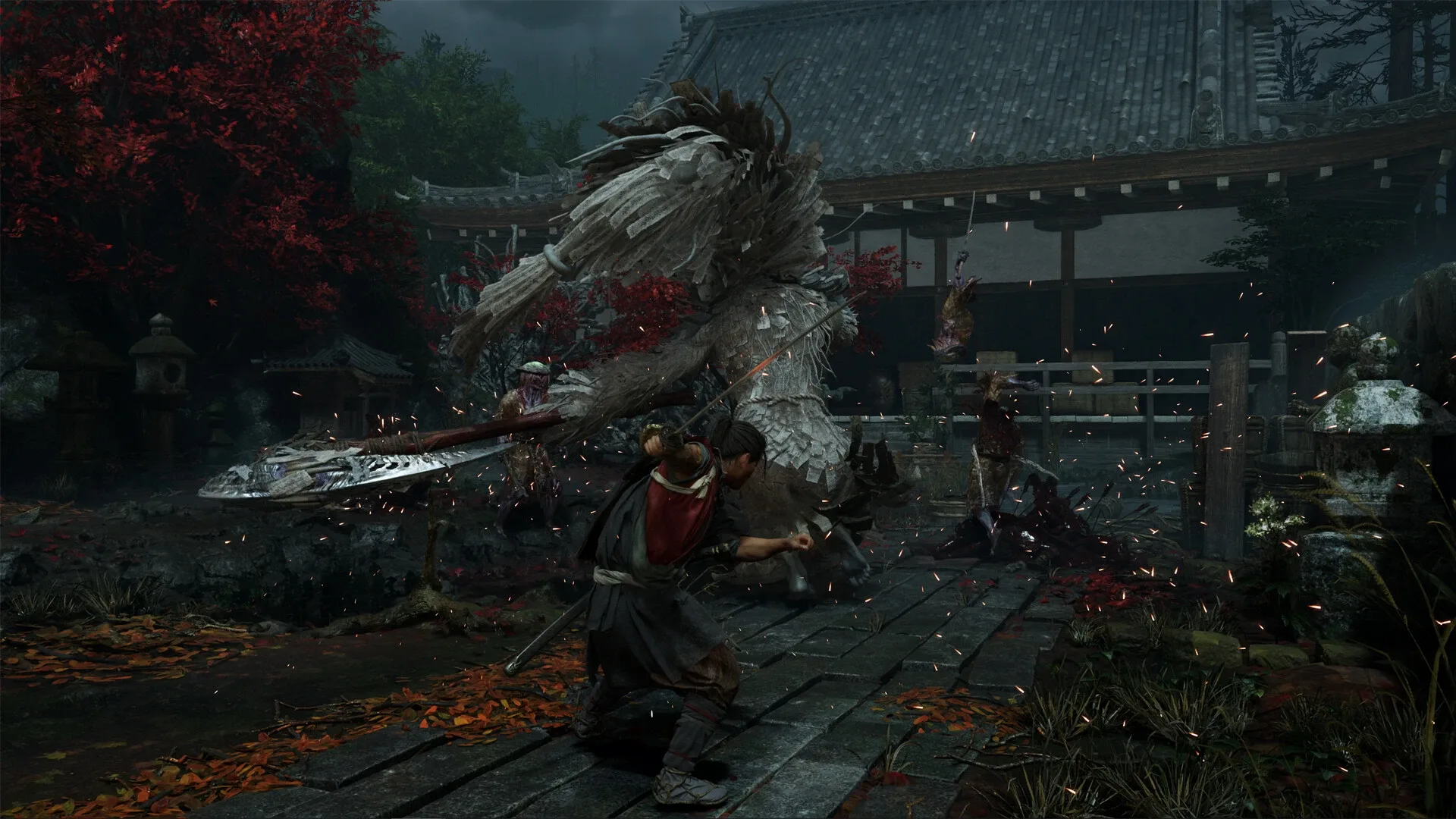
A samurai game that finally trusts its sword#
Onimusha: Way of the Sword is Capcom's first mainline entry in the series in more than two decades, and it spends its opening hour proving the wait was about the right idea rather than the wrong one. Released on 4 September 2026 for PlayStation 5, Xbox Series X|S, Nintendo Switch 2 and PC, three weeks earlier than its original date, it drops the wandering swordsman Miyamoto Musashi into a demon invasion of Edo-period Kyoto and asks the player to solve every fight with a single blade rather than a toolbox. The result is not a soft reboot that plays it safe with the franchise's old ideas. It is a combat system built almost entirely around one skill, reading an enemy's swing and answering it at the exact right instant, wrapped in a story that takes its time and a campaign that, by the credits, has said everything it needs to say roughly an hour before it actually stops talking.

What makes Way of the Sword different#
The one idea the whole game is built on is that a parry should be a conversation, not a button. Issen, the series' signature counter, returns as a razor-thin window: press the attack button in the instant just before an enemy's strike lands, not when the wind-up starts, and Musashi answers with a single stroke that can end a lesser Genma outright. Get the timing wrong in either direction, too early or too late, and Musashi is left standing in the open with his guard down. That single mechanic reshapes how every encounter plays. Enemies are not obstacles to whittle down with combos; they are patterns to be read, and the game repeatedly stages fights specifically to test whether the player has actually learned that pattern rather than memorised a combo string. A duel with a lone swordsman on a temple veranda becomes a genuine back-and-forth, not because the enemy has a large health bar, but because a single correctly timed Issen can end it in seconds and a single mistimed one can nearly end Musashi instead.
Combat: Issen, Break Issen and the soul that runs out#
Underneath Issen sits a second layer that keeps the pattern-reading from becoming rote. Standard parries and deflects chip away at an enemy's stamina rather than their health, and once that stamina bar breaks, the game offers Break Issen: a guaranteed, often gruesome execution that dismembers the weakened Genma outright. The loop this creates, parry to break stance, execute to end the fight cleanly, is closer to Sekiro's posture system than anything the older Onimusha games attempted, but it is layered onto a resource the series has always leaned on: souls. Every Genma that falls releases coloured orbs that only linger for a few seconds before vanishing, and Musashi has to physically raise the Oni Gauntlet to pull them in. Yellow souls restore health, red souls feed long-term progression, and blue souls charge the meter that powers Oni Armaments, demon-forged weapons that Musashi switches into for short, devastating bursts. The tension is that Genma can absorb the same souls to enter their own empowered state, so a fight is rarely just about winning an exchange of blows; it is about winning the race to the corpse afterward, too. It is a small addition, but it turns every kill into a decision rather than a formality, and it is the clearest sign that Capcom understood which parts of the old Onimusha loop were worth keeping.
Weapon variety is where the design is more conservative. Musashi carries a single katana for the entire campaign, upgraded rather than replaced, alongside a bow for softening enemies at range and a rotating handful of Oni Armaments that serve as situational cooldowns rather than alternate playstyles. Three separate upgrade tracks, clothing, sword and gauntlet, each with five proficiency tiers built from materials like whetstone, iron, tempered iron and tamahagane, give the numbers behind Musashi's stats plenty of room to grow. What they do not do is meaningfully change how a fight plays out from the first Genma to the last. Players coming from a game with a deep weapon-switching loop will notice the gap; players who came for the parry duel at the centre of the design will barely register it, because that duel is precisely as sharp in hour twenty as it is in hour two.

Kyoto: a linear road with real reasons to step off it#
Way of the Sword is not an open world, and it does not pretend to be one. The campaign moves through Kyoto's temples, shrines and back alleys along a largely linear critical path, but that path regularly opens into self-contained side areas built around a specific shrine, a purification task or an optional Genma nest, each rewarding exploration with upgrade materials or a scrap of context the main story does not otherwise provide. Kiyomizu-dera, the wooden temple complex that anchors the opening act, sets the tone: its verandas and stacked halls are used as literal fighting arenas, with Genma ambushes staged on narrow walkways where a mistimed parry sends Musashi tumbling rather than just losing health. The environmental art is some of the best RE Engine work Capcom has produced, lantern light catching on wet stone, gauntlet effects rendered with a genuine sense of weight, and it is put to direct use rather than treated as a backdrop; several of the game's better boss arenas use collapsing scenery or shifting light as part of the actual fight rather than as a one-time spectacle.
The side content is optional in the way that matters: skipping it does not lock a player out of finishing the story, but it does mean arriving at some of the harder mid-game fights under-levelled on the sword and gauntlet tracks. That design choice is reasonable on its own. Where it becomes a genuine cost is in pacing. A player chasing every shrine and purification task will find the game's back half stretching well past the point where its central ideas have already been fully demonstrated, turning what could be a tight twelve-to-fifteen-hour critical path into something closer to twenty-five hours of content that increasingly repeats earlier lessons rather than building new ones.
The purification tasks themselves are a small but well-judged addition. Rather than a checklist of collectibles, each one asks Musashi to clear a specific Genma nest that is actively corrupting a shrine, and completing it changes something visible in that area afterward: a torii gate rights itself, a well runs clear, a merchant reopens a stall that had been boarded shut. It is a modest system, but it gives the side content a sense of consequence that pure loot rewards would not, and it is one of the clearer signs that Capcom put real thought into Kyoto as a place rather than a level select screen dressed up as a map.
Bosses: Ganryu, Daidara, Benkei and Shuten Doji#
The boss roster is where Way of the Sword makes its strongest case for itself. Sasaki Ganryu, Musashi's historical rival reimagined here as the game's first real gatekeeper, opens the campaign inside Kiyomizu-dera itself: a duelist with no gimmicks, just fast, deliberately readable strikes that exist purely to teach the Issen timing the rest of the game assumes the player already has. Daidara, a Genma built from scavenged temple debris and scale rather than any human silhouette, forces a different lesson entirely, punishing players who try to treat a giant enemy like a small one and rewarding patient stamina-breaking over aggression. Benkei, staged as a folklore-tinged brute with a weapon far too large for the arena he fights in, is the game's clearest homage to the series' older, more theatrical boss design, and Shuten Doji, the closest thing the campaign has to a final trial before its last stretch, combines multiple attack phases with soul-absorption mechanics of his own, effectively demanding the player use every system the game has taught by that point at once. None of the four are padded with an oversized health bar standing in for difficulty; each teaches something specific about the parry system and then gets out of the way once that lesson lands.

Story: two men, one gauntlet, one wrong choice#
The premise is a single sentence: a duel between two swordsmen is interrupted by hell itself. Musashi and Ganryu, locked in a fight neither can win outright, are ambushed by Genma mid-duel and both revived by a mysterious figure known only as the Man in White, each given an Oni Gauntlet that draws its power from absorbed souls. From there the two men's paths split cleanly. Musashi uses the gauntlet to fight the Genma incursion and, by extension, to protect the ordinary people caught in Kyoto's collapse, while Ganryu turns the same power inward, slaughtering innocents outright rather than demons because human souls, it turns out, feed the gauntlet faster. It is a clean, almost fable-like moral structure, and it works best in the campaign's first and final thirds, where the choice each man has made is put directly in front of the player through action rather than dialogue.
The middle third is where the writing loses some of that clarity. Capcom has confirmed that Way of the Sword deliberately starts a new continuity with no direct narrative link to earlier Onimusha games or the Netflix series, a decision made specifically so long-time fans and newcomers begin the story on equal footing. That choice pays off in accessibility, nobody needs a wiki to understand who Musashi is here, but it also means the new cast has to earn its stakes from scratch, and several supporting characters introduced mid-campaign get more screen time than their eventual role in the Musashi–Ganryu conflict justifies. The game is at its best when it keeps its two leads in the same frame; it is at its most forgettable when it wanders off to develop a subplot that never quite closes. The Man in White, the figure who hands both swordsmen their gauntlets and then largely vanishes from the story until its final stretch, is the clearest example: the game clearly wants his motives to feel like a mystery worth chasing, but he appears so rarely in the middle third that his eventual return lands as a plot requirement rather than a payoff the player has been anticipating.
Difficulty and accessibility: two modes, a lot of comfort settings#
Way of the Sword offers exactly two combat difficulty settings, Story and Action, switchable at any point without restarting a fight or the game itself. Story mode widens the Issen window considerably and reduces enemy damage, letting players who came primarily for the setting and the story see the campaign through without mastering split-second timing. Action mode, the default, is where the parry system is meant to be experienced, and the gap between the two is wide enough that a player bouncing off Action mode should switch immediately rather than assume the game will soften with practice. Outside of that binary choice, the accessibility menu is unusually thorough for the genre: three subtitle sizes, three text colours, optional opaque backgrounds behind dialogue, speaker-name labels, colour-blind palettes and fully customisable button prompts are all present from the settings menu at launch, which is more comprehensive than most action games manage even after a post-launch patch.

New to Onimusha? Start here#
Way of the Sword is deliberately the easiest entry point the series has ever had, and Capcom's own decision to break continuity means there is genuinely nothing to catch up on. New players should stay in Action mode through the Ganryu fight specifically, since it exists to teach Issen timing before the game expects it in earnest, and should resist the urge to rush past Kiyomizu-dera's side areas, since the sword and gauntlet upgrade materials found there make the Daidara fight noticeably more forgiving. Anyone who bounces off Action mode after the Ganryu fight should not read that as a sign they are playing the game wrong; switching to Story mode mid-run carries no penalty and no visible marker, and it is the intended solution rather than a last resort.
Compared with Sekiro and Ghost of Tsushima#
Sekiro: Shadows Die Twice is the unavoidable comparison, and Way of the Sword does not shy away from inviting it: both games build their entire combat identity around reading an opponent's rhythm and breaking their poise rather than depleting a health bar through attrition. Sekiro's posture system is marginally tighter and its enemy roster more consistently vicious across the whole runtime, and it never pads its length with the kind of optional detour Way of the Sword leans on in its back half. What Way of the Sword offers instead is a gentler on-ramp, thanks to Story mode and the soul-absorption system's built-in risk-reward tension, plus a boss roster that trades some of Sekiro's unrelenting difficulty for more theatrical, folklore-driven staging. Ghost of Tsushima is the better comparison for tone and setting rather than combat mechanics: both place a katana-wielding protagonist inside a richly rendered, historically inspired Japan and lean on environmental beauty as part of the emotional pitch, but Tsushima's open world and stance-switching combat are built for a much wider, more forgiving audience, while Way of the Sword commits fully to a linear structure and a single demanding skill. Players who want Sekiro's precision without quite its cruelty, or Tsushima's setting without its open-world sprawl, land closer to what Way of the Sword is actually trying to be than fans of either game expecting a direct clone.

Worth the money?#
At $69.99 for the standard edition and $79.99 for the Digital Deluxe Edition, Way of the Sword sits at the going rate for a full-priced single-player action game rather than an especially generous or especially stingy one. A focused run through the critical path takes roughly 12 to 15 hours, while chasing the side shrines, purification tasks and full upgrade trees pushes that closer to 25 hours, which is a reasonable amount of content for the price as long as the back half's slower pacing does not become a dealbreaker on its own. The game is available on PlayStation 5, Xbox Series X|S, Nintendo Switch 2 and PC via Steam.
| Platform | Notes |
|---|---|
| PC (Steam) | Strong RE Engine optimisation; runs well on Steam Deck at roughly 30 fps |
| PlayStation 5 / Xbox Series X|S | Full native releases with no reported performance issues at launch |
| Nintendo Switch 2 | Full release alongside the other platforms, part of the wider launch rather than a delayed port |
Text support covers fourteen languages, including English, French and German, and voice audio is available in both English and Japanese, switchable independently from the display language in the settings menu. Buying at launch carries little of the platform-specific risk that has hit other recent releases; anyone hesitant should weigh the price against how much the back half's padding will bother them rather than against any technical concern.
Play this instead if …#
If you want a shorter, harder version of the same idea, Sekiro: Shadows Die Twice delivers a tighter posture-and-parry system across a runtime with almost no optional padding. If you want something easier and more forgiving while staying in the same setting, Ghost of Tsushima trades Way of the Sword's punishing single-skill focus for a wider stance system and a genuinely open, explorable Japan. And if you want the same demon-slaying fantasy for less money or with a friend, the classic Onimusha: Warlords remaster is a fraction of the price and a fraction of the length, and still carries the original Issen counter that started all of this.
Frequently asked questions#
How long is Onimusha: Way of the Sword? Roughly 12 to 15 hours for a focused run through the main story, and closer to 25 hours chasing side shrines, purification tasks and full equipment upgrades.
Is it connected to the earlier Onimusha games? No. Capcom has confirmed Way of the Sword starts an entirely new continuity, with no direct narrative link to earlier mainline games or the Onimusha Netflix series, specifically so newcomers and longtime fans begin at the same point.
Is there an easy mode? Yes. Story mode widens the Issen counter window and reduces enemy damage, and can be switched to or from Action mode at any point without restarting.
Does it have co-op or multiplayer? No. Way of the Sword is a single-player campaign from start to finish, with no co-op or competitive modes.
Is it an open world? No. The campaign follows a largely linear path through Kyoto's temples and districts, with self-contained optional side areas rather than a fully open map.
Do you need to have played earlier Onimusha games first? No. The story and cast are entirely new, and no prior knowledge of the series is assumed or required.
The Game Avant verdict#
Onimusha: Way of the Sword is the rare legacy revival that gets its central idea exactly right and then does not entirely trust it. Issen, Break Issen and the race to absorb a dying enemy's souls make up one of the sharpest parry systems built since Sekiro, and Ganryu, Daidara, Benkei and Shuten Doji are the kind of named, specific boss fights the series was built on. What keeps it from the top tier is everything the game does once it has already made its point: a middle third that wanders from its two leads, a weapon roster that stops growing well before the credits, and a back half padded with detours that repeat lessons the player has already learned. None of that undoes what the combat gets right. It does mean that Way of the Sword earns its place as the best Onimusha in over twenty years without quite becoming the best action game of its own.
8 out of 10 – a parry system worth the wait, wrapped in a campaign that runs longer than its best ideas do.