
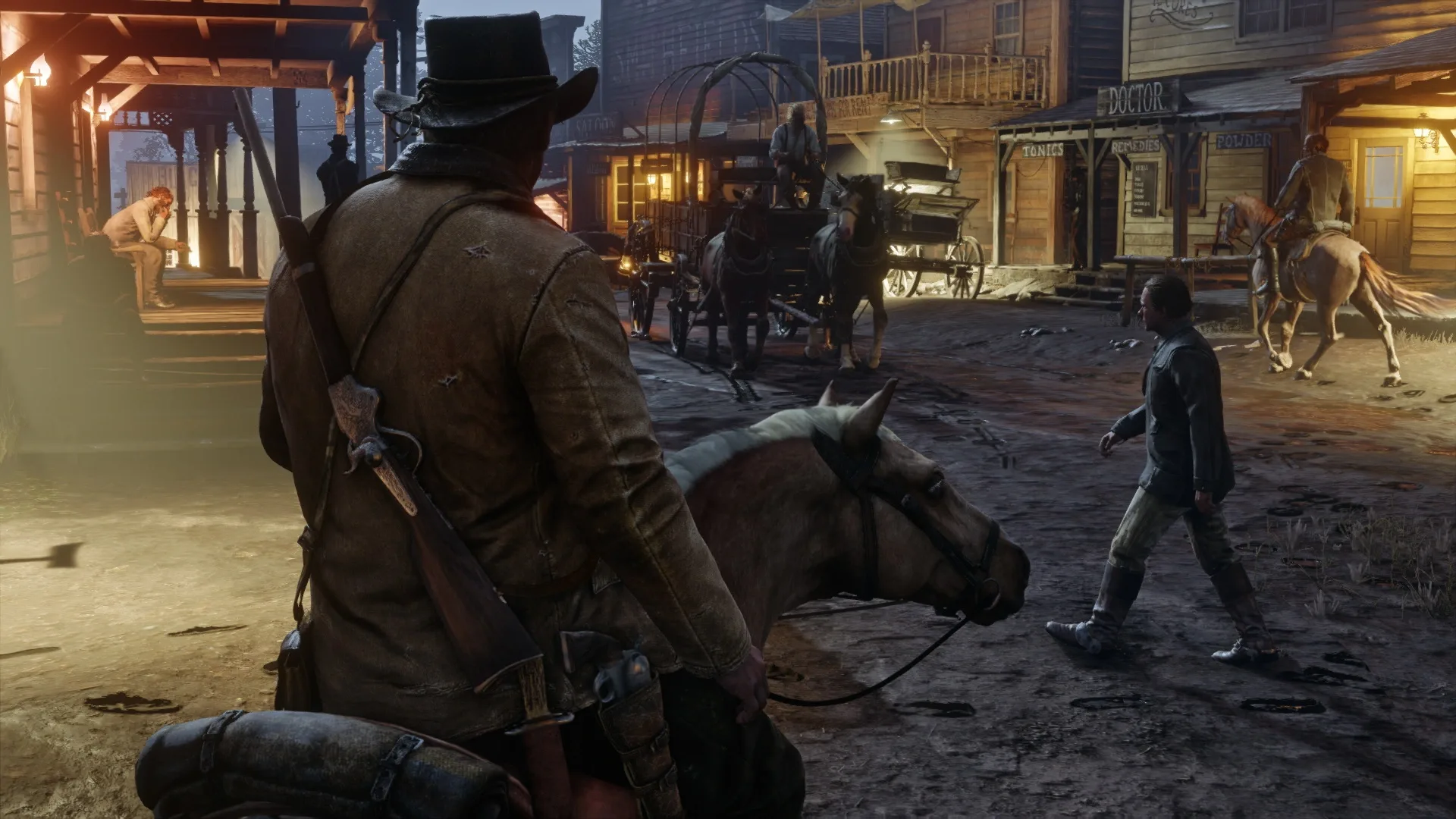
A frontier that refuses to be rushed#
Red Dead Redemption 2 is Rockstar Games' open-world western, released on 26 October 2018 for PlayStation 4 and Xbox One, with a PC version following just over a year later on 5 November 2019. It is a prequel to 2010's Red Dead Redemption, set roughly a decade earlier and following Arthur Morgan, a senior enforcer in the Van der Linde gang, through the last years the American frontier had left to give. Nothing about that premise is unusual for the genre. What is unusual is what the game does with the hours between its missions, which is where it spends almost all of its runtime and nearly all of its ambition. This is a game that treats waiting, riding and looking as the main activity, and treats gunfights as the punctuation.
That is not a compromise the game apologizes for. There is no difficulty setting, no experience-point skill tree, and no fast travel until well into the story. Instead there is Honor, a hidden value that tracks nearly everything Arthur does and quietly reshapes how the world, and eventually the ending, treats him. It earns a 10 here not because it is flawless, but because it commits so completely to a slower, denser version of the open world that almost nothing else in the genre has tried to match it since.
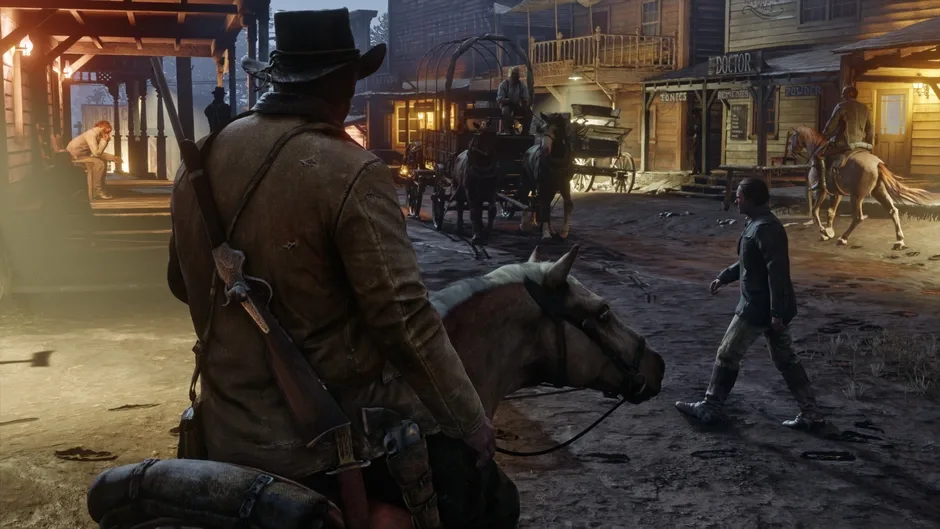
What makes Red Dead Redemption 2 different#
The one idea the whole game is built around is that consequence should be ambient rather than announced. Most open-world games tell you a choice matters with a cutscene, a warning prompt or a stat readout. Red Dead Redemption 2 tracks Honor from the opening chapter with no visible meter at all. Greeting a stranger on the road, returning a dropped wallet, paying off a bounty at a post office instead of running from it, sparing an opponent in a duel: each nudges the number, and the player is never told by how much or where it currently sits.
The payoff for that restraint is that the world starts answering back in ways that feel discovered rather than delivered. Shopkeepers charge a high-Honor Arthur less and a low-Honor Arthur more. Strangers on the road greet a kind Arthur warmly and flinch from a cruel one. Arthur's own appearance and the sound of his cough change as his illness progresses in the later chapters, shaded by which version of him the player has been building. None of it is spelled out, and the game never once stops to congratulate or scold the player for it. The starkest example arrives in the closing chapters: Arthur's own fate, and the specific scenes that lead to it, differ depending on where his Honor has settled, and neither version is presented as the "correct" one. It is the rare game where the ending feels earned by a hundred small moments rather than a single dialogue wheel five minutes before the credits.
Honor, Dead Eye and a world with no waypoint for morality#
Honor's mechanical reach goes further than most players expect on a first playthrough. It touches prices, NPC reactions, random encounter outcomes, and Arthur's own physical presentation, all from the same hidden tally, and it carries no reset button between chapters. Story missions with a built-in choice, almost always framed as a "kind" option against a "cruel" one, swing it hardest, but the everyday behaviour, tipping a hat, greeting a passerby, choosing not to loot a body Arthur did not kill, accumulates into something just as decisive over fifty hours.
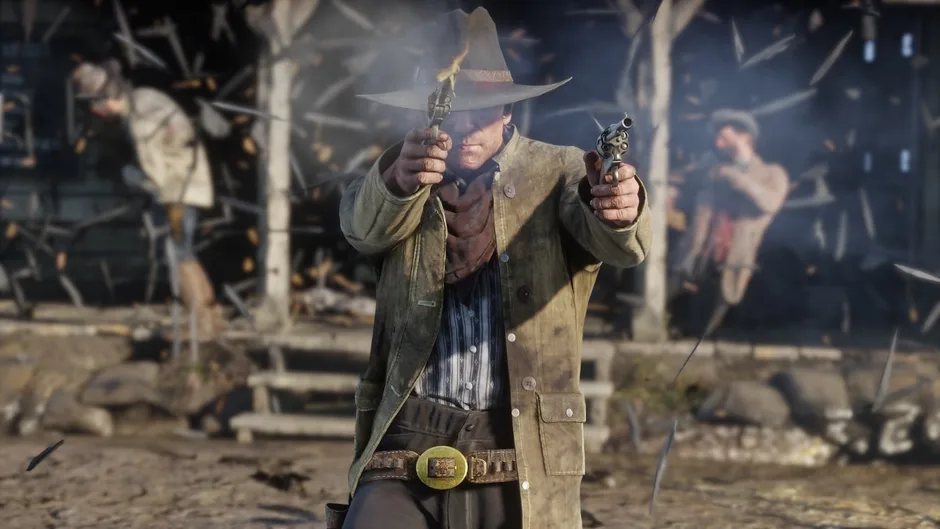
Dead Eye, the game's slow-motion aiming system, works on the same philosophy of restraint applied to combat instead of morality. It unlocks in four fixed ranks tied to story progress rather than a spendable skill tree: rank one simply slows time while aiming and is available from the very start; rank two highlights critical zones; rank three lets Arthur tag several targets and fire on all of them in sequence; rank four auto-tags those zones while tagging. There is no build to optimize and no points to allocate. The system instead teaches restraint the way the rest of the game does, by gating power behind story pacing rather than player grinding, so that a gunfight in Chapter 6 genuinely plays differently from one in Chapter 2 without Arthur ever visiting a menu to make that true.
The weapon wheel underneath it carries that same density. Two long guns strapped to the horse, a holstered sidearm, and a full set of throwables sit behind a radial menu that briefly slows time when opened, and ammunition is not just a damage slider: split point rounds punish unarmored targets and waste armored ones, express rounds are the honest all-rounder, and high-velocity rounds hit harder at range. Hunting makes that concrete rather than theoretical, since the wrong round can ruin a pelt that the right one would have preserved intact. It is one of the few open-world shooters where choosing the correct bullet, not just the correct gun, is a real decision.
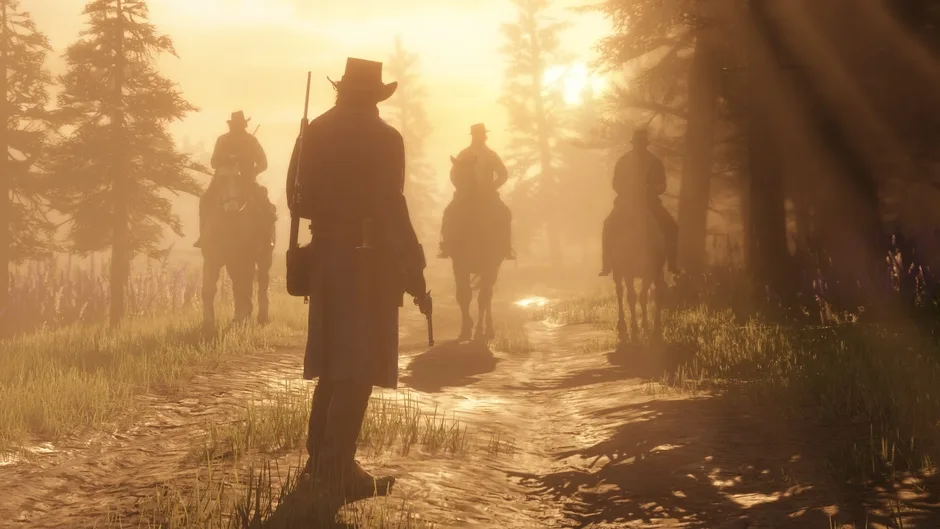
The camp: a hub that keeps changing shape#
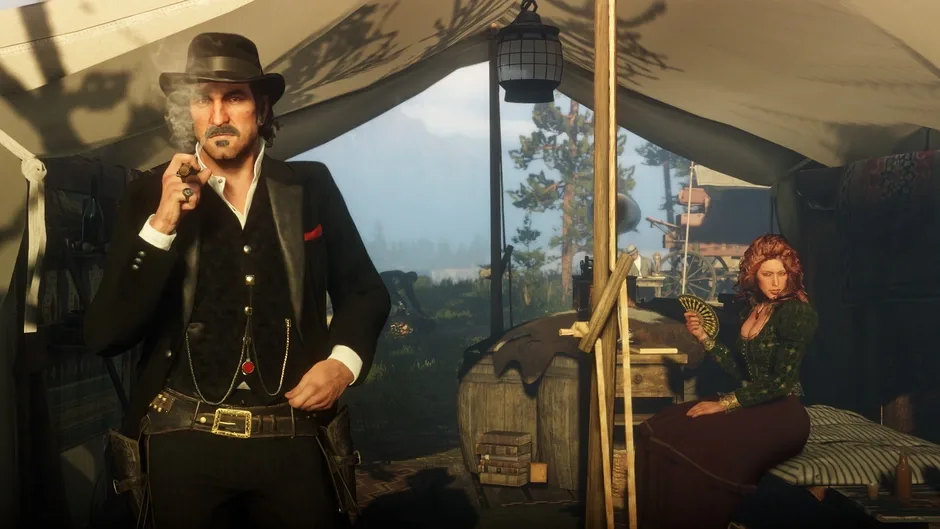
The Van der Linde gang's camp is the game's clearest rebuttal to the idea that a hub area has to be static. It runs on a shared fund that Arthur, and later John Marston in the epilogue, can top up directly or simply by looting money and valuables during missions rather than pocketing it. Donations unlock upgrades split across feed and provisions, medicine, ammunition stock, better sleeping tents that improve core regeneration, and purely ambient touches like lanterns and a better campfire that change how the place looks and sounds without changing a single stat.
The camp also physically relocates several times as the story advances, and each move resets some of that ambient progress, which means the donation habit has to be an ongoing one rather than a single unlock ticked off early. What makes it worth the effort is how much of the gang's best writing lives in that ambient layer rather than the main missions: overheard arguments between Dutch van der Linde and Hosea Matthews, small kindnesses or cruelties from Micah Bell depending on how the story is trending, quiet moments around the fire that no marker ever points a player toward. Skip the camp, and Red Dead Redemption 2 plays like a solid open-world shooter. Sit in it, and it plays like the best-written thing Rockstar has shipped.
Horses, hunting and a map built to be walked#
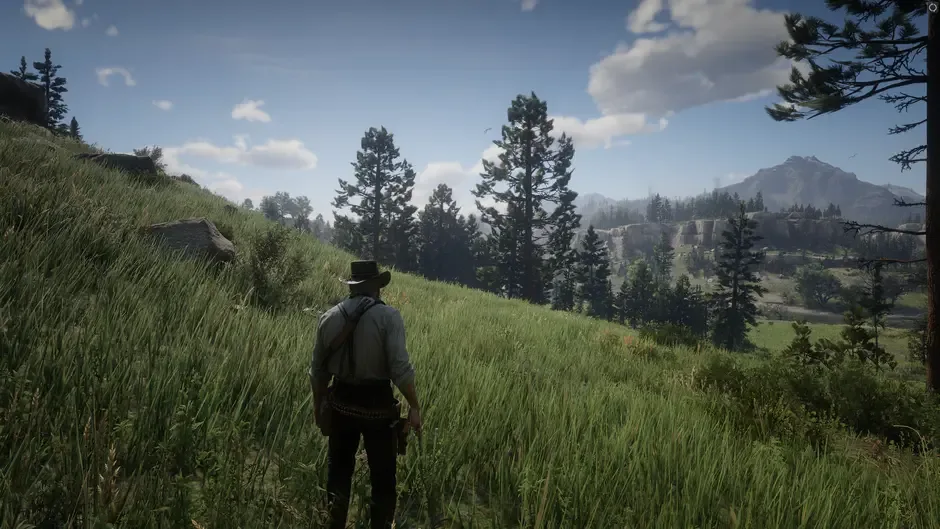
At roughly 75 square kilometres, spanning swampland, mountains, prairie and coastline, the map is large by open-world standards without feeling padded, mostly because so little of it carries a story requirement to visit at all. Legendary animals, unique and named creatures scattered across every region, are tougher than their ordinary counterparts and are tracked through their own dedicated journal once Arthur learns of the first one, but hunting them properly, with the correct weapon and round, is genuinely rewarding rather than a checklist chore. Gang hideouts, small fortified camps guarded by several armed NPCs, sit unmarked until Arthur gets close or hears about one secondhand, and clearing them is one of the more reliable ways to fund the camp and a good horse without any dedicated grinding. Stranger missions, the small side stories flagged by NPCs marked with a question mark, form some of the game's most quietly affecting writing, and several form multi-part arcs that only pay off if a player is willing to leave the golden path.
The horse under Arthur is not decoration. Every horse carries a bond level from one to four, raised by riding, grooming, feeding and calming it when startled, and a fully bonded horse handles better, recovers stats faster and can be talked down in dangerous moments rather than throwing its rider. Health and Stamina work like a second set of cores, draining with riding and combat and refilled with rest and the right feed, and losing a horse a player has actually bonded with is one of the few losses in the genre that lands as a loss rather than an inconvenience. Every horse can also be insured at a stable for close to nothing, which quietly removes the worst version of that grief without removing the stakes entirely.
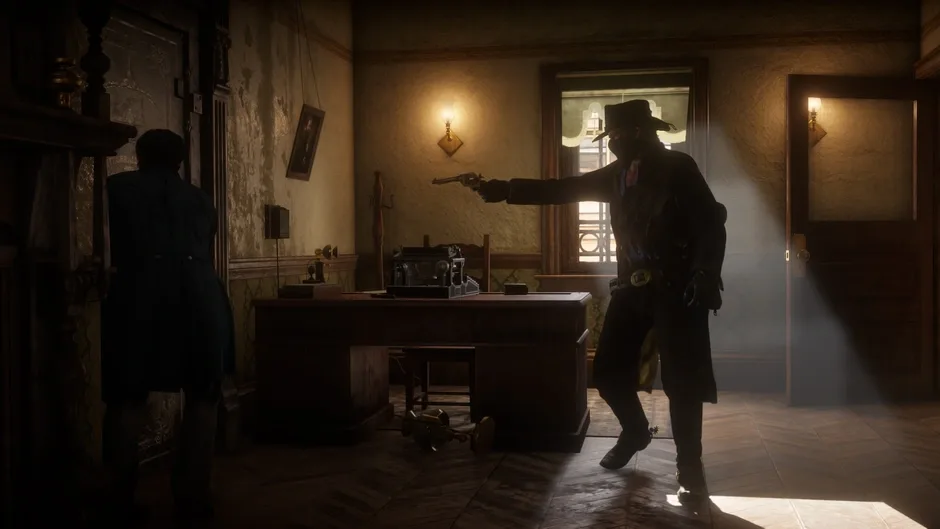
A story told at walking pace#
Arthur Morgan carries the entire game, and Rockstar's writing knows it: he is not a blank protagonist waiting for the player to define him, but a specific, weary man capable of both real cruelty and real tenderness, and the Honor system exists specifically to let the player lean into either without ever breaking who he already is. Dutch van der Linde's slow unraveling from charismatic idealist into something closer to a con man believing his own con is the backbone of the plot, and it plays out gradually enough across seven chapters and an epilogue that its final turns feel inevitable rather than sudden. Micah Bell's growing influence over Dutch, Hosea Matthews' quiet exhaustion with the life, Sadie Adler's transformation from widow to gunslinger, and John Marston's own arc toward the man players may already know from the original Red Dead Redemption, all get room to breathe because the game refuses to compress its own timeline.
That patience is also the story's biggest ask of the player. The main missions are the least improvised part of the game by design, often built around scripted set pieces and escort-style pacing rather than open confrontation, and a player who treats them as a checklist to clear before "really" playing the game will find the pacing sluggish precisely where it is meant to be felt rather than rushed through.
Difficulty and the case for a game with no difficulty slider#
Red Dead Redemption 2 does not have a difficulty option, and it does not need one, because nearly every system that would normally be gated behind a slider is instead gated behind time and attention. Dead Eye's ranks arrive on the story's schedule rather than the player's, cores for Health, Stamina and Dead Eye each improve passively the more they are used rather than through spent points, and combat itself rewards patience over reflexes: tagging targets, using cover and picking ammunition correctly matters more than raw aim. The honest criticism is that this makes the earliest hours feel underpowered by design, since Arthur genuinely is weaker in Chapter 1 than he will be by Chapter 4, and a player expecting immediate mastery will spend several hours feeling deliberately behind the curve before the systems catch up to the character.
Compared with Grand Theft Auto V and the original Red Dead Redemption#
Grand Theft Auto V is the obvious sibling, built by the same studio on adjacent technology, and the contrast is instructive. GTA V's Los Santos is denser, faster and built for spectacle: heists, high-speed chases and three switchable protagonists keep its pace kinetic in a way Red Dead Redemption 2 never tries to match. Red Dead Redemption 2 trades that kinetic energy for texture: weather that actually changes how animals behave, an Honor system with real narrative teeth, and a horse that matters more than any car in GTA V ever does. If a fast, mission-to-mission open world with modern weapons is the appeal, GTA V remains the better fit. If the appeal is a world that rewards slowing down, Red Dead Redemption 2 is the far deeper game.
The original Red Dead Redemption, the 2010 game this one is a prequel to, is the closer spiritual match but a far smaller one in every dimension: a shorter story, a smaller map and a simpler Honor system that this sequel expands on directly. Playing the original afterward adds real emotional weight to John Marston's arc and to certain characters players will already recognize, but nothing in Red Dead Redemption 2 assumes that history, and it is a complete story entirely on its own terms.
Worth the money?#
At full price the base game sits around 60 dollars on PC and console alike, and it is frequently discounted well below that within a year or two of any given sale cycle. For that money, the main story alone runs roughly 50 hours for most players; a meaningful amount of side content, hunting and exploration pushes that past 60 to 80 hours, and full completion, every stranger mission, every collectible category, every challenge, takes considerably longer than that. Almost nothing else in the open-world genre offers that many hours of writing this careful for the price.
The PC version remains the one with the most graphics options and the only one with mod support, and it is the version to buy if a strong enough machine is available. Red Dead Redemption 2 has never received a native PlayStation 5 or Xbox Series X|S release; on those consoles it runs entirely through backward compatibility with the PS4 and Xbox One versions, which is worth knowing before assuming a next-generation upgrade exists. Red Dead Online, the shared open-world multiplayer mode that launched as a public beta alongside the base game in November 2018 and became a standalone product in December 2019, still runs and still receives seasonal events and rotating bonuses, but Rockstar has confirmed development resources have shifted toward Grand Theft Auto Online and Grand Theft Auto 6. It should be treated as a pleasant bonus for anyone who already owns the base game, not as a reason to buy it.
Play this instead if…#
Shorter: The original Red Dead Redemption tells a tighter, smaller-scale western story in roughly a third of the time, with a simpler but still meaningful Honor system.
Easier and faster-paced: Grand Theft Auto V delivers the same studio's open-world craftsmanship with far less downtime between action, at the cost of the horse, the Honor system and most of the slower texture.
Cheaper or with friends: Red Dead Online is included with most current copies of the base game at no extra cost, and its Bounty Hunter, Trader, Collector, Moonshiner and Naturalist roles give a lighter, more social version of the same world for anyone who wants company rather than a solo epic.
Frequently asked questions#
How long is Red Dead Redemption 2? Roughly 50 hours for the main story alone, well past 60 to 80 hours with a meaningful amount of side content and hunting, and considerably longer for full completion.
Do you need to play the original Red Dead Redemption first? No. This is a prequel that stands entirely on its own; playing the original afterward adds context to certain characters but assumes nothing.
Is Red Dead Redemption 2 available on PS5 and Xbox Series X|S? Only through backward compatibility with the PS4 and Xbox One versions; there is no native next-generation release.
Does it have co-op? Not in the main story. Red Dead Online, the shared multiplayer mode set in the same world, is where the multiplayer and social side of the game lives.
Is there a difficulty setting? No. Dead Eye's ranks and core bonuses unlock through story progress and use rather than a menu option, and the game's challenge comes from patience and preparation rather than a slider.
Can Arthur's Honor path change partway through? Yes. It is cumulative and can move in either direction throughout the entire game, including the closing chapters, with no point where it locks in early.
The Game Avant verdict#
Red Dead Redemption 2 is not a game for players in a hurry, and it never pretends otherwise. Its opening chapters are deliberately slower than the world they lead into, several of its systems only reveal their depth to a player willing to sit in camp or ride the long way around a mountain, and its multiplayer half has clearly been left to run on maintenance rather than momentum. None of that is a flaw worth docking a point for, because the thing this game does better than almost anything else in the genre, tracking who a player actually is rather than what they say they are, and building an entire world and ending around that tally without ever showing its work, is executed completely enough that the slowness is the point rather than a cost. Eight years after release it remains the outlaw simulation every other open-world game gestures at and rarely commits to.
10 out of 10 – the open-world western that turns patience, not gunfights, into the main mechanic.