
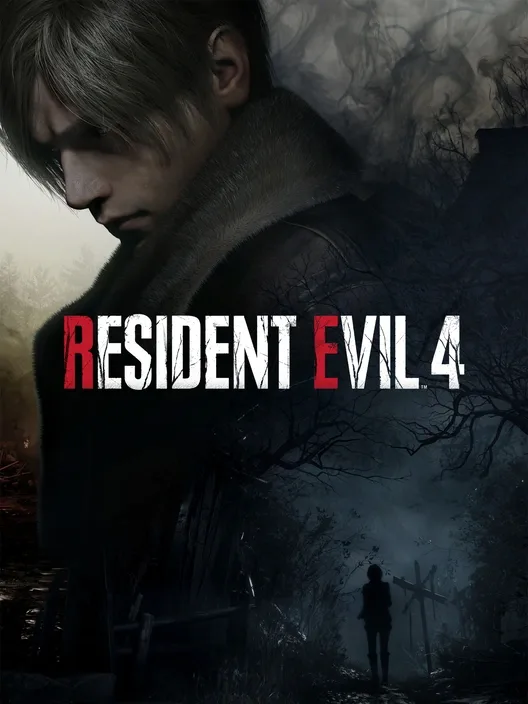
Resident Evil 4
Survival Horror · Zombies · Third-Person Shooter · Horror · Cinematic
Game page →
Review
A survival horror game with two playable characters, each with their own style: one more tense and vulnerable, the other more action-driven. You explore, solve puzzles, manage resources and fight. Playable in both first and third person. Is it your kind of game?
Game Avant verdict
A confident, technically superb survival horror game whose dual-camera, dual-protagonist structure mostly justifies itself, held back by a thin antagonist and a second half that cannot decide what kind of game it wants to be.
By GameAvant · Published Sep 28, 2026 · Updated Oct 9, 2026 · 14 min read
Choose what matters to you
Every question is optional.
How do you like to find your way?
What suits you better?
How do you want to play?
Based on your choices
Pick what matters to you above and the result shows up here.
IGDB
90%
335 ratings
Steam:
95%
107,474 reviews
Fits you if
you want survival horror with puzzles, resource management and a mix of tension and action.
Skip it if
you want multiplayer or an open world.
Availability
Steam
$69.99
Resident Evil Requiem is the clearest evidence yet that Capcom's RE Engine team had run out of easy problems left to solve within the series' established formula, and went looking for a genuinely hard one instead. Developed and published by Capcom, it released on 27 February 2026 for PlayStation 5, Xbox Series X|S, PC and Nintendo Switch 2. Every mainline entry since the series moved past its fixed-camera roots has picked a single perspective and committed to it for the entire game. Requiem refuses that choice entirely: it builds two full campaigns around two different protagonists and lets the player decide, chapter by chapter, whether to experience the horror from a traditional over-the-shoulder third-person view or live through it directly from a locked first-person perspective. Stated plainly like that, it sounds like a marketing bullet point rather than a meaningful design decision. In practice, it is the structural backbone the rest of the game is built around, and it mostly earns the significant weight it is asked to carry. The story is set roughly three decades after the destruction of Raccoon City, long enough that the incident has settled into history rather than remaining breaking news, but not so long that the people who survived it have stopped paying a very real price for having done so. Grace Ashcroft, a technical analyst working for the FBI, is sent to the Wrenwood Hotel to investigate a body discovered bearing the same unexplained black bruising found on several other victims connected to Raccoon City survivors. The hotel carries additional personal weight: it is the exact location where Grace's mother, journalist Alyssa Ashcroft, was murdered eight years earlier while trying to expose what the Umbrella Corporation had actually done to the people who lived through the events of 1998. Grace has no combat training whatsoever, and critically, she has no illusions about that fact. Requiem forces the player to feel that specific lack of preparation directly, through a locked first-person camera that never cuts away to a more flattering angle, rather than watching a conventionally capable action hero shrug off danger the way most survival horror protagonists do. Leon S. Kennedy, older, visibly more worn down, and pulled into the case as a federal agent, runs the parallel investigation with an entirely different toolkit built on thirty years of practice at not dying in exactly these kinds of places: firearms, honed reflexes, and hard-won experience. The dual-camera structure is not simply a gimmick layered over otherwise identical gameplay. Grace's first-person sections lean into vulnerability and genuine dread in a way the series has not attempted with this much commitment since its earliest entries, forcing slower, more careful engagement with threats she is poorly equipped to handle directly. Leon's third-person sections deliver the kind of confident, high-mobility combat the modern series built its reputation on, giving players a genuine tonal and mechanical contrast depending on whose chapter they are currently playing. Switching between the two perspectives chapter by chapter, rather than locking players into one camera for the entire game, is the single best structural idea the series has introduced in years. What keeps Requiem from reaching the very top of the genre is less about the dual-camera concept itself and more about what surrounds it. The central antagonist remains underwritten relative to the rest of the cast, never quite earning the dread the game clearly wants them to carry, and the back half of the campaign loses some of the tonal discipline of its opening hours, occasionally struggling to decide whether it wants to commit fully to Grace's slow-burn dread or lean into Leon's more conventional action pacing. Those are real weaknesses, not minor nitpicks, but they sit against a genuinely bold structural experiment that mostly justifies itself across a full campaign, and that balance is exactly what a 8 out of 10 is meant to reflect.
You may love it because
Choosing first person for Grace and third for Leon lets each character's fear read the way it was designed to, and switching at will means you are never stuck with the wrong view for a scene.
It may frustrate you because
The two feel different enough that some players will prefer one campaign's camera over the other and never fully warm to the mismatch when the story cuts between them.
You may love it because
Grace's blood-based crafting and near-total lack of combat training make every encounter a negotiation, while Leon's traditional scrap-and-ammo loop delivers the release valve after a tense chapter.
It may frustrate you because
Jumping from Grace's scarcity straight into Leon's firepower, and back again, can make the tonal gearshift feel abrupt rather than earned within a single sitting.
You may love it because
The campaign never pads itself with filler backtracking, so nearly every room in Wrenwood Hotel and the Raccoon City ruins serves the story or a puzzle.
It may frustrate you because
That same tightness means the game ends before some of its best ideas, particularly Victor Gideon's operation, get the room to fully develop.
14 min read
· By Game Avant
Three alternatives, one line each on why.
Survival Horror · Zombies · Third-Person Shooter · Horror · Cinematic
Game page →
Survival Horror · Zombies · Horror · FPS · Survival
Game page →
Zombies · Survival Horror · Third-Person Shooter · Horror · Survival
Game page →
Survival Horror · Horror · Zombies · Third-Person Shooter · Survival
Game page →
Survival Horror · Zombies · FPS · Horror · Survival
Game page →
Zombies · Survival Horror · Third-Person Shooter · Cinematic · Post-apocalyptic
Game page →