
The Spire is back, and the formula barely needed fixing#
Slay the Spire II is a sequel that understands what made the first game a genre-definer and refuses to break it. Mega Crit released it in Early Access on 5 March 2026, and the result is a roguelike deckbuilder that plays like the original on its best day while adding enough new machinery that a veteran cannot simply coast on habit. The core stays: climb a spire made of branching routes, build a deck one card at a time, learn what each enemy is about to do, and lose a run to a mistake you can name afterwards.
That last point is the whole secret. Very few roguelikes make a loss feel this legible. When a run ends in Slay the Spire II, the reason can usually be traced to a decision: a card taken because it looked strong in isolation, a fight picked from the map when a rest site would have been safer, an attack ignored for one turn too many. Nothing is opaque. That legibility is why the score here is a 9, and why the caveats are mostly about what is still unfinished rather than what is wrong with the design.
The caveat that matters most is right there in the release model. The game is in Early Access. The developers have said they expect it to stay there for one to two years, and they have listed the plans: more cards, events, environments and enemies, improved balance and visual effects, and a proper ending before the full release. This review rates the game as it exists now, and it flags where that matters. Anyone who wants a complete campaign with a finish line should know the finish line is still under construction.
What makes Slay the Spire II different#
The one idea holding the whole game up is that a deck is a conversation between what you are offered and what you decide to refuse. After almost every fight, the game offers a choice of cards, and the strongest option is frequently to take none of them. A deck of thirty mediocre cards loses to a deck of twelve sharp ones. Mega Crit built the first game around that tension, and the sequel keeps it at the centre, which is the right call.
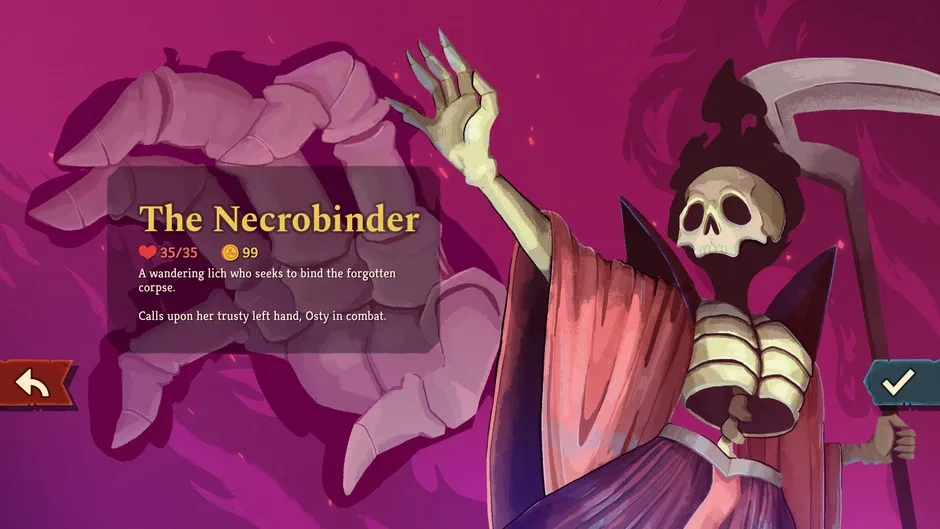
What changes is the shape of the space that idea lives in. The sequel has five playable characters, three of them returning, Ironclad, Silent and Defect, and two new: the Necrobinder, a vengeful lich who fights beside a large skeleton hand called Osty that can attack and shield her from incoming damage, and the Regent, a cosmic monarch who can forge a sovereign blade and spends a resource called stars as an additional cost on his more powerful cards. Those two are not reskins. Osty gives the Necrobinder a second body on the board that soaks hits and deals its own damage, which changes what a defensive turn even means. Stars give the Regent a second currency to budget alongside energy, which means a hand is judged against two limits rather than one.
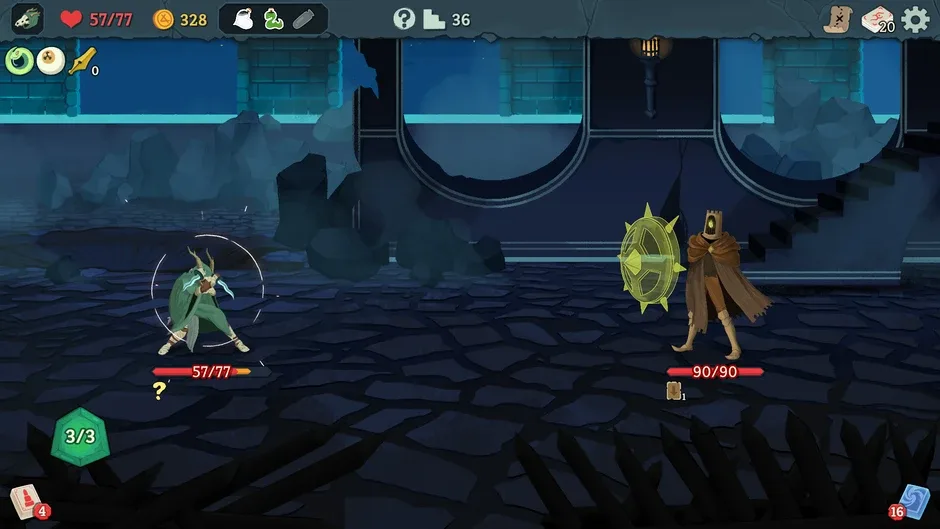
Then there is the map. Each act now exists in two different versions, one of which is randomly picked at the start of a run, each with its own enemies, events and bosses. That sounds like a small tweak and behaves like a large one. In the first game, an experienced player knew exactly which threats waited in Act 1 and could plan a deck around them from the first card. Here, that plan has a hole in it. A deck built to beat one version of an act may be badly prepared for the other, so the knowledge of veterans still helps but never quite settles into autopilot.
Finally, the cooperative mode for up to four players changes what a deck is for. It deserves its own section below, but the short version is that a single player in the first game only ever had to worry about their own health bar, and a table of four has to worry about each other.
Combat: a puzzle where the enemy shows you its hand#
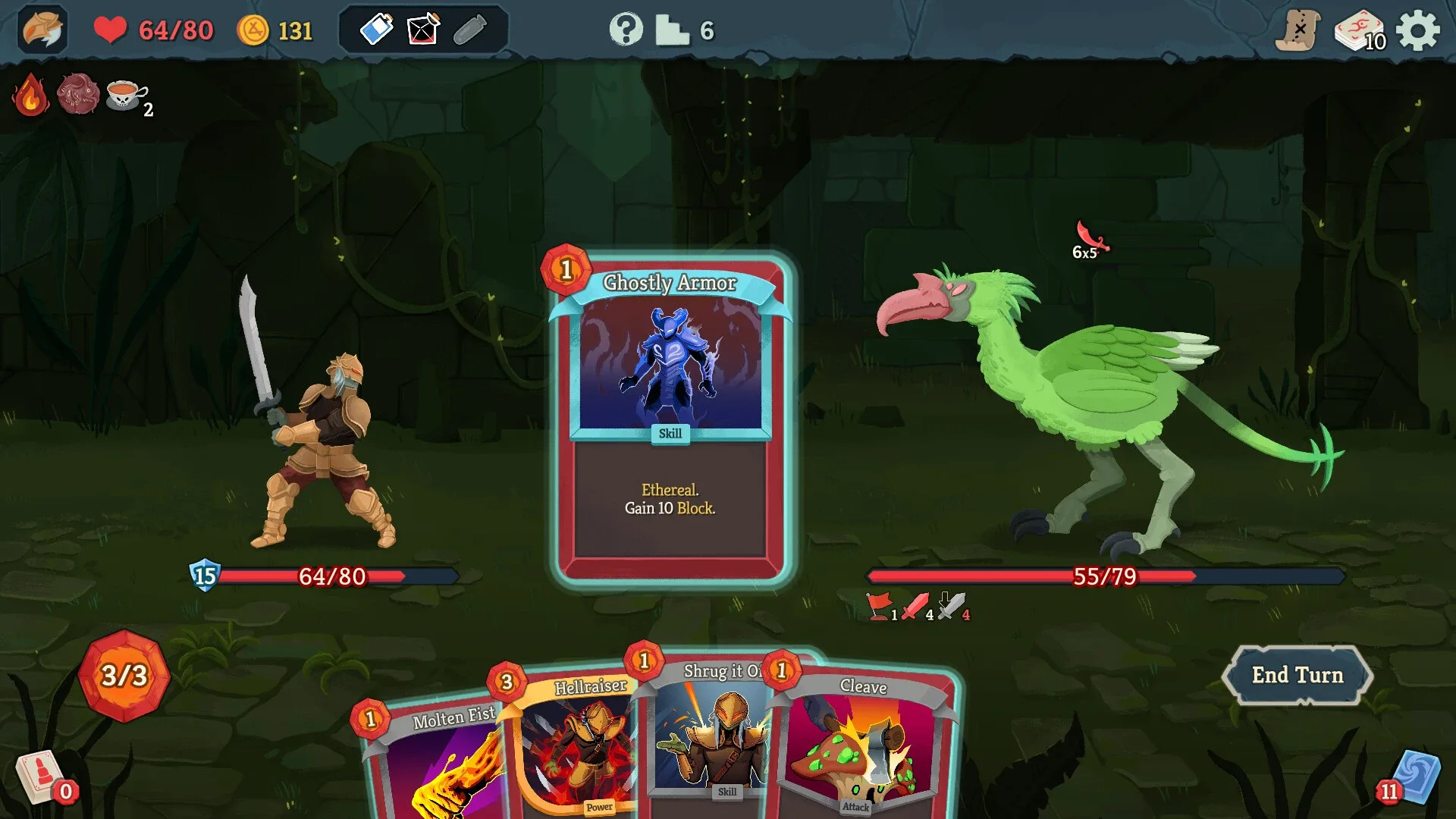
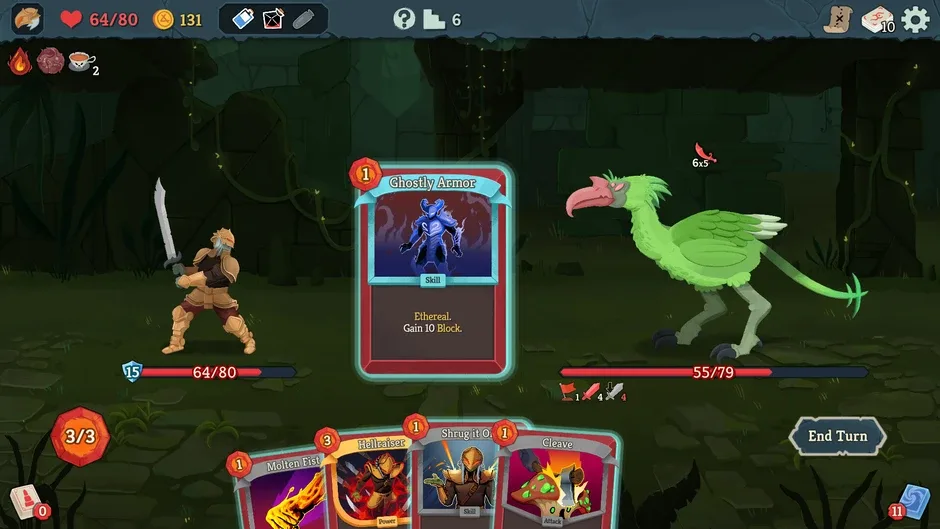
The combat is turn-based and simple to describe. Each turn you receive a limited amount of energy, draw a hand of cards and spend the energy on attacks, defensive moves, buffs, debuffs and other effects. Enemies telegraph what they are going to do next, so before you commit anything you know roughly how much damage is coming, whether an enemy is about to buff itself, and whether it is about to weaken you.
That single piece of design, giving away the enemy's plan, is what turns a card game into a puzzle. There is no bluffing and no hidden information on the enemy's side. The uncertainty lives entirely in your own draw pile. The question every turn is not what the enemy will do, but what the best use of five or six cards and three energy is against a known threat. A good turn feels like finding the single line through a tangle of options: block exactly enough, apply the debuff that makes the next three turns easier, and keep the one card you need alive for next round.
There is also a simple honesty to the failure state. When a run collapses, it is usually because the deck could not answer a specific kind of pressure: too little block for a big multi-hit attack, too little damage for a boss with a timer, too little draw to assemble a combination. Since the game shows you what is coming, you can see the mismatch building for a floor or two before it becomes fatal. That is the good kind of tension.
Deckbuilding: fewer cards, sharper decisions#
The main skill in a game like this is restraint. Every card added dilutes the rest, and the deck that reaches the third act is rarely the largest one. Card removal at shops, upgrading cards at campfires and skipping card rewards are the tools that keep a deck tight, and they interact with the map in a way that gives every route real weight. A campfire is either a place to recover health or a chance to make a key card better, and choosing one always costs the other.
The routes matter because the map is visible. The player sees the branching paths, and each node is a combat, an event, a campfire or a shop. A route with many fights offers more card rewards and more relics but risks attrition. A route with a shop offers the chance to buy a relic or thin out the deck, but only if enough gold has been saved. A route with events is a gamble on things like a stat gain against a curse. Planning a path is a small risk-management puzzle nested inside the larger one of building a deck, and the two feed each other constantly.
Potions and relics add the last layer. Potions are one-use emergency tools, best kept for the fights that would otherwise end the run, and relics are permanent modifiers that quietly redefine what a deck wants. A relic that gives extra energy every turn does not just make a deck stronger; it changes which cards are worth taking. This is where the best runs come from: not from a single powerful card but from a relic and a handful of modest cards that click together in a way the game never explicitly announced.
Characters: five ways to lose a run#
Each character solves the same problem differently, and the game is at its best when you notice that the differences are structural, not numeric.
Ironclad, Silent and Defect
The returning three carry the identities players know. Ironclad is the straightforward bruiser, the character to pick when you want strength to grow across a run and the deck to hit hard. Silent is the cardplay-heavy one, trading raw damage for volume, debuffs and card flow. Defect is the puzzle-box character, built around setups that pay off over several turns. Those descriptions are the shorthand of the first game, and they still hold as a starting point, though the cards in the sequel are new and old habits do not transfer perfectly. That is a good thing. A veteran who assumes they already know the answer to every situation gets punished for it, gently.
The Necrobinder
The Necrobinder is the most interesting new arrival, largely because of Osty. A companion that can attack and shield her means that every turn is really two turns: one for the lich and one for the hand. Damage that Osty absorbs is damage the Necrobinder does not take, and damage Osty deals is damage that does not need a card from the hand. That reshapes the usual balance between offence and defence. It also makes positioning a question of resources rather than space, since the board is not a grid but the companion is a second body with its own role.
The Regent
The Regent is the character for anyone who likes budgeting. The sovereign blade he can forge gives him a persistent weapon, and stars, the additional cost on his stronger cards, give him a second constraint on each turn. In practice that means a hand is not just a set of energy costs; it is also a set of star costs, and the best plays involve holding back stronger cards until the resource is there. It is a tighter, more deliberate style than the Ironclad's, and it rewards players who like reading a hand like a spreadsheet.
Alternate acts: a map that will not stay memorised#
The choice of two versions per act is the sequel's smartest structural move. It addresses the single biggest long-term weakness of the first game, which was that a very good player eventually memorised the whole tour. Knowing which elite waited on which floor made high-level play a matter of execution more than discovery.
Two versions of each act break that pattern without throwing away the knowledge players already have. Each version has its own enemies, events and bosses, so the environments feel distinct instead of being a palette swap with a new background. A player who has solved one version of an act gains real understanding, but that understanding does not cover the other. The game therefore keeps a permanent layer of discovery running behind the moment-to-moment puzzle.
The cost is that early learning is a bit slower. New players have twice as much to absorb, and a boss that looked defeated after five attempts may turn out to have a sibling with a different attack pattern next run. That is a fair price for a game that is meant to be played for hundreds of hours, and it is easier to accept because the rest of the design keeps the rules consistent.
Timeline and Epochs: progress that has a shape#
Between and across runs, the game adds a Timeline feature built from Epochs. Winning runs unlock entries that reveal the history of the Spire and the backstory of the characters, and reaching certain milestones unlocks new characters and features. It is a lightweight framing device, not a story told through cutscenes, and it works as a progress bar with some flavour.
That matters for one reason: roguelikes live or die by their sense of forward motion between runs. A player who loses an hour to a doomed attempt still wants to feel the hour was not wasted. Unlocks that arrive as the result of performance, and that expand what the game offers instead of just raising numbers, do that job well. The Timeline gives the whole thing a slow pulse that keeps a long play session moving even on a bad night.
The story itself is deliberately light. The store page notes that the Spire lay dormant for a thousand years and has now reopened, and the Epochs fill in more of the history. Anyone expecting a narrative on the scale of a big role-playing game will not find one, and the game does not pretend to offer it. The writing exists to give the runs texture, not to carry the experience.
Co-op: a deck built by a table#
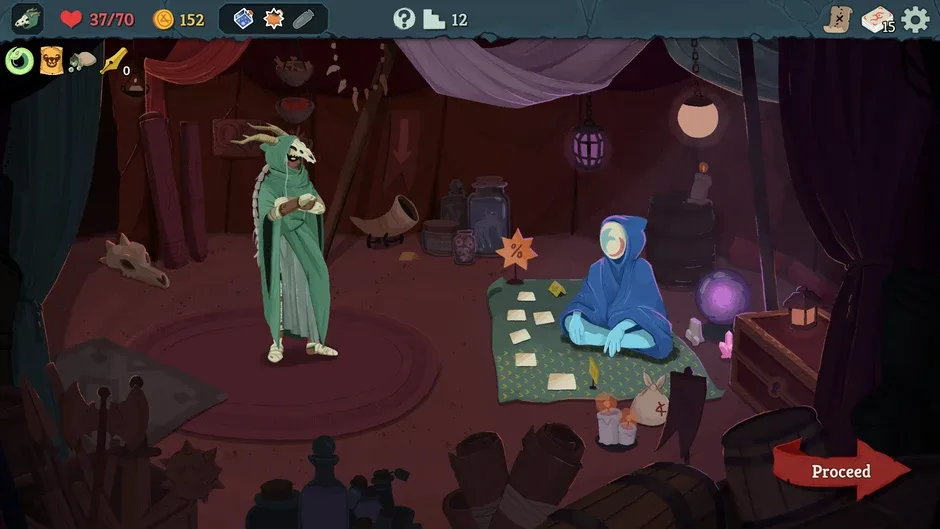
The addition that changes the most is cooperative play for up to four players. Each player picks one of the characters at the start, and during combat they can apply healing, defensive, buffing or debuffing effects to their allies. There are multiplayer-specific cards, individual health totals, individual decks and individual resource pools. Enemies have increased health, and their attacks hit all players. A character who goes down is revived with 1 hit point after the combat ends, and the run ends only when every player has fallen.
Those rules produce a very different game from the solo version. In solo play, the deck is a private project. In co-op, it is a shared engineering problem. A Necrobinder who shields the table with Osty is playing a very different role from an Ironclad who spends the turn hitting hard, and a Regent who is holding cards back for stars needs teammates who understand why. The game encourages composition thinking: what does this table lack, and who is the best person to cover it?
The honest limitation is that it rewards communication and punishes mismatched skill. Because enemy attacks target all players and health is inflated, a single player making poor decisions can drag the whole run down. Playing with friends who enjoy the genre is a delight. Playing with someone who has never touched a deckbuilder and does not want to learn is a risk to the evening and a test of patience. The good news is that solo play remains fully supported and is not treated as an afterthought.
Difficulty: harsh, fair and mostly self-inflicted#
The difficulty is what defines the genre's appeal, and it is best described as strict but transparent. Because enemy actions are telegraphed, most losses feel earned. The lower-skill mistakes, like taking too many mediocre cards or fighting too many optional elites, are visible in hindsight, and every run teaches something.
Randomness is the exception. A run can be dealt a truly bad hand, and no amount of skill fully compensates for a shop that never offers anything useful or a stretch of fights that never rewards the archetype you were building around. That is the nature of the genre and part of its charm, since good players consistently beat bad luck more often than they lose to it. It does mean that a small percentage of runs are lost before skill enters the picture, and anyone who finds that frustrating will not be won over by the sequel.
The first game's answer to the problem of mastery was a ladder of ascension levels that stacked new challenges on top of each run. Whatever the sequel does in the long run, Early Access is the place to see how the developers approach the top end of the difficulty curve, and the current state of the game is not the final word.
Presentation: functional rather than flashy#
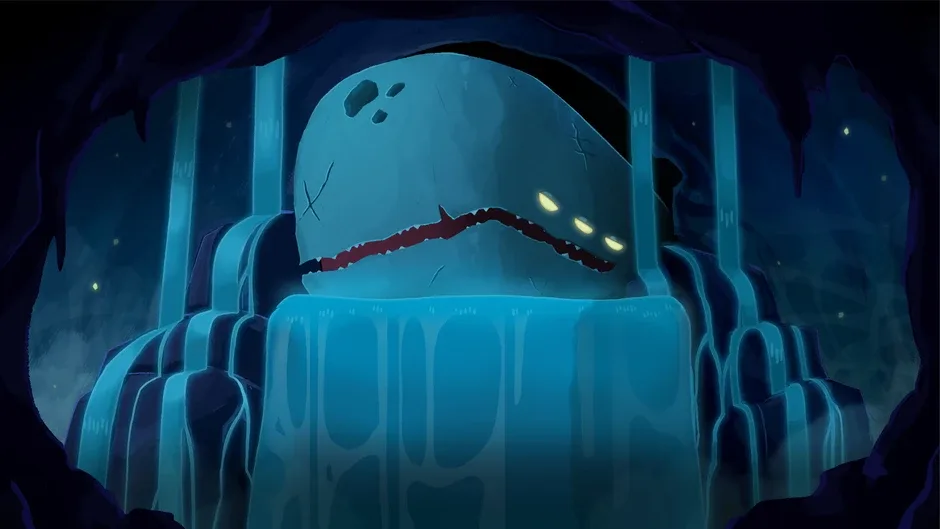
The art and interface serve the game. Cards are readable, the map is clear and the enemies are characterful enough to be recognised at a glance. Nothing here aims at cinematic ambition, and nothing needs to. A game built on rapid decision making benefits from a clean screen and quick animations, and the game respects that with an interface that gets out of the way.
The sequel was originally built in Unity. After Unity's 2023 runtime licensing announcement, Mega Crit moved the project to Godot, a decision that meant porting roughly two years of work. That is a striking thing to do to a project, and it is a sign of the studio's priorities. The release runs on Windows, macOS and Linux, and the choice of engine is the sort of detail that mostly matters to people who care about tools, but it also says something about a developer willing to absorb a large cost to keep control over its own game.
A launch that made noise#
The numbers around the release are worth noting, since they show how much the audience wanted this. The game reached 177,000 concurrent players on launch day, a higher peak than Hades II or Mewgenics had reached, and exceeded 400,000 within 24 hours. Sales in the first week of Early Access passed three million. Those are big figures for a genre that many publishers still treat as niche.
Popularity does not automatically make a game good, and the launch also brought its share of turbulence, including review-bombing tied to balance patches. That is a normal hazard of Early Access, where patches change the meta in visible ways and communities react loudly. The lesson for a potential buyer is not to fear the noise but to expect change. The version played today will not be identical to the version that ships as 1.0, and a strategy that is dominant this month may be trimmed next month.
Compared with the first Slay the Spire and with Hades#
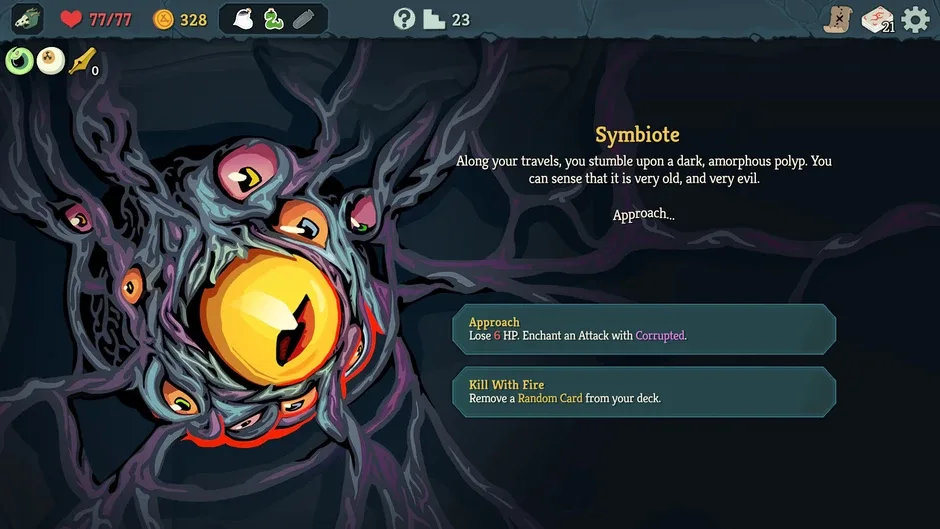
The first Slay the Spire is the obvious comparison, and the honest answer is that it depends what you want. The original is finished, cheaper in most sales, and has years of refinement, a full ascension ladder and a fourth character, the Watcher, built up over its own Early Access and release. The sequel is the game to pick if you want new characters, the alternate-act map, and co-op, and if you are willing to accept that it is unfinished. Anyone who has never played either should be aware that both share the same fundamental loop, so the first game remains a very good place to learn whether the genre suits you.
Hades is the useful comparison for anyone weighing the relationship between story and repetition. Hades wraps a roguelike in a big, character-driven story that reacts to each death. Slay the Spire II does almost the opposite: the run is the story, and the reward for dying is understanding. Hades is real-time and action-driven, a game of reflexes and positioning. Slay the Spire II is a game of thought and planning, where the only reflex involved is the decision to click the correct card. Players who love Hades for its boon-building will find a cousin of that pleasure here, since both games are about assembling something absurd out of random parts, but the tempo and the demands could hardly be more different.
Worth the money?#
At launch in Early Access the game costs 22.99 euros on Steam. That is a fair price for a game of this depth, and it sits in the range where a couple of hours of enjoyment already justify the purchase. It has no fixed campaign length, since the design is built around repeated runs, and the value lies in the number of distinct decks and strategies you can build, not in a single story arc. Players who enjoyed the first game for hundreds of hours will find the same open-ended replay value here.
The Early Access status is the deciding factor. Buying now means paying for a game that is missing its proper ending and will keep changing, with more cards, events, environments and enemies promised. Buying at 1.0 means a more stable, more complete product, possibly at the same price or a different one. For a fan of the genre, buying now is a reasonable bet on a developer that has already shown it can deliver, and the game is complete enough in its current state to be worth playing as is. For someone who is curious but cautious, waiting costs very little.
Best platform: the game is available for Windows, macOS and Linux, so PC is the platform, and the turn-based pace suits a laptop or a handheld PC well. The store page lists supported languages, and it is worth checking there whether a language you need is covered before buying, since text is central to a card game.
New to deckbuilders? Start here#
Slay the Spire II is friendlier than it looks, and a few habits make the first hours smoother.
- Read every enemy intent before playing anything. The game tells you how much damage is coming and what else the enemy plans, and spending three seconds on that saves far more than it costs.
- Skip card rewards more often than feels natural. A small deck that draws its best cards frequently beats a large deck that draws them rarely.
- Use campfires deliberately. Upgrading a card that defines your deck is often worth more than recovering health, but only if the next fights are ones you can survive.
- Start with a returning character. Ironclad is the most direct, and its plain approach to damage and defence makes the fundamentals easy to see.
- Treat the first several runs as lessons. Losing early is normal, and the Timeline rewards curiosity as well as victory.
Co-op is best saved for after a few solo runs. A table where everyone understands what a good turn looks like is far more fun than one where half the players are learning the rules mid-fight.
What the game does not do#
A fair review includes what is missing. Slay the Spire II does not offer a finished ending, since that is still on the development list. It does not offer a big authored story, since the Epochs are a light framing device rather than a narrative campaign. It does not offer cinematic presentation, and it does not offer real-time action. It does not remove randomness, and it does not pretend to.
It also asks for a particular temperament. A player who wants the game to hold their hand will find it unforgiving, and a player who wants power fantasy handed over without effort will find it demanding. The pleasure comes from solving problems, and someone who does not enjoy problem solving will not be won over by good presentation or a big sale.
There is also the matter of the sequel's relationship with the original. Anyone hoping for a revolution will find a refinement instead. The new characters, the alternate acts and the co-op mode are meaningful, but the loop is the loop, and a player who tired of the first game will not necessarily be converted. This is a game for people who want more of the good thing with fresh angles, not for people who wanted a different good thing.
Play this instead if…#
Shorter: The original Slay the Spire delivers the same core loop with a finished, refined package, and its runs fit comfortably into an evening.
Easier: Hades offers a gentler on-ramp to roguelike structure, since its story rewards dying and its Pact of Punishment lets you set the difficulty on your own terms.
Cheaper or co-op: Slay the Spire II's own co-op is the best shared version of this idea on the market right now, but for a cheaper solo alternative the original game is usually available at a lower price, and it shares the same pleasures.
Frequently asked questions#
How long is Slay the Spire II? There is no fixed campaign length, because the game is built around repeated runs through a randomly generated spire. The Early Access version does not yet include the proper ending that the developers plan to add before the full release.
Is Slay the Spire II open world? No. Each run is a climb through acts shown as maps with several routes, and each map node is a fight, an event, a campfire or a shop.
Does it have co-op? Yes, for up to four players. Each player chooses a character, applies healing, defence, buffs and debuffs to allies and has their own health, cards and resource pool. Enemies have more health and attack every player.
Is there an easy mode? The game does not sell itself as an easy experience, but telegraphed enemy attacks and the freedom to skip rewards and shape your own deck give careful players a lot of control over how hard a run feels.
Do you need to have played the first game? No. The sequel teaches its own rules through play, though the three returning characters, Ironclad, Silent and Defect, will feel familiar to players who know the original.
Which platforms is it on? Windows, macOS and Linux, with a Steam release at 22.99 euros when Early Access launched on 5 March 2026.
The Game Avant verdict#
Slay the Spire II is not finished, and that is worth stating plainly, because the ending is missing, the balance is moving and the content pool is still filling up. Those are real limits and they keep this from a perfect score. None of them touches the thing that matters most, which is that the decision making at the heart of the game is as sharp as it has ever been, and that the new characters, the alternate acts and the co-op mode give a veteran reasons to come back rather than merely repeat themselves.
The honest opinion that runs against the grain is that Early Access is not a reason to wait. The game already delivers more satisfying decisions per hour than most finished ones, and a developer that ported two years of work to a new engine rather than compromise has earned some trust. Buy it if the genre appeals, and treat every patch as a bonus.
9 out of 10 – a sequel that keeps the best puzzle in the genre intact and gives it new rooms to live in.